
Black Magic Insta-Cling Window Tint: 4 Films Compared

Black Magic Insta-Cling 20% VLT is the best match for most shoppers seeking reusable Black Magic static-cling tint, with 20% visible light transmission for side and rear windows. Choose another film if you want a darker shade or a trim-and-apply product rather than a reusable cling film.
We earn a commission if you buy through links on this page. As an Amazon Associate I earn from qualifying purchases. Products are compared on manufacturer specifications, not hands-on testing.
- Best overall: Black Magic Insta-Cling 20% VLT – Reusable static-cling film with 20% VLT for side and rear windows.
- Best for 5% VLT: Black Magic Insta Cling 5% VLT – Static-cling film measures 26 by 78 inches and is removable and reusable.
- Best for extra-dark tint: Black Magic Midnight Black 2.5% VLT – Its 2.5% VLT film measures 25 by 78 inches.
| Product | Best for | VLT | Film size | Application | Shop |
|---|---|---|---|---|---|
| Black Magic Insta-Cling 20% VLT | Reusable 20% tint | 20% | — | Static cling | Check Price on Amazon |
| Black Magic Insta Cling 5% VLT | Reusable 5% tint | 5% | 26 × 78 in | Static cling | Check Price on Amazon |
| Black Magic Midnight Black 2.5% VLT | Very dark tint | 2.5% | 25 × 78 in | Trim and apply | Check Price on Amazon |
| Black Magic Premium Metalized 35% VLT | Metalized 35% tint | 35% | 24 × 78 in | Metalized film | Check Price on Amazon |
Black Magic Insta-Cling Window Tint Options
Compare the reusable cling films with Black Magic’s trim-and-apply alternatives by darkness, dimensions and application.
Black Magic Insta-Cling 20% VLT
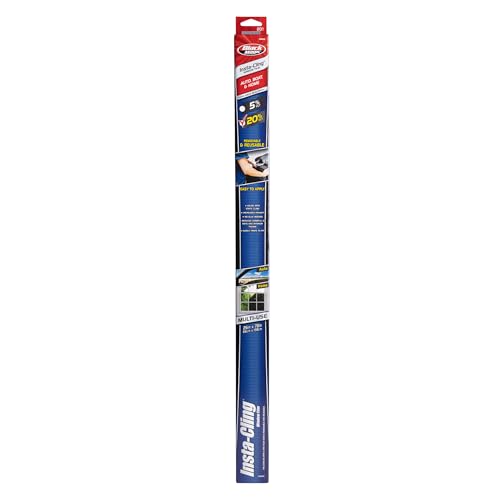
Black Magic Insta-Cling 20% is the direct match for buyers seeking reusable static-cling tint with a moderate-dark 20% VLT. Black Magic says the film reduces heat and glare and helps reduce interior fading; it is intended for side and rear windows. The product dimensions do not give a usable film width and length, so buyers planning coverage should confirm the roll size before ordering. Choose this option when removable application matters more than a precisely documented coverage area; its 20% VLT is less dark than the 2.5% and 5% alternatives.
Bottom line: Pick this for reusable 20% VLT tint intended for side and rear windows.
Black Magic Insta Cling 5% VLT

Black Magic’s 5% Insta-Cling film pairs a darker shade with a measurable 26-by-78-inch sheet, unlike the 20% option whose film size is not clear. It holds by static cling without glue, and the film is removable and reusable. Its very low 5% visible light transmission suits buyers prioritizing a darker appearance, but the reduced light transmission can make visibility more challenging, especially at night. Check local tint rules and consider how dark the existing glass already is before choosing 5% film.
Bottom line: Choose this when you want reusable cling film with 5% VLT and a defined sheet size.
Black Magic Midnight Black 2.5% VLT

Black Magic Midnight Black is the darkest automotive film here at 2.5% VLT, and its 25-by-78-inch sheet is trimmed to fit rather than applied as a reusable cling. The maker says it reduces heat and glare and adds privacy; the suggested coverage is two standard rear side windows or one standard back window. That extra darkness is a tradeoff: 2.5% VLT transmits less visible light than the other films, so it may be unsuitable where visibility or local tint requirements are concerns. It fits buyers who want a very dark, cut-to-fit film.
Bottom line: Pick this for a trim-to-fit film with the lowest VLT in this group.
Black Magic Premium Metalized 35% VLT

Black Magic Premium Metalized differs from the cling products by using a metalized layer and offering the highest VLT here at 35%. The 24-by-78-inch film is described as removable and reusable, and the maker says the metalized layer reflects heat; it also identifies the film as fade- and scratch-resistant. Buyers seeking a lighter tint or that reflective layer may prefer it over the darker options. The specifications do not establish static-cling application, so do not assume it attaches the same way as Insta-Cling film.
Bottom line: Choose this for 35% VLT and a metalized film rather than a confirmed static-cling application.
How to choose window tint darkness
Choose VLT by balancing light transmission, privacy, visibility and local rules. Visible light transmission is the percentage of visible light that passes through the glass and film; a lower number means a darker result. A film’s VLT is not necessarily the finished window’s VLT because factory glass already filters light. As a practical rule, if your local minimum applies to the finished window, do not select a film based on its percentage alone: account for the glass and verify the result against the applicable limit. A 2.5% or 5% film is substantially darker than 20% or 35%, which can make seeing out harder at night. Check the vehicle’s glass and local requirements before selecting a very dark film.
Static cling versus trim-and-apply film
Static-cling film attaches without adhesive, while a conventional installation film is trimmed and applied to the glass; the two approaches are not interchangeable. A removable cling can be useful when you want to take the tint off, but clean glass and careful smoothing still matter because dust and trapped air can interfere with a clear fit. Trim-and-apply film gives the installer a sheet to cut to the window shape, so measure the glass before cutting and leave room to refine the edge. The dimensions vary across these options: match sheet width and length to the pane rather than assuming a roll covers a fixed number of windows. For any film, avoid obstructing the driver’s sight lines.
How to estimate film coverage
Measure each pane’s visible glass width and height, then compare those measurements with the film sheet; a 26-by-78-inch sheet is not necessarily enough for every window layout. Add a small trimming allowance around each pane, but avoid assuming a single sheet can cover multiple panes without checking the total area and cut plan. Here is a simple fit guide based on the sizes and application types.
| Need | Option | What to compare |
|---|---|---|
| Reusable cling | 20% or 5% VLT | Confirm pane coverage; the 5% sheet is 26 × 78 in |
| Very dark cut-to-fit film | 2.5% VLT | 25 × 78 in sheet |
| Metalized film | 35% VLT | 24 × 78 in sheet |
When a pane is wider or taller than the sheet, a single piece will not cover it without seams. A careful layout also reduces wasted film and the chance of cutting a piece too small.
Installation and visibility mistakes to avoid
Clean the glass thoroughly and use a lint-free surface before applying tint, since dust trapped between film and glass remains visible. Do not judge legality from a film’s VLT alone: the original glass affects finished transmission, and tint rules differ by location and window position. Very dark films can reduce visibility at night, so avoid choosing 2.5% or 5% solely for privacy without considering driving conditions. Keep film clear of areas needed for driver visibility and vehicle equipment. For a removable cling, follow its application directions and avoid assuming an adhesive installation technique applies; for a trim-and-apply film, measure and dry-fit before making final cuts.
Frequently Asked Questions
What does VLT mean on window tint?
VLT means visible light transmission, the share of visible light that passes through the tint. Lower percentages indicate darker film; factory glass also affects the finished window’s light transmission.
Is 5% tint darker than 20% tint?
Yes, 5% VLT is darker because it allows less visible light through than 20% VLT. Consider night visibility and local rules before choosing very dark film.
Can static-cling window tint be removed and reused?
Static-cling film can be removed without adhesive, and the Black Magic 5% film is identified as reusable. Keep the film clean during removal and storage to reduce dust contamination.
How do I know whether a tint sheet fits my window?
Measure the pane’s width and height and compare them with the sheet dimensions, allowing extra material for trimming. A sheet smaller than either pane dimension cannot cover it in one piece.
Does a film’s VLT equal the finished window VLT?
No, factory glass also reduces transmitted light, so the finished window can be darker than the film’s VLT alone suggests. Verify the finished result against local limits when compliance matters.