
Bluevua Reverse Osmosis Systems Compared by Fit

The Bluevua RO100ROPOT suits most buyers who want a countertop reverse osmosis system with a glass carafe and no plumbing; choose the Lite instead if its 3:1 pure-to-drain ratio is your priority.
Reverse osmosis (RO) pushes water through a membrane to reduce dissolved substances. The replacement-filter set is not a complete system, so it is not included in these picks.
We earn a commission if you buy through links on this page. As an Amazon Associate I earn from qualifying purchases. Products are compared on manufacturer specifications, not hands-on testing.
- Best overall: Bluevua RO100ROPOT – A plug-in countertop system with a borosilicate glass carafe and a 2:1 pure-to-drain ratio.
- Best for extra storage: Bluevua RO100ROPOT(UV) Bundle – The bundle includes an additional carafe for more water storage.
- Best for water efficiency: Bluevua RO100ROPOT-Lite – The maker specifies a 3:1 pure-to-drain ratio and seven-stage filtration.
| Product | Best for | Carafes included | Filtration stages | Pure-to-drain ratio | Shop |
|---|---|---|---|---|---|
| Bluevua RO100ROPOT | Everyday countertop use | 1 glass carafe | — | 2:1 | Check Price on Amazon |
| Bluevua RO100ROPOT(UV) Bundle | Extra water storage | 2 glass carafes | 6-stage | — | Check Price on Amazon |
| Bluevua RO100ROPOT-Lite | Lower drain-water ratio | 1 glass carafe | 7-stage | 3:1 | Check Price on Amazon |
Bluevua reverse osmosis systems
Compare the countertop systems by storage, filtration configuration and water use before choosing a fit for your routine.
Bluevua RO100ROPOT

The RO100ROPOT combines a single glass carafe with a 2:1 pure-to-drain ratio, making it the straightforward choice for everyday countertop use. The maker says it needs no plumbing, uses a borosilicate glass carafe, and enters standby mode when idle. Its dimensions are 14.3 inches high, 10.9 inches long and 15.4 inches wide, so measure the available counter space before choosing it. The limitation is storage: unlike the bundle, this version does not include an extra carafe. Choose another option if you want more water stored at once or prioritize the Lite’s 3:1 ratio.
Bottom line: Pick this if you want one glass carafe and a simple plug-in countertop setup.
Bluevua RO100ROPOT(UV) Bundle
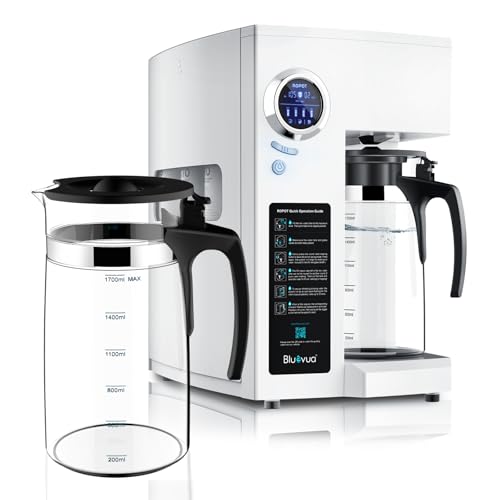
The RO100ROPOT(UV) bundle stands apart by including an extra borosilicate glass carafe, giving households a second vessel for storing filtered water. The maker says its six-stage system combines a 0.0001-micron RO membrane, UV light and remineralization, and reduces TDS and several named contaminants. No plumbing is required. Verify the countertop footprint and available outlet space before selecting a countertop unit.
Bottom line: Choose this when a second glass carafe is more useful than a water ratio.
Bluevua RO100ROPOT-Lite

The RO100ROPOT-Lite is distinguished by its 3:1 pure-to-drain ratio and seven-stage filtration, which includes a 5-in-1 filter, UV light and remineralization filter. The maker describes it as a plug-and-play countertop system with a borosilicate glass carafe and a smart LED panel with filter alerts. Its dimensions are 14.1 inches high, 9.7 inches long and 9.5 inches wide, narrower than the RO100ROPOT’s width. The tradeoff is that no extra carafe is included in the specifications; choose the bundle if a second vessel is essential.
Bottom line: Choose this if its 3:1 ratio and narrower listed width suit your priorities.
How to choose a countertop reverse osmosis system
Start with counter space, water storage and the pure-to-drain ratio rather than stage count alone. RO systems use a semipermeable membrane; prefilters help protect that membrane, while postfilters can affect taste. A higher stage count does not by itself establish how well a system reduces a particular substance. Measure the counter and leave room to fill the reservoir, remove the carafe and reach the controls. For these models, the Lite’s ratio is 3:1, while the RO100ROPOT’s is 2:1; the bundle emphasizes an extra carafe instead. If you regularly need more than one carafe at hand, storage capacity may matter more than a small footprint.
What pure-to-drain ratios mean
A 2:1 pure-to-drain ratio means the maker specifies two parts filtered water for each part of drain water; a 3:1 ratio specifies three parts filtered water for each part of drain water. These are product claims, not universal results for every installation or source water. Water temperature, inlet pressure and membrane condition can affect RO operation and output. Compare ratios only when both systems provide one, and do not treat an unstated ratio as equivalent to either figure. Drain water is the concentrated reject stream from membrane filtration, so plan for its collection or disposal according to the system’s setup guidance. A ratio alone does not show how much water the unit produces per hour.
Countertop space, carafes and electrical safety
Measure the full footprint, not just the machine’s width: countertop units also need clearance for filling, ventilation and removing a reservoir or carafe. Leave the unit on a stable, dry surface, keep its plug and electrical connections away from splashes, and do not operate electrical equipment with wet hands. A glass carafe can break if dropped or struck, so handle it over a clear surface and inspect it for cracks before use. Avoid placing a water-filled carafe near the counter edge.
RO maintenance and common selection mistakes
Replace RO prefilters and membranes on the schedule set for the system: intervals depend on design, usage and incoming water, so a universal month or gallon figure would be misleading. Filter alerts can help track service, but keep replacement parts matched to the model. A common mistake is assuming that remineralization or a stage count proves a specific contaminant reduction; check the maker’s certification scope and claims for the exact model and contaminant you care about. TDS readings measure dissolved ions, not every possible contaminant, so a lower TDS number is not a complete safety test. Before buying, verify the required replacement-filter set and confirm whether the unit’s certification covers the desired reduction claim.
Frequently Asked Questions
Does reverse osmosis remove every contaminant from water?
No, RO does not mean every possible contaminant is removed. Reduction depends on the membrane and system configuration, so check the exact model’s claims for the substance you want addressed.
Why does a reverse osmosis system send water to a drain?
An RO membrane separates part of the feed water as a concentrated reject stream while producing filtered water. The amount depends on the system and operating conditions; compare stated ratios only when available.
How much counter space does the RO100ROPOT need?
The RO100ROPOT measures 14.3 inches high, 10.9 inches long and 15.4 inches wide. Leave additional clearance for filling and removing its carafe.
How often should reverse osmosis filters be replaced?
Replacement timing depends on the filter design, water use and incoming water quality. Use the model’s filter alerts or service schedule, and match replacement parts to that system.
Is a higher filtration stage count always better?
No, stage count alone does not show the reduction achieved for a particular contaminant. Check the model-specific reduction claims and certification scope for the substance that matters to you.