
Eye Glass Nose Pads: 5 Replacement Types Compared

For screw-in frames, Mr.ZzjOOj 15 x 8 mm Screw-In Pads is the named product and the fit is the deciding factor; Bloom&Bloom 1 mm Adhesive Silicone Pads, Setex Gecko Grip 1.0 mm Pads and Clear Silicone Adhesive Nose Pads are adhesive options for plastic frames, while 24-Pair Screw-In Repair Kit offers more sizes and repair tools.
Choose adhesive pads only when your frame has a suitable flat contact area; screw-in pads require matching mounts. Nose pads are the small frame contacts that cushion and stabilize eyewear at the bridge.
We earn a commission if you buy through links on this page. As an Amazon Associate I earn from qualifying purchases. Products are compared on manufacturer specifications, not hands-on testing.
- Best overall: Mr.ZzjOOj 15 x 8 mm Screw-In Pads – A screw-in set with six pairs of air-chamber silicone pads, screws and a micro screwdriver.
- Best for size choice: 24-Pair Screw-In Repair Kit – Includes 24 pairs in eight sizes from 9 to 18 mm, plus screws and precision tools.
- Best for wet grip: Setex Gecko Grip 1.0 mm Pads – Adhesive microfibers are designed to grip in wet, sweaty or oily conditions.
| Product | Best for | Attachment | Material or design | Included quantity | Shop |
|---|---|---|---|---|---|
| Mr.ZzjOOj 15 x 8 mm Screw-In Pads | Screw-in frames | Screw-in | Silicone air chamber | 6 pairs | Check Price on Amazon |
| 24-Pair Screw-In Repair Kit | Multiple pad sizes | Screw-in | Multiple pad styles | 24 pairs | Check Price on Amazon |
| Bloom&Bloom 1 mm Adhesive Silicone Pads | Slim adhesive fit | Adhesive | 1 mm silicone | 6 pairs | Check Price on Amazon |
| Setex Gecko Grip 1.0 mm Pads | Wet-condition grip | Adhesive | Gecko-inspired microfiber | 5 pairs | Check Price on Amazon |
| Clear Silicone Adhesive Nose Pads | Everyday cushioning | Adhesive | 1 mm silicone | 20 pads | Check Price on Amazon |
Eye Glass Nose Pads Compared
Start with the frame mount, then compare pad design and the quantity or tools included.
Mr.ZzjOOj 15 x 8 mm Screw-In Pads

For a screw-in mount, this set combines soft silicone air-chamber pads with a plastic backbone and includes replacement screws and a micro screwdriver. The pads measure 15 x 8 mm, and the maker says the chamber deforms under frame pressure to fit the bridge. Six pairs make sense for replacing worn pads or keeping spares on hand. The key limitation is mount compatibility: these are for frames with screw-in nose pads, not plastic frames that need adhesive pads. Check that the existing pad mount and pad dimensions match before choosing this style.
Bottom line: Choose this set when your frame has screw-in mounts and its pad size matches.
24-Pair Screw-In Repair Kit
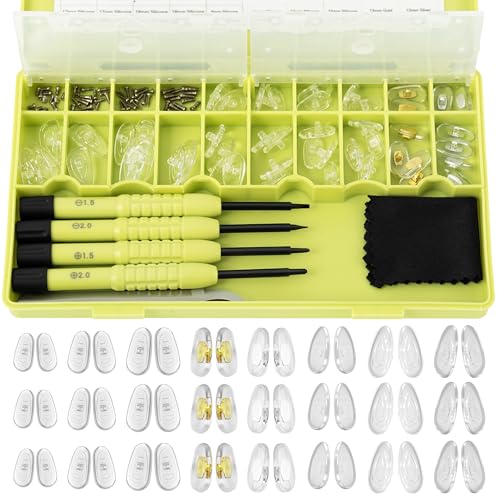
The broadest size selection here is this screw-in kit, with 24 pairs across eight sizes from 9 to 18 mm. It also includes four sizes of rust-resistant screws, four magnetic screwdrivers and a curved tweezer, which gives it a different role from a small replacement set. The selection suits repair work when the correct pad size is not yet known, or when several screw-in pairs need servicing. The tradeoff is that a multi-size kit requires matching the replacement to the original mount and shape; it is not an adhesive solution for plastic frames.
Bottom line: Pick this kit if you need several screw-in pad sizes and repair tools.
Bloom&Bloom 1 mm Adhesive Silicone Pads

Among the adhesive choices, this option has a 1 mm profile and a teardrop shape, making it the slim silicone choice for compatible plastic frames. The maker says its upgraded adhesive lasts up to three times longer than ordinary nose pads and peels away cleanly; treat those as maker performance claims rather than a guarantee for every frame. Six pairs are included. Unlike screw-in replacements, adhesive pads need a suitable frame surface, and the thin profile offers less added lift than a thicker pad. Confirm that the bridge area can accept a stick-on pad.
Bottom line: Choose these for a compatible plastic frame when a 1 mm pad profile suits.
Setex Gecko Grip 1.0 mm Pads

This adhesive option stands apart for its gecko-inspired microfiber surface, with 3,500 microfibers per pad and a design aimed at wet, sweaty or oily conditions. The pads are 1.0 mm thick and intended for full plastic frames, including acetate and TR90. Five pairs are included. The maker says the grip works without sticky residue, but this is still a stick-on pad rather than a replacement for a screw-in mount; it suits frames with an adhesive-compatible surface. Its microfiber construction also differs from the silicone pad choices.
Bottom line: Pick these when a plastic frame needs adhesive pads designed for damp or oily conditions.
Clear Silicone Adhesive Nose Pads

These clear silicone stick-on pads are a basic cushioning choice for compatible plastic frames, sunglasses and safety glasses. The maker gives a 1 mm thickness and recommends checking bridge shape and available space, particularly on smaller frames. Grip can vary with frame fit, skin oils and activity, so the pads are better treated as a contact cushion than a guaranteed fix for slipping. The package is described as a 20-pack, with the color variant identifying 10 pairs. They do not replace screw-in pads and need enough suitable surface area to adhere.
Bottom line: Choose these for thin adhesive cushioning on a compatible frame with enough bridge space.
How to choose eye glass nose pads
Match the attachment before comparing cushioning or grip: screw-in pads fit a threaded mount, while stick-on pads need a clean, flat frame contact area. Screw-in styles let the frame’s existing pad arms carry the load; adhesive styles add a pad to a surface that otherwise has no replaceable mount. A practical rule is to use screw-in replacements only when the frame already has screw-mounted pads, and adhesive pads only where there is a broad, smooth landing area. Measure the old pad width and height in millimeters, and compare the outline as well as the numbers. A pad that is the right width but too tall or sharply curved can change where the frame sits.
Adhesive and screw-in nose pads compared
Adhesive and screw-in nose pads solve different frame problems, so attachment type is the first filter. The table compares common needs with the corresponding style; it does not imply that the styles interchange.
| Frame or need | Style to consider | Fit condition |
|---|---|---|
| Existing screw mount | Screw-in pad | Match pad dimensions and mount |
| Plastic frame with flat contact area | Adhesive pad | Confirm space and surface |
| Thin profile desired | 1 mm adhesive pad | Use only on compatible frame |
| Wet or oily conditions | Microfiber grip pad | Adhesive-compatible plastic surface |
Adhesive replacement is not a repair for a broken screw mount, and screw-in pads cannot attach to a plain plastic bridge without the appropriate hardware. When a pad’s original shape is available, use it as a template rather than choosing by appearance alone.
Measure the bridge contact and pad size
Measure an existing nose pad across its widest point and from top to bottom, using millimeters; record both dimensions before removing it. Common replacement kits offer multiple widths, and the 9–18 mm range in one kit shows why a single nominal size is not universal. Also compare the pad’s curve, screw-hole location and orientation: a left/right pair may not sit correctly when reversed. For adhesive pads, check the usable area on the frame and allow room for the pad edges to contact the surface. If the frame is narrow or strongly curved, choose a smaller adhesive footprint rather than letting its edges overhang.
Replace nose pads without losing small screws
Small eyewear screws are easy to drop, so work over a light-colored tray and use a precision screwdriver that fits the screw head. For screw-in replacement, support the frame near the mount, remove the fastener carefully, align the new pad, and tighten only until secure; overtightening can damage small hardware. Keep the left and right pads separate if their curves differ. Adhesive pads need a clean, dry contact surface and firm placement; oils or dust can weaken adhesion. Do not bend a frame arm aggressively to compensate for a poorly sized pad, because frame adjustment is separate from replacing the nose contact.
Frequently Asked Questions
How do I tell whether my glasses need screw-in pads?
Look for a small pad attached to a metal arm with a visible screw; that is a screw-in mount. A smooth plastic bridge without a pad arm generally calls for a compatible adhesive pad instead.
Can adhesive nose pads go on metal frames?
Adhesive pads need a smooth, broad contact area, and many are intended for plastic frames. Check the frame surface and pad compatibility before applying one, especially on narrow or curved metal parts.
What size replacement nose pads should I choose?
Measure the old pad’s width and height in millimeters and compare its curve and screw-hole position too. Multi-size kits may cover 9–18 mm, but a matching width alone does not ensure the pad sits correctly.
How often should eyeglass nose pads be replaced?
Replace pads when they are loose, cracked, discolored or no longer stay in position; there is no single interval that fits every wearer. Adhesive pads may need replacement sooner if their edges lift or the frame surface becomes oily.
Why do my glasses still slide with new nose pads?
Sliding can come from frame fit as well as pad material, since skin oils, sweat and bridge shape affect grip. If fresh pads do not stabilize the frame, an optician can assess frame adjustment rather than relying on a thicker pad alone.