
Bono Olive Oil: 3 Bottles Compared by Origin and Size

For a distinct regional choice, BONO Organic Val di Mazara PDO EVOO is the Bono olive oil to consider: it is organic extra virgin olive oil from the Val di Mazara PDO region of Sicily. Choose BONO Organic Unfiltered EVOO for an unfiltered organic oil or BONO Italian EVOO 3L for a larger 3-liter bottle; the right fit depends on whether regional origin, unfiltered character or volume matters most.
We earn a commission if you buy through links on this page. As an Amazon Associate I earn from qualifying purchases. Products are compared on manufacturer specifications, not hands-on testing.
- Best overall: BONO Organic Val di Mazara PDO EVOO – Its Val di Mazara PDO origin distinguishes it from the broader Italian blends.
- Best for unfiltered oil: BONO Organic Unfiltered EVOO – It is explicitly unfiltered and combines four organic Italian olive varieties.
- Best for larger households: BONO Italian EVOO 3L – The 3-liter format provides substantially more oil than the other two bottles.
| Product | Best for | Bottle size | Origin | Olive varieties | Shop |
|---|---|---|---|---|---|
| BONO Organic Val di Mazara PDO EVOO | Regional Sicilian oil | 16.9 fl oz | Val di Mazara, Sicily | Biancolilla, Cerasuola, Nocellara del Belice | Check Price on Amazon |
| BONO Organic Unfiltered EVOO | Unfiltered organic oil | 33.8 fl oz | Italy | Biancolilla, Cerasuola, Carolea, Coratina | Check Price on Amazon |
| BONO Italian EVOO 3L | High-volume cooking | 101.4 fl oz (3 L) | Sicily and Puglia | Biancolilla, Cerasuola, Nocellara del Belice | Check Price on Amazon |
Bono olive oil options
Compare these Bono extra virgin olive oils by regional designation, filtration and bottle volume.
BONO Organic Val di Mazara PDO EVOO

The Val di Mazara PDO designation is the defining difference: this 16.9-ounce bottle comes from a specific area of western Sicily, rather than a broad Italian blend. BONO says it is made from organically grown Biancolilla, Cerasuola and Nocellara del Belice olives, and identifies the oil as cold extracted, USDA Organic and Non-GMO Project Verified. That makes it a fit for shoppers prioritizing regional provenance and a smaller bottle. Its volume is much lower than the 3-liter option, so frequent cooks may prefer a larger format.
Bottom line: Choose this if Val di Mazara PDO provenance matters more than bottle volume.
BONO Organic Unfiltered EVOO

Unfiltered texture sets this 33.8-ounce bottle apart from the other choices. BONO says the oil combines organic Biancolilla, Cerasuola, Carolea and Coratina olives, and is cold extracted, USDA Organic and Non-GMO Project Verified. The unfiltered style suits buyers seeking an oil with a more substantial texture and a broader four-variety blend, without moving up to a 3-liter container. Unlike BONO Organic Val di Mazara PDO EVOO, it is identified as Italian rather than tied to a named PDO region, and the specifications do not establish its specific growing region.
Bottom line: Pick this for an unfiltered organic EVOO in a mid-size bottle.
BONO Italian EVOO 3L
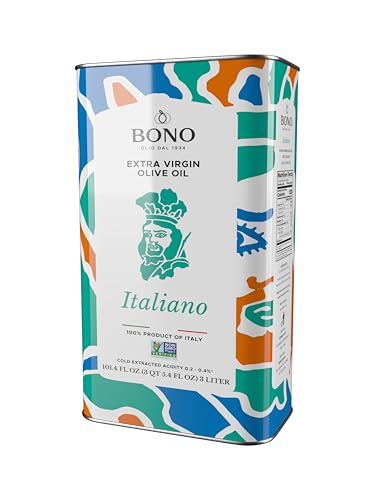
The 3-liter container makes this BONO EVOO the volume choice, holding more than three times as much as BONO Organic Unfiltered EVOO. BONO says the cold-extracted oil is made from olives grown in Sicily and Puglia, with Biancolilla, Cerasuola, Nocellara del Belice and Coratina varieties; its profile is medium-light and fruity, with green olive and unripe almond notes. It is Non-GMO Project Verified. The larger container suits households that use olive oil often, but may be cumbersome if you need a compact bottle or use oil only occasionally.
Bottom line: Choose this for regular use when a 3-liter container suits your storage space.
How to choose Bono olive oil
Start with origin, filtration and how quickly you expect to use the bottle. PDO means Protected Designation of Origin, a geographic designation tied to production rules; BONO Organic Val di Mazara PDO EVOO names Val di Mazara in Sicily. BONO Organic Unfiltered EVOO is the only unfiltered choice, while BONO Italian EVOO 3L is a blend from Sicily and Puglia. Olive oil is best stored tightly closed in a cool, dark place because light, heat and air speed flavor loss. A practical rule: choose a smaller bottle if you use oil only occasionally, and reserve a 3-liter container for frequent use and suitable storage.
| Priority | Match |
|---|---|
| Named Sicilian PDO region | BONO Organic Val di Mazara PDO EVOO |
| Unfiltered organic style | BONO Organic Unfiltered EVOO |
| Larger 3-liter volume | BONO Italian EVOO 3L |
What PDO and unfiltered mean
A PDO mark identifies an origin-linked product made under rules associated with that place; it is not the same thing as a general country-of-origin statement. That distinction matters here because BONO Organic Val di Mazara PDO EVOO specifies Val di Mazara, while BONO Organic Unfiltered EVOO and BONO Italian EVOO 3L are described more broadly as Italian oils or blends. Unfiltered oil retains suspended olive particles, which can create a cloudy appearance and heavier texture; those particles can also shorten shelf life compared with filtered oil. Since the fields do not identify a filtration style for BONO Organic Val di Mazara PDO EVOO or BONO Italian EVOO 3L, do not infer one from appearance or origin. For any bottle, check the harvest or best-before marking and keep it away from a stove or sunny counter.
Picking a bottle size for your kitchen
Bottle volume changes freshness management as well as how much oil you have on hand. The options span 16.9, 33.8 and 101.4 fluid ounces, so the largest holds six times the smallest amount. Olive oil quality declines with exposure to oxygen after opening; keeping the cap closed and transferring only a small working quantity to a cruet limits repeated air exposure to the bulk supply. Choose a 3-liter container only if your household can use it steadily and store it in a cool cabinet. If the oil is mostly for occasional finishing, the smaller bottle is easier to use through before its flavor fades.
Using extra virgin olive oil
Extra virgin olive oil works for dressings, dipping, finishing and many everyday cooking tasks; its flavor can be more noticeable than neutral oils in uncooked dishes. Heating does not automatically make EVOO unsuitable: smoke point varies with oil composition and freshness, and typical extra virgin oils generally tolerate ordinary sautéing but are not ideal when heated until smoking. Keep the pan below the smoking point and discard oil that smells rancid or paint-like. Because only BONO Italian EVOO 3L has a flavor profile specified here, do not assume the other options share its green-olive and almond notes; choose by the attributes actually given.
Frequently Asked Questions
How should Bono olive oil be stored after opening?
Keep the bottle tightly closed in a cool, dark cupboard, away from the oven and direct sunlight. Oxygen, light and heat accelerate oxidation, so avoid leaving oil in an open cruet for long periods.
Does unfiltered olive oil need different storage?
Unfiltered oil can spoil sooner because suspended olive particles remain in the oil. Store it cool and dark, close it promptly, and use it sooner than a filtered oil rather than buying a large container for occasional use.
Can extra virgin olive oil be used for frying?
EVOO can handle many everyday sautéing and shallow-frying tasks, but it should not be heated until it smokes. Smoke point varies with freshness and composition, so keep heat moderate and use a more neutral oil for prolonged high-heat frying.
What does Val di Mazara PDO mean on olive oil?
PDO stands for Protected Designation of Origin and ties a food to a defined geographic area and production requirements. For this oil, Val di Mazara identifies a region in western Sicily rather than simply indicating that the oil is Italian.
How long does olive oil stay fresh after opening?
Olive oil is generally best used within a few months after opening for its freshest flavor, though storage and the oil’s age at purchase affect that window. Keep it sealed and away from heat and light to slow flavor loss.