
Bose VCS-10 Center Channel Speaker: Fit and Alternatives

The factory-renewed Bose VCS-10 is the direct match for shoppers seeking a Bose VCS-10 center channel speaker, with an articulated-array design and a 21.5-inch width. Choose another model if you need a different cabinet size or speaker design; each alternative below is also a center channel speaker, but not a VCS-10.
We earn a commission if you buy through links on this page. As an Amazon Associate I earn from qualifying purchases. Products are compared on manufacturer specifications, not hands-on testing.
- Best overall: Bose VCS-10 Center Channel Speaker – It is the requested Bose center speaker, with articulated-array design and compound-loaded drivers.
- Best for a smaller cabinet: Yamaha NS-C210BL Center Speaker – Its 13.4-inch width is narrower than the Bose, Sony and Klipsch models here.
- Best for a three-driver design: Sony SS-CS8M2 Center Channel Speaker – Its two 3.94-inch woofers and 0.98-inch tweeter are specified as a 2-way, 3-driver system.
| Product | Best for | Dimensions (H × W × L) | Design | Driver configuration | Shop |
|---|---|---|---|---|---|
| Bose VCS-10 Center Channel Speaker | Bose system match | 3.3 × 6 × 21.5 in. | Articulated Array | Compound Loaded | Check Price on Amazon |
| Yamaha NS-C210BL Center Speaker | Narrower cabinets | 4.2 × 13.4 × 5.2 in. | 2-way bass-reflex | Aluminum-cone woofers; dome tweeter | Check Price on Amazon |
| Sony SS-CS8M2 Center Channel Speaker | Three-driver layout | 5.75 × 16.93 × 8.66 in. | 2-way bass-reflex | Two 3.94-in. woofers; 0.98-in. tweeter | Check Price on Amazon |
| Klipsch Reference R-30C Center Speaker | Horn-loaded design | 4.96 × 25.98 × 6.81 in. | Horn-loaded | Quad woofers; aluminum tweeter | Check Price on Amazon |
Bose VCS-10 Center Channel Speaker and Alternatives
Compare the requested Bose model with three other center channel speakers by cabinet size and speaker design.
Bose VCS-10 Center Channel Speaker

The Bose VCS-10 is the direct match for a Bose center channel speaker, and its 21.5-inch length makes cabinet space an important consideration. The factory-renewed unit is black and uses an Articulated Array design with Compound Loaded drivers. Its dimensions are 3.3 inches high, 6 inches wide and 21.5 inches long, with a weight of 4 pounds. Bose says the renewed product offers first-quality performance and the same warranty as a new product. Choose it when the Bose model and its long, low profile suit your system; buyers who want another driver or enclosure design should compare the alternatives.
Bottom line: Choose this when the specific Bose VCS-10 model and its 21.5-inch length suit your setup.
Yamaha NS-C210BL Center Speaker

The Yamaha NS-C210BL is a narrower center speaker than the Bose VCS-10, measuring 13.4 inches wide rather than 21.5 inches. Its 2-way bass-reflex design combines woofers with light aluminum cones and a 7/8-inch balanced dome tweeter. Yamaha says the speaker is designed to reproduce the dynamic sound of HD sources. The black model measures 4.2 inches high and 5.2 inches long, and the specifications include a 4-meter speaker cable. Choose it if its shorter cabinet width and driver design better suit your space; it is an alternative, not the Bose model.
Bottom line: Pick this if you want a narrower cabinet with a 2-way bass-reflex design.
Sony SS-CS8M2 Center Channel Speaker

The Sony SS-CS8M2 separates itself with a specified 2-way, 3-driver layout: two 3.94-inch woofers and a 0.98-inch tweeter. The single center channel speaker also has a bass-reflex enclosure, and Sony says its high-precision tweeter is intended for vocal reproduction. Its reinforced cellular cone is another specified construction feature. The cabinet measures 5.75 inches high, 16.93 inches wide and 8.66 inches long, making it shorter in width than the Bose but deeper front to back. Choose the Sony if you want the three-driver arrangement; it is not a Bose VCS-10 replacement by model identity.
Bottom line: Choose this for a defined two-woofer, one-tweeter center channel arrangement.
Klipsch Reference R-30C Center Speaker
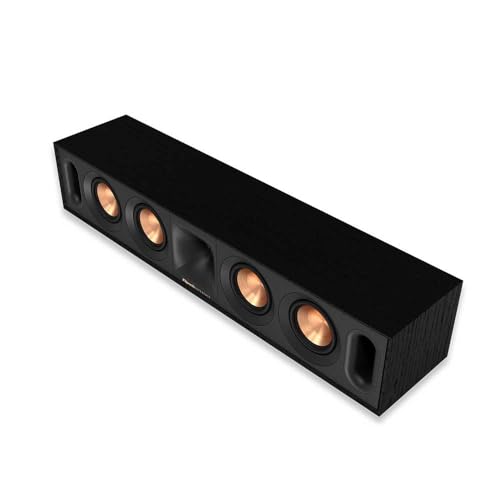
The Klipsch Reference R-30C is the widest alternative here at 25.98 inches, so measure the shelf or cabinet before choosing it. Its design pairs quad woofers with a 1-inch aluminum tweeter and a 90° × 90° Tractrix horn. Klipsch says the horn provides directivity control across a wider frequency bandwidth, while its Linear Travel Suspension tweeter uses a Kapton suspension. The black speaker measures 4.96 inches high and 6.81 inches long. Its larger width and horn-loaded high-frequency design distinguish it from the Bose; choose it only if those design and space requirements fit your system.
Bottom line: Pick this if a horn-loaded design fits your available width and speaker setup.
How to choose a center channel speaker
Start with cabinet fit, then compare the speaker’s design and role in your system. The widths range from 13.4 inches for the Yamaha to 25.98 inches for the Klipsch, so measure the usable shelf width and leave room for the speaker and cables. A center speaker carries much of a movie’s dialogue and on-screen sound; place it centered above or below the display when possible. Keep the front of the cabinet near the shelf edge so the shelf does not obstruct sound. For a shelf narrower than 22 inches, the Bose and Klipsch options here may not fit; measure actual clear space rather than relying on a nominal furniture size.
Center speaker size and placement
Height, width and depth all matter: a low cabinet can still be too deep for a shallow console, and a long speaker may block a screen or cabinet door. These models range from 3.3 to 5.75 inches high and from 5.2 to 8.66 inches in length. Measure from the front edge to the back wall, accounting for any ports and the speaker cable, then check that the display does not cover the speaker. A speaker aimed toward seated listeners can improve dialogue clarity; if it sits above or below ear level, angle it toward the main seats when the mounting arrangement allows. Never place a speaker where it can fall or obstruct ventilation around other equipment.
Driver and enclosure designs compared
Driver count alone does not determine sound quality; driver type, crossover design, cabinet construction and placement all affect the result. The options here include an articulated-array Bose, Yamaha and Sony bass-reflex cabinets, and a Klipsch horn-loaded model. Bass-reflex speakers use a port to extend low-frequency output, so avoid blocking the port with a wall or shelf. A horn guides high-frequency sound into a defined coverage pattern; seating angle and distance can influence how evenly listeners hear it. When replacing a center speaker in a multi-speaker system, a model from the same brand and series as the left and right speakers is often the simplest way to maintain a similar tonal balance.
Center speaker wiring and compatibility
Most home-theater center speakers use passive speaker wire from a receiver’s center channel output; a powered subwoofer output is not a substitute. Match the receiver’s center output to a speaker’s impedance and power handling, since either value can affect compatibility, and do not assume those ratings from cabinet size or driver count. Use the same polarity at both ends of the wire—positive to positive and negative to negative—to preserve consistent speaker phase. For common home runs up to about 50 feet, 16-gauge copper speaker wire is a practical baseline; longer runs or unusually low-impedance speakers can call for heavier wire. Turn the receiver off before connecting wires and prevent loose strands from touching adjacent terminals.
Frequently Asked Questions
Does the Bose VCS-10 work with any AV receiver?
The Bose VCS-10 is a passive center channel speaker, so it needs a receiver with a center channel speaker output. Confirm the speaker impedance and receiver compatibility before connecting it; those electrical ratings are not included here.
How much shelf width does a Bose VCS-10 need?
The Bose VCS-10 measures 21.5 inches long, so a shelf needs at least that much clear width plus space for cable routing. Measure the usable opening rather than the outside width of the furniture.
Where should a center channel speaker sit?
Place a center speaker centered above or below the screen, with its front edge near the shelf edge to reduce obstruction. If the speaker is above or below seated ear level, angle it toward the primary seats when practical.
Can I put a bass-reflex center speaker against a wall?
A bass-reflex speaker uses a port to support low-frequency output, so avoid blocking its port. Port location differs by model; leave enough room for an unobstructed opening rather than pressing the cabinet flush against a surface.
What gauge wire should I use for a center speaker?
For common home speaker-wire runs up to about 50 feet, 16-gauge copper wire is a practical baseline. Longer runs or lower-impedance speakers may need heavier wire, and polarity should match at both speaker terminals.