
Burnout 73 Pool Shock: 5 Options Compared by Dose

BioGuard Burnout 73 is the closest match for a Burnout 73 pool shock search, with one 1-pound bag treating 16,500 gallons. Pool shock is a concentrated oxidizer used to address contaminants; choose a different option if you need a different treatment rate, formula or pack quantity.
We earn a commission if you buy through links on this page. As an Amazon Associate I earn from qualifying purchases. Products are compared on manufacturer specifications, not hands-on testing.
- Best overall: BioGuard Burnout 73, 1 lb – A 1-pound bag treats 16,500 gallons, the largest treatment volume here.
- Best for clarifiers: BioGuard Burnout 3, 1 lb – Burnout 3 includes clarifiers and filter enhancers.
- Best for quick swim readiness: Clorox Pool&Spa Shock XTRABLUE Plus, 1 lb – Clorox says the pool is swim-ready in 15 minutes after treatment.
- Best for a 24-pack: Pool Essentials Shock Treatment, 1 lb – Pool Essentials supplies 24 one-pound bags.
| Product | Best for | Treatment volume | Pack size | Shop |
|---|---|---|---|---|
| BioGuard Burnout 73, 1 lb | Larger treatment volume | 16,500 gal | 12 bags | Check Price on Amazon |
| BioGuard Burnout 3, 1 lb | Clarifier additives | — | 12 bags | Check Price on Amazon |
| Clorox Pool&Spa Shock XTRABLUE Plus, 1 lb | Quick swim readiness | 12,000 gal | 12 bags | Check Price on Amazon |
| Pool Essentials Shock Treatment, 1 lb | Larger pack quantity | 12,000 gal | 24 bags | Check Price on Amazon |
| BioGuard Burnout 3, 1 lb, 24 Pack | Burnout 3 bulk pack | 10,000 gal | 24 bags | Check Price on Amazon |
Burnout 73 Pool Shock and Alternatives
Compare the treatment rates and formulas to choose a pool shock that fits your pool and maintenance needs.
BioGuard Burnout 73, 1 lb
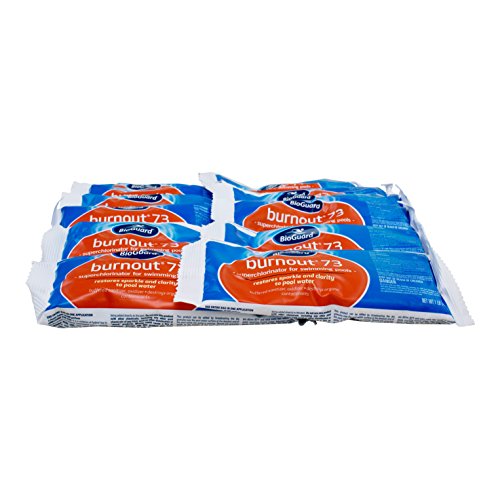
BioGuard Burnout 73 stands apart with a treatment volume of 16,500 gallons per 1-pound bag. BioGuard describes it as a superchlorinator with a high percentage of calcium hypochlorite in its shock range, intended to oxidize combined chlorine and other impurities. The 12-bag pack suits pool owners who want this specific product for recurring care or post-use treatment. BioGuard says it works on vinyl, fiberglass and plaster surfaces. Its per-bag volume is higher than the alternatives here, but that does not establish that it is the right dose for every pool; calculate from your water volume and product directions.
Bottom line: Choose this if you want Burnout 73 and its 16,500-gallon treatment volume per bag.
BioGuard Burnout 3, 1 lb

BioGuard Burnout 3 differs from Burnout 73 by adding clarifiers and filter enhancers. BioGuard says its quick-dissolving granular shock targets algae and organic contaminants and can be used in chlorine, bromine and salt pools. The 12-bag pack and compatibility with vinyl and plaster pools may suit owners looking for those additives. Buyers who need a precise gallons-per-bag comparison should confirm the dose on the package before treating the pool. Do not assume Burnout 73’s treatment volume applies to this product.
Bottom line: Pick this if clarifiers and filter enhancers are your priority.
Clorox Pool&Spa Shock XTRABLUE Plus, 1 lb

Clorox Pool&Spa Shock XTRABLUE Plus sets itself apart with a swim-ready interval: Clorox says treatment allows swimming in 15 minutes. Its granular 6-in-1 formula is described as targeting bacteria, algae and contaminants, with a use rate of 1 pound per 12,000 gallons. The 12-pack is a fit for owners who value the interval and a defined per-bag dose; Clorox says it is compatible with vinyl, plaster, fiberglass and tile. The 15-minute claim is product-specific, so do not treat it as a general rule for other pool shocks or disregard label directions.
Bottom line: Choose this if the 15-minute swim-ready interval matters to you.
Pool Essentials Shock Treatment, 1 lb

Pool Essentials differs from the 12-bag options by supplying 24 one-pound bags, with a use rate of 1 pound per 12,000 gallons. Its 4-in-1 granular formula is described as fast-dissolving and intended to clear cloudy water, control bacteria and reduce chlorine odor. It is listed as compatible with vinyl, plaster, fiberglass and tile surfaces. This option suits owners who want a larger bag count and a clear per-treatment volume. The formula does not specify an immediate swim-ready interval, so allow the water to meet the label’s requirements before swimming.
Bottom line: Pick this if a 24-bag pack and 12,000-gallon dose fit your maintenance plan.
BioGuard Burnout 3, 1 lb, 24 Pack

This Burnout 3 option is distinguished by its 24-bag pack and a dose of 1 pound per 10,000 gallons, unlike the other Burnout 3 option. The product is a quick-dissolving granular calcium hypochlorite pool shock. That combination can suit buyers seeking the Burnout 3 name in a larger pack and a specific per-bag rate. The rate is not interchangeable with Burnout 73’s 16,500-gallon figure; match the dose to this product’s own directions and your measured pool volume.
Bottom line: Choose this if you want a 24-pack of Burnout 3 with a dose.
How to Choose a Pool Shock Dose
Start with the product’s own dose and your pool’s water volume; the treatment rates in this group range from 10,000 to 16,500 gallons per 1-pound bag where given. Measure pool length, width and average depth to estimate gallons, then round up the water volume rather than underdosing. For a rectangular pool, length × width × average depth × 7.5 gives an approximate gallon count; use 5.9 for a round pool’s diameter × diameter × average depth calculation. These are estimates, so account for slopes, steps and unusual shapes. Do not transfer one brand’s rate to another formula: ingredients and concentrations vary. If your pool has less than a full bag’s treatment volume, follow the product label’s measured-dose directions instead of guessing.
| Stated treatment volume | Choice in this group |
|---|---|
| 16,500 gallons per 1-pound bag | BioGuard Burnout 73, 1 lb |
| 12,000 gallons per 1-pound bag | Clorox Pool&Spa Shock XTRABLUE Plus, 1 lb or Pool Essentials Shock Treatment, 1 lb |
| 10,000 gallons per 1-pound bag | BioGuard Burnout 3, 1 lb, 24 Pack |
| No dose figure to compare | BioGuard Burnout 3, 1 lb |
Pool Shock Types and Formulas
Granular pool shocks are dry oxidizers that are dosed according to the product label, while formulas can differ in additives and treatment rates. Calcium hypochlorite is a chlorine-based shock; the maker identifies that ingredient for BioGuard Burnout 73, 1 lb and BioGuard Burnout 3, 1 lb, 24 Pack, but do not assume the other products use the same active ingredient. Some formulas also advertise clarifiers or filter enhancers, while others emphasize multiple functions or rapid swim readiness. Those claims do not make the products interchangeable. Decide first whether you want a particular product, gallons-per-bag dose, pack size or additional formula feature, then compare only products whose label instructions suit your pool. Pool surface compatibility also varies by product, so check the label before treating a specialty or unusual finish.
Pool Shock Safety and Swimming Time
Never mix pool chemicals, including different shock products; mixing can cause a dangerous reaction, fire or release of toxic gas. Keep dry chemicals away from moisture, heat, children and pets, and use a clean, dry measuring tool dedicated to pool chemicals. For granular chlorine products, follow the label’s application sequence and avoid contact with skin and eyes. A swim-ready interval applies only to the product making that claim; for all other treatments, wait until the label permits swimming and test the water. The CDC’s general pool guidance is free chlorine of at least 1 ppm and pH 7.0–7.8, though chlorine levels differ for pools using cyanuric acid. Never enter water above the product’s allowed chlorine level.
When to Shock a Swimming Pool
Common times to shock include after heavy pool use, hot weather or heavy rain, and some product labels also recommend a weekly schedule. Those triggers are not a substitute for water testing: test free chlorine and pH before deciding whether a treatment is needed, and follow the particular shock’s directions. Organic debris, swimmer load, sunlight and sanitizer type all affect chlorine demand. Avoid dosing based only on odor; a strong chlorine smell can occur when combined chlorine compounds are present, but testing is the way to check water chemistry. Keep circulation and filtration running as directed after treatment so the water can mix and the filter can capture particles. Re-test before swimming rather than relying on appearance alone.
Frequently Asked Questions
How many gallons does one pound of pool shock treat?
The rates among these products range from 10,000 to 16,500 gallons per 1-pound bag. Use the rate for the specific product and calculate your pool volume before dosing.
How do I estimate my swimming pool volume?
For a rectangular pool, multiply length by width by average depth in feet, then multiply by 7.5 to estimate gallons. For a round pool, multiply diameter by diameter by average depth and then by 5.9; irregular shapes need separate section estimates.
When can swimmers enter after pool shock?
Use the product label’s swim interval and test the water before anyone enters. A 15-minute interval is claimed for Clorox XTRABLUE Plus only, not the other products here.
Can I mix two types of pool shock?
No; never mix pool chemicals, even if both are intended for swimming pools. Keep products separate and use a clean, dry tool to avoid cross-contamination.
Should I shock a pool after heavy rain?
Heavy rain can dilute pool water and bring in contaminants, so testing sanitizer and pH afterward is a sensible first step. Shock only if the test results or the product’s maintenance directions call for it.