
AM/FM Radio DIY Kits Compared by Learning Style

Elenco AM/FM STEM Soldering Kit suits most learners because it combines AM/FM reception with a 56-page, nine-lesson course on soldering and radio circuitry. Choose AM/FM Radio Kit with Two Tuning Modes for a simpler practice build with two tuning modes, or VIGURTIME VT-16 AM/FM Stereo Kit if stereo playback matters more than a structured course.
DIY AM/FM radio kits are solder-together receivers that teach how circuit components capture and process broadcast signals.
We earn a commission if you buy through links on this page. As an Amazon Associate I earn from qualifying purchases. Products are compared on manufacturer specifications, not hands-on testing.
- Best overall: Elenco AM/FM STEM Soldering Kit – Its AM/FM superheterodyne design comes with a nine-lesson course covering radio stages and soldering.
- Best for tuning practice: AM/FM Radio Kit with Two Tuning Modes – It offers two mechanical tuning modes for AM and FM.
- Best for stereo sound: VIGURTIME VT-16 AM/FM Stereo Kit – It includes two 8Ω, 1W speakers for stereo playback.
| Product | Best for | Learning features | Shop |
|---|---|---|---|
| Elenco AM/FM STEM Soldering Kit | Structured learning | 56-page course; 9 lessons | Check Price on Amazon |
| AM/FM Radio Kit with Two Tuning Modes | Tuning practice | Electronics and soldering practice | Check Price on Amazon |
| VIGURTIME VT-16 AM/FM Stereo Kit | Stereo playback | Full-color manual; radio schematics | Check Price on Amazon |
AM/FM Radio DIY Kits
Compare these kits by the reception bands, audio setup and learning support that shape the finished build.
Elenco AM/FM STEM Soldering Kit

Elenco AM/FM STEM Soldering Kit stands out for its structured course and stage-by-stage explanation of a superheterodyne receiver. The kit covers audio amplification, AM detection and intermediate-frequency stages, plus FM detection, FM intermediate-frequency and RF stages. Its circuit board places components over matching symbols, and the included manual explains each section’s purpose and operation. The maker describes it as suitable for high-school and university-level electronics study. Choose it if you want theory alongside soldering practice; the limitation is that soldering is required, so it is a less suitable choice for someone seeking a ready-to-use radio or a no-solder activity.
Bottom line: Pick this if you want a guided course as part of the build.
AM/FM Radio Kit with Two Tuning Modes
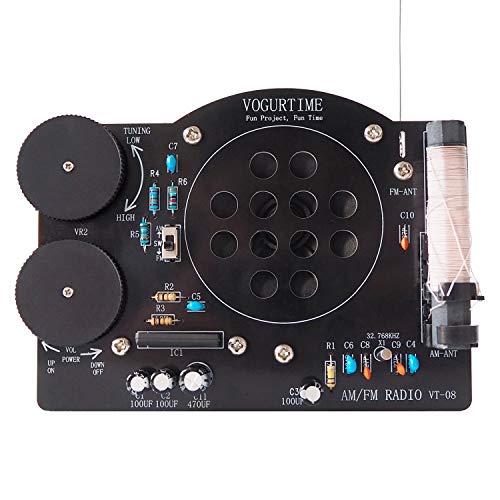
AM/FM Radio Kit with Two Tuning Modes is distinguished by its two mechanical tuning modes, giving a learner more than one way to tune the AM and FM receiver. The kit uses a fiberglass board and is designed as a straightforward soldering and electronics-learning project; its assembled form is intended to stand on a flat surface without a plastic case. That open, simple format suits beginners who want to see the assembly rather than build around a finished enclosure. The trade-off is that it does not include the extensive multi-lesson theory course offered by Elenco AM/FM STEM Soldering Kit, so it is a weaker fit for a curriculum-style project.
Bottom line: Choose this for soldering practice and mechanical tuning.
VIGURTIME VT-16 AM/FM Stereo Kit

VIGURTIME VT-16 AM/FM Stereo Kit is the stereo-focused option, with two 8Ω, 1W speakers rather than a course centered on receiver stages. Its full-color manual and complete parts kit are intended to help builders practice soldering, identify components and read radio schematics. The maker says the main IC and related configuration have been upgraded, but that performance claim should not be treated as a measured comparison. This kit suits someone who wants a radio project with stereo speakers; its limitation is that stereo output does not replace the deeper lesson-by-lesson circuit explanations supplied with Elenco AM/FM STEM Soldering Kit.
Bottom line: Choose this if two-speaker stereo is a priority.
How AM and FM radio kits receive broadcasts
AM and FM kits receive different U.S. broadcast bands: AM spans 530–1,700 kHz, while FM spans 88–108 MHz. AM carries audio by varying the carrier’s amplitude; FM varies its frequency, which is why a dual-band kit needs circuitry suited to both modulation methods. A superheterodyne receiver, such as Elenco AM/FM STEM Soldering Kit, mixes the incoming signal with a local oscillator to shift it to an intermediate frequency for filtering and amplification. That architecture is a useful learning target, but not every kit explains it in equal depth. For either band, reception depends on the local station signal, antenna orientation and nearby electrical noise, so a completed radio may not receive every station clearly indoors.
Choosing a radio kit by learning goal
Choose the kit whose build teaches the skill you want to practice: structured circuit theory, tuning mechanics or stereo assembly. A course with circuit-stage explanations is a better match for learning why a receiver works; a build with multiple tuning modes gives more direct practice with controls. Stereo kits add speaker wiring and channel output to the project. The comparison below maps each learning goal to the most relevant feature, so select by the task rather than assuming every AM/FM kit has the same instruction depth.
| Learning goal | Look for | Product fit |
|---|---|---|
| Understand receiver stages | Lessons explaining circuit sections | Elenco AM/FM STEM Soldering Kit |
| Practice tuning controls | More than one mechanical tuning mode | AM/FM Radio Kit with Two Tuning Modes |
| Build stereo audio | Two speakers and stereo output | VIGURTIME VT-16 AM/FM Stereo Kit |
Soldering and assembly safety for radio kits
Soldering projects require a stable, heat-resistant work surface, eye protection and ventilation that carries flux fumes away from the face. A soldering iron tip can burn skin and damage a tabletop, so return the iron to its stand between joints and keep the cord clear of the work area. Let the board cool before handling it, and avoid touching solder joints immediately after heating. Follow the kit’s assembly sequence closely: placing components in the wrong orientation can prevent operation and make diagnosis harder. If a beginner cannot safely manage a hot iron, an adult or experienced supervisor should guide the soldering rather than leaving the builder to work alone.
Common AM/FM kit build mistakes
Reversed components and poor solder joints are common causes of a radio that will not power or receive properly. Check polarized parts such as electrolytic capacitors and ICs against the board markings before soldering, and inspect each joint for a secure connection without bridges between neighboring pads. Keep antenna leads and other wiring in the positions the assembly guide specifies; changing their routing can affect reception or create shorts. Test methodically after assembly: verify power first, then tune across the intended band and adjust antenna orientation before assuming the receiver is faulty. A dry or bridged joint should be corrected only after the iron is safely heated and the board is stable.
Frequently Asked Questions
What frequencies do U.S. AM and FM stations use?
U.S. AM broadcast stations occupy 530–1,700 kHz, and FM stations occupy 88–108 MHz. The radio must be designed to receive the relevant band to tune those stations.
Why do AM and FM radios use different circuits?
AM encodes audio by changing carrier amplitude, while FM changes carrier frequency. A dual-band receiver needs detection circuitry that can recover audio from both modulation types.
What does superheterodyne mean in a radio kit?
A superheterodyne receiver mixes the selected incoming signal with a local oscillator to produce an intermediate frequency. Filtering and amplification at that frequency help the receiver process the signal before audio output.
How can I improve reception after assembling a kit?
Start by extending or repositioning the antenna and tuning across the full intended band. Indoor walls, nearby electronics and weak local signals can all reduce reception, so try a different location before changing the circuit.
What safety steps matter when soldering a radio kit?
Use eye protection, ventilation and a stable heat-resistant work surface, and keep the hot iron in its stand when not in use. Let solder joints cool before touching them, and have an experienced person supervise anyone who cannot safely manage the iron.