
Casters for Kitchen Island: 5 Sets Compared by Fit

For a wood kitchen island, JGJC 2-Inch Brass Ball Casters is the closest match because its maker specifically lists kitchen islands among its uses and includes mounting screws. Choose another set if your island needs a stem mount or a larger utility-style wheel; those differ in how they attach and roll.
Casters are wheeled supports that let furniture move, and a lock helps hold it in place after repositioning.
We earn a commission if you buy through links on this page. As an Amazon Associate I earn from qualifying purchases. Products are compared on manufacturer specifications, not hands-on testing.
- Best overall: JGJC 2-Inch Brass Ball Casters – The maker names kitchen islands as a use, and the set includes screws for installation.
- Best for plate mount: ASHGOOB 2-Inch PU Plate Casters – Four 2-inch plate casters include mounting screws and washers.
- Best for stem mount: JGJC 2-Inch TPR Stem Casters – Its 5/16-inch by 1-1/2-inch stem fits a matching 3/8-inch insertion hole.
| Product | Best for | Wheel size | Mount style | Set capacity | Shop |
|---|---|---|---|---|---|
| JGJC 2-Inch Brass Ball Casters | Wood island furniture | 2 in | Screw-mounted | — | Check Price on Amazon |
| ASHGOOB 2-Inch PU Plate Casters | Plate-mounted islands | 2 in | Swivel plate | 450 lb total | Check Price on Amazon |
| HOLKIE 2-Inch PU Plate Casters | Higher stated capacity | 2 in | Swivel plate | 600 lb total | Check Price on Amazon |
| BOSGEOT 3-Inch PU Plate Casters | Larger wheel size | 3 in | Swivel plate | 1,000 lb total | Check Price on Amazon |
| JGJC 2-Inch TPR Stem Casters | Matching stem holes | 2 in | Grip-neck stem | 360 lb total | Check Price on Amazon |
Casters for Kitchen Island
Compare attachment style, wheel size and stated capacity before choosing casters for a movable island.
JGJC 2-Inch Brass Ball Casters

Unlike the utility-style plate sets, these brass-finish ball casters are made for furniture, and the maker specifically includes kitchen islands among suitable uses. The four-piece set has a 2-inch wheel, a 360-degree swivel, brakes and 18 screws, including two extras. The vintage finish also suits buyers who want the hardware to remain visible on a wood island. A ball caster is a furniture-oriented design, so choose a different style if your island needs a larger wheel for rough or uneven floors. The screws make it a more natural option for screw-attached wooden furniture.
Bottom line: Choose this set for a wood island where furniture-style ball casters and a brass finish fit the project.
ASHGOOB 2-Inch PU Plate Casters
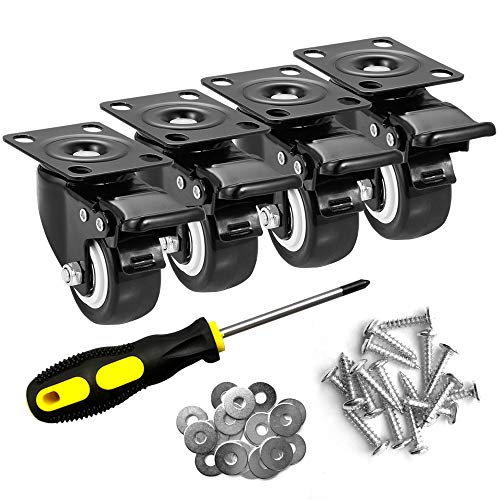
This set stands out for including installation hardware and giving a total capacity of 450 pounds across four casters. The four 2-inch polyurethane wheels have swivel plates, dual-locking brakes, double ball bearings, screws and washers. The maker says the PU wheels roll quietly and avoid scuffing hard floors; it also names kitchens and furniture among the intended settings. These are plate-mounted casters rather than decorative ball casters, so the island needs a flat, compatible mounting surface underneath. The total load figure applies to the four-caster set, not to an individual wheel.
Bottom line: Pick these when your island can accept plate mounts and you want the screws and washers.
HOLKIE 2-Inch PU Plate Casters

The set capacity is the main distinction here: 600 pounds across four casters, compared with the lower total rating of the other 2-inch PU plate set. The set uses swivel plate mounts, dual ball-bearing raceways and total-lock brakes that secure the wheel and swivel. The maker says the PU wheels are non-marring and suitable for hardwood, tile and laminate. Its workbench-and-furniture orientation makes it a possible choice for a substantial movable island, but it is not the furniture-specific ball-caster style. Confirm that the island base can take a plate mount before selecting it.
Bottom line: Choose this set if its plate mount suits your base and the 600-pound capacity is useful.
BOSGEOT 3-Inch PU Plate Casters

These 3-inch wheels are larger than the 2-inch options, which can be useful when a movable island needs more wheel diameter. The four-caster set has swivel plates, brakes and polyurethane wheels; the maker gives a capacity of 250 pounds per caster, or 1,000 pounds for four. It also says the wheels are non-marking and quiet. The larger wheel and industrial styling are less furniture-specific than a brass ball caster, and the higher total rating does not establish the island’s safe working load by itself. Make sure the wheel height and mounting position preserve a stable island stance.
Bottom line: Pick these if you want a 3-inch utility-style wheel and your island base accepts plate casters.
JGJC 2-Inch TPR Stem Casters
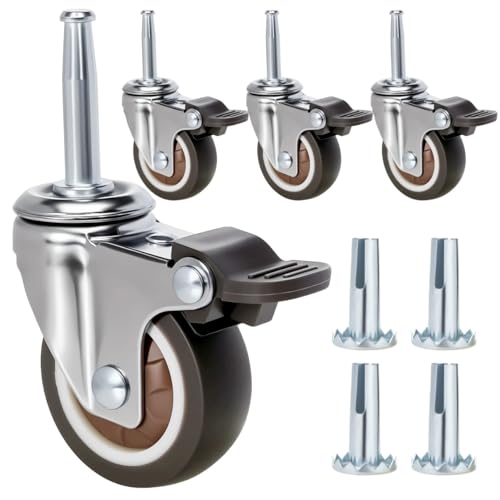
This is the only stem-mounted option in the group, so it suits an island base that already has compatible insertion holes rather than a flat plate-mount surface. The four 2-inch thermoplastic rubber wheels have a combined capacity of 360 pounds, locking brakes and a 5/16-inch by 1-1/2-inch grip-neck stem; the maker specifies a 3/8-inch hole. The maker says the tread is quiet, anti-skid and suitable for wood floors and carpet. A stem caster cannot substitute for a plate mount without the right hole, making this a poor choice when the base has no matching sockets.
Bottom line: Choose these only when your island has the specified insertion holes for the stem.
How to choose casters for a kitchen island
Start with the base attachment and the island’s loaded weight, then choose a wheel. A caster set’s total capacity should exceed the combined weight of the island and its contents; because floors are not perfectly even, a conservative approach is to divide that load across three casters rather than assuming all four share it equally. For example, a 300-pound loaded island calls for at least 100 pounds of capacity per caster under that three-wheel check. Select brakes that lock both wheel and swivel if the island must stay put while in use. Check that the locked wheels cannot turn or swivel under a gentle push before loading the island.
Plate mounts and stem mounts
Plate casters attach through a flat plate, while stem casters insert into a matching socket or hole. A plate mount needs a flat, solid area and appropriate fasteners; a stem mount needs the exact hole and stem dimensions, since a loose fit can wobble or pull out. Screw length matters on wood: fasteners should secure the plate without passing through the island’s top or into a drawer. Measure the available mounting footprint and verify that the plate and screw locations land on sound material. If the base has no existing stem sockets, choose a plate-mounted caster only if the structure can take its fasteners.
Wheel size, tread and floor clearance
Wheel size affects how easily a loaded piece rolls over seams and small floor transitions: a larger diameter generally passes these more readily, while a smaller wheel keeps the furniture lower. Measure floor-to-base clearance and account for the caster’s full installed height, not just its wheel diameter. Soft polyurethane or rubber-like treads are commonly chosen for hard indoor floors because they are quieter and less likely to mark than hard plastic, though dirt trapped under any wheel can still scratch a finish. Avoid moving a loaded island over thresholds or cords; unload it first if the route is uneven or obstructed.
Common kitchen island caster mistakes
The most common mistake is choosing by total capacity alone and ignoring mount strength, wheel height and brake type. Load capacity is a static rating, not permission to roll an island over bumps at full load; impact forces can be higher than a stationary load. Another mistake is assuming a brake holds every direction: a wheel-only brake may still let a swivel caster pivot, so confirm whether the lock secures both motions. Keep fingers and toes clear while rolling or locking a heavy island, and never use casters to make an unstable island safe. If the island rocks or the locks allow movement, stop using it as a work surface until the setup is corrected.
Frequently Asked Questions
How many casters should a kitchen island have?
Four casters are common for a rectangular island, one near each corner, but capacity should be checked conservatively across three wheels. Divide the loaded weight by three to estimate a minimum per-caster rating that allows for uneven floor contact.
What size caster works best on an island?
A 2- to 3-inch wheel is a common furniture-caster range, with larger wheels generally rolling more easily over small seams. Measure installed caster height and confirm it leaves adequate floor clearance without making the island unstable.
Can I attach stem casters to a wood island?
Only if the island has a secure, correctly sized socket or hole for the stem. A 5/16-inch stem designed for a 3/8-inch hole needs that fit; an oversized or loose hole can let the caster wobble or pull free.
How do I calculate the caster capacity I need?
Add the island’s weight and its expected contents, then divide by three for a conservative per-caster check on a four-wheel base. For a 300-pound loaded island, each caster should support at least 100 pounds by that calculation; rolling over obstacles calls for extra caution.