
Castor Oil for Voles: 4 Lawn Repellents Compared

For castor oil for voles, Natural Elements 1-Gallon Mole and Vole Repellent is the clearest match because it is a gallon-size, 100% castor oil repellent formulated for both moles and voles. Choose Baar MolEvict 32 oz instead if you want hose-end application and a 5,000-square-foot coverage figure; neither product guarantees that voles will leave.
Castor oil lawn repellents are intended to make treated soil less attractive to burrowing pests, rather than trap or remove them.
We earn a commission if you buy through links on this page. As an Amazon Associate I earn from qualifying purchases. Products are compared on manufacturer specifications, not hands-on testing.
- Best overall: Natural Elements 1-Gallon Mole and Vole Repellent – A gallon-size, 100% castor oil lawn treatment formulated for both moles and voles.
- Best for measured coverage: Baar MolEvict 32 oz – The 32-ounce hose-end formula states coverage of 5,000 square feet.
- Best for gallon size: Nature’s MACE Mole & Vole Repellent, 1 Gallon – A gallon-size castor oil lawn repellent specifically names moles and voles.
| Product | Best for | Size | Shop |
|---|---|---|---|
| Natural Elements 1-Gallon Mole and Vole Repellent | General lawn treatment | 128 fl oz | Check Price on Amazon |
| Baar MolEvict 32 oz | Hose-end application | 32 oz | Check Price on Amazon |
| PetraMax 33.8 fl oz Castor Oil Repellent | Smaller package | 33.8 fl oz | Check Price on Amazon |
| Nature’s MACE Mole & Vole Repellent, 1 Gallon | All-season claim | 128 fl oz | Check Price on Amazon |
Castor Oil for Voles
Compare the formulas by purpose, package size and application method before choosing one for your yard.
Natural Elements 1-Gallon Mole and Vole Repellent
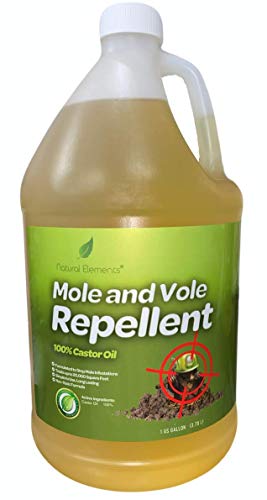
Natural Elements 1-Gallon Mole and Vole Repellent is a gallon-size lawn treatment explicitly formulated for both moles and voles, distinguishing it from formulas that emphasize moles or give a specific coverage figure. The product describes its formula as 100% castor oil and says the repellent works gradually by affecting pests’ sensory perception.
Bottom line: Choose this if you want a gallon-size formula expressly aimed at both moles and voles.
Baar MolEvict 32 oz

Baar MolEvict 32 oz is the only option here with both an area figure and hose-end application: 32 ounces covers 5,000 square feet. The product says its castor oil formula is for moles, voles, gophers and armadillos, and its directions call for application twice per month followed by maintenance as needed. That schedule is useful when planning repeat treatments, but it also means this is not a one-application-per-season approach according to the product. Choose it when your measured lawn area fits the coverage and you have a garden hose and sprayer.
Bottom line: Pick this when hose-end application and a 5,000-square-foot coverage figure fit your yard.
PetraMax 33.8 fl oz Castor Oil Repellent

PetraMax 33.8 fl oz Castor Oil Repellent comes in a 33.8-fluid-ounce package, smaller than the gallon-size options, and its formula is identified as castor oil for outdoor lawns and gardens. The product says it targets moles and gophers and also describes the formula as a vole deterrent. That makes the target range less consistent than products that explicitly center both moles and voles, so it is a less direct match if vole control is your sole goal.
Bottom line: Consider this if a smaller package matters and you are comfortable confirming coverage and use directions.
Nature’s MACE Mole & Vole Repellent, 1 Gallon

Nature’s MACE Mole & Vole Repellent, 1 Gallon is a gallon-size castor oil lawn repellent whose targets include both moles and voles. The product claims all-season prevention and says rain or irrigation helps the oil seep into the ground; treat those as maker claims, not a guarantee for every yard or weather pattern. Choose it if the all-season claim is relevant and you can check its package directions against your yard conditions.
Bottom line: Choose this if you want a gallon-size product whose maker claims all-season prevention.
How castor oil repellents fit into vole control
Castor oil products are soil treatments intended to discourage burrowing animals through odor or taste, not barriers that physically block access. Voles also use runways through grass and groundcover and feed on roots, bulbs and bark, so a repellent alone does not remove the cover and food that support them. Keep grass short and remove dense weeds or mulch from around vulnerable plantings to make runways less protected. For young trees and shrubs, a physical trunk guard is a more direct defense: use 1/4-inch hardware cloth, bury its lower edge about 2 to 3 inches, and leave roughly 18 inches above ground. These steps address access and habitat whether or not a repellent is used.
How to match coverage to your lawn
Measure the treatment area before selecting a package: multiply lawn length by width in feet, then subtract untreated beds, patios and structures. For example, a 50-by-100-foot rectangle is 5,000 square feet, matching the coverage for Baar MolEvict 32 oz. A gallon is a volume, not an area rating, so the 128-fluid-ounce size of Natural Elements 1-Gallon Mole and Vole Repellent or Nature’s MACE Mole & Vole Repellent, 1 Gallon cannot by itself show how much lawn it treats. Coverage depends on the product’s dilution and label rate; use the actual package directions rather than estimating from bottle size. If the yard is larger than a coverage figure, plan for the additional treatment area rather than stretching the application thinner.
Which application approach suits your yard
Choose by how you want to apply the treatment and how much area you can verify. Hose-end application can distribute a treatment over a lawn, but it does not replace measuring the area or setting the label’s rate. The products also differ in their claims: Natural Elements 1-Gallon Mole and Vole Repellent and Nature’s MACE Mole & Vole Repellent, 1 Gallon explicitly name both moles and voles, whereas PetraMax 33.8 fl oz Castor Oil Repellent names moles and gophers and describes vole deterrence. This table separates usable application information from package size.
| Need | Match | Decision point |
|---|---|---|
| Known area and hose-end use | Baar MolEvict 32 oz | Stated 5,000 sq ft coverage |
| Gallon package for moles and voles | Natural Elements 1-Gallon Mole and Vole Repellent or Nature’s MACE Mole & Vole Repellent, 1 Gallon | Check label rate and coverage |
| Smaller package | PetraMax 33.8 fl oz Castor Oil Repellent | Confirm coverage and directions |
Ways to reduce vole damage beyond repellents
Habitat changes and barriers can reduce the cover voles use, while repellents are only one part of a control plan. Keep vegetation trimmed and remove piled grass, leaves and other dense cover close to trunks and garden edges. Protect individual trees with 1/4-inch hardware cloth extending about 18 inches above ground and buried 2 to 3 inches to discourage surface access and shallow digging. Avoid assuming that a treated lawn is protected indefinitely: weather, irrigation and new vole activity can change conditions, and product reapplication should follow its own label. For extensive or recurring damage, identify active runways and burrows before choosing additional control methods.
Frequently Asked Questions
How much castor oil repellent covers 5,000 square feet?
Baar MolEvict 32 oz gives a specific rate: 32 ounces for 5,000 square feet. Measure the treatment area and follow the package dilution and application directions rather than applying more thinly to cover a larger lawn.
Does rain affect castor oil vole repellent?
Weather effects depend on the product formula and its directions. Nature’s MACE Mole & Vole Repellent, 1 Gallon claims rain and irrigation help its castor oil seep into the ground, but that claim does not establish performance for other formulas or every soil condition.
How can I keep voles from damaging tree bark?
Use 1/4-inch hardware cloth around vulnerable trunks, burying the lower edge about 2 to 3 inches and extending the guard roughly 18 inches above ground. Keep vegetation and mulch from forming sheltered runways against the guard.
What is the difference between voles and moles?
Voles are small rodents that eat plants, roots and bark and often use surface runways through vegetation. Moles are insect-eating mammals that tunnel through soil, so the kind of damage—such as gnawed bark or raised soil ridges—helps identify which animal is active.
How often should castor oil repellent be reapplied?
Follow the specific package schedule because application frequency is product-specific. Baar MolEvict 32 oz says to apply twice per month and then as needed for maintenance; that schedule should not be transferred to the other formulas.