
Cat Barrier for Doorway: 5 Options Compared by Fit

For a named cat barrier, QWR Reinforced Cat Screen Door is a reinforced mesh screen for door openings up to 32 by 80 inches; choose a tall gate instead if your cat could climb or jump over mesh.
Measure the clear opening before choosing: the two gates cover different width ranges and adjust to 87 inches tall, while the screens attach across a doorway with zipper closures.
We earn a commission if you buy through links on this page. As an Amazon Associate I earn from qualifying purchases. Products are compared on manufacturer specifications, not hands-on testing.
- Best overall: QWR Reinforced Cat Screen Door – Reinforced mesh and a zipper closure suit door openings up to 32 by 80 inches.
- Best for narrower doorways: Extra Tall Cat Gate 51–87 in – Its 27.56- to 37-inch width range fits openings below the other gate’s minimum.
- Best for wider doorways: Snuowu Extra Tall Pet Gate – Its adjustable width reaches 40.5 inches, with 1.57-inch bar spacing.
| Product | Best for | Barrier type | Fits opening width | Height | Shop |
|---|---|---|---|---|---|
| QWR Reinforced Cat Screen Door | Mesh doorway barrier | Zippered mesh screen | Up to 32 in | Up to 80 in | Check Price on Amazon |
| Extra Tall Cat Gate 51–87 in | Narrower gate openings | Pressure-mounted gate | 27.56–37 in | 51–87 in | Check Price on Amazon |
| Snuowu Extra Tall Pet Gate | Wider gate openings | Pressure-mounted metal gate | 29.5–40.5 in | 51–87 in | Check Price on Amazon |
| Reinforced Pet Screen Door, Strap | Frequent screen access | Zippered mesh screen | Up to 32 in | Up to 80 in | Check Price on Amazon |
| Reinforced Cat Screen Door, Bilateral Zipper | Wider mesh openings | Zippered mesh screen | Up to 34 in | Up to 80 in | Check Price on Amazon |
Cat Barriers for Doorways
Match the barrier style to your opening dimensions and how your cat may try to get through.
QWR Reinforced Cat Screen Door

Unlike the pressure-mounted options, QWR Reinforced Cat Screen Door is a flexible screen barrier for doorways, with a zipper closure and reinforced mesh. The screen measures 34 by 82 inches and is intended for a clear opening no larger than 32 inches wide and 80 inches tall; the frame is not included. The maker says the vinyl-coated steel-wire mesh and upgraded stitching resist clawing and climbing.
Choose this style when airflow through a screened opening matters more than a rigid, tall barrier. It is not the right fit for cats that climb or jump over mesh, and the opening needs careful measurement first.
Bottom line: Choose this for a measured doorway that needs a zippered mesh screen.
Extra Tall Cat Gate 51–87 in
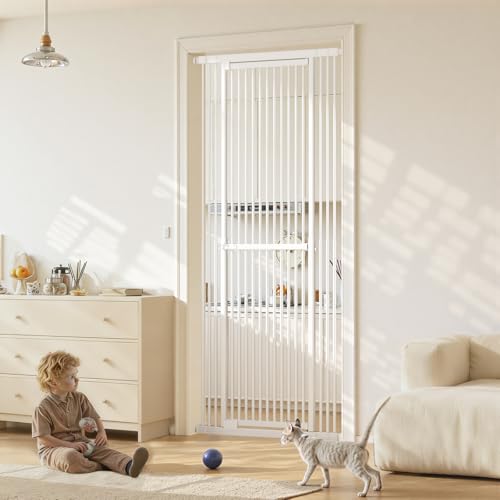
Extra Tall Cat Gate 51–87 in covers the narrowest doorway range among the gates here, starting at 27.56 inches wide, and rises from 51 to 87 inches. Its kit includes four extensions, and the maker describes the pressure-mounted installation as tool-free; stabilizing brackets are also included. Bar spacing is 1.37 inches.
This is a rigid barrier option for a doorway or stair opening where a screen would be easy to climb. It is not suitable for openings narrower than 27.56 inches or wider than 37 inches, and the installation method relies on a compatible pressure-mount surface.
Bottom line: Choose this for a narrow opening that falls within its width adjustment range.
Snuowu Extra Tall Pet Gate

Snuowu Extra Tall Pet Gate reaches 40.5 inches wide, extending farther than the other gate, and adjusts from 51 to 87 inches tall. The pressure-mounted metal barrier comes with two extension kits and stabilizing brackets; bar spacing is 1.57 inches. Those dimensions make width the key distinction when comparing the two tall gate options.
Choose it for openings from 29.5 through 40.5 inches where a rigid gate is preferred. Its minimum width is wider than Extra Tall Cat Gate 51–87 in’s, and its bar gaps are larger, so confirm that a small kitten cannot fit through before relying on it.
Bottom line: Choose this for a wider doorway within its adjustment range.
Reinforced Pet Screen Door, Strap

Reinforced Pet Screen Door, Strap adds a short strap for pulling the screen aside when passing through, a convenience the other mesh options do not identify. Its 34-by-83-inch screen is sized for door openings up to 32 by 80 inches, excluding the frame. The maker says vinyl-coated steel-wire mesh and upgraded stitching are intended to resist claws and climbing.
This screen suits homes where people regularly pass through the doorway and want to hold the mesh aside. It remains a flexible screen rather than a rigid gate, so it is a poor choice for a persistent climber or jumper.
Bottom line: Choose this for frequent passage through a doorway-sized mesh screen.
Reinforced Cat Screen Door, Bilateral Zipper

Reinforced Cat Screen Door, Bilateral Zipper accommodates a door size up to 34 by 80 inches, giving it a wider stated fit than the other mesh screens. The screen itself measures 36 by 82 inches and has a bilateral zipper design, while the maker specifies a flexible U-shaped zipper. Measure the door opening rather than including the frame.
This option suits a doorway up to 34 inches wide where a zippered screen is preferred. It is still mesh, not a tall rigid gate, so cats that climb or jump may need a different barrier style.
Bottom line: Choose this for a wider doorway that still fits a mesh screen.
How to choose a cat barrier for doorway use
Choose the style by measuring the clear opening and considering how your cat tries to cross it. A mesh screen closes a doorway while retaining a flexible fabric-like barrier; a pressure-mounted gate creates rigid bars across the opening. The mesh options here fit openings up to 32 or 34 inches wide and up to 80 inches tall, while the gates adjust from 51 to 87 inches high. If a cat climbs or jumps, a screen is a poor match regardless of its mesh reinforcement. For a rigid barrier, measure both width and floor-to-top height, then confirm the range includes both dimensions before installation.
Opening measurement rule
Measure the narrowest width between the surfaces where the barrier will sit. If the clear height is over 80 inches, the mesh options here do not reach it; a gate may fit only if its adjustable height and mounting location work.
Mesh screens and pressure-mounted gates
A mesh screen and a pressure-mounted gate block passage in different ways, so neither style suits every doorway. Screens use flexible material and a zipper for passage; gates rely on rigid bars and pressure against the sides of the opening. A 1.37-inch bar gap is narrower than a 1.57-inch gap, a distinction that matters for kittens and small pets. Pressure-mounted gates avoid drilling, but depend on secure contact with the doorway surfaces. Never treat a flexible screen or gate as a substitute for supervising a pet around stairs or other fall hazards.
Use the comparison by the main physical constraint:
| Need | Choose | Fit condition |
|---|---|---|
| Flexible zippered coverage | Mesh screen | Opening no wider than 32 or 34 in |
| Rigid barrier, narrower span | Pressure-mounted gate | Width 27.56–37 in |
| Rigid barrier, wider span | Pressure-mounted gate | Width 29.5–40.5 in |
Measure a doorway before installing a barrier
Measure the clear opening, not the outside dimensions of the trim or door frame. The mesh screens specify door-opening limits and exclude the frame; their screen panels are larger than the opening they fit. Gate width ranges refer to the space the pressure mount spans, so extensions change the usable width. A doorway under 27.56 inches is narrower than either gate’s minimum, while an opening over 40.5 inches is wider than either gate’s maximum. For the screens, an opening over 34 inches wide exceeds the wider screen’s fit.
Also check the height from the floor to the intended top edge. The screens top out at 80 inches of opening height, while the gates start at 51 inches and extend to 87 inches. Confirm the surfaces are suitable for the mounting approach and that no gap at the edges allows a cat to squeeze through.
Bar spacing and safe use around cats
Bar spacing is a safety consideration for kittens and small pets: 1.37 inches leaves a narrower gap than 1.57 inches, but body size and head shape also matter. Check that a pet cannot push its head through or become caught, and do not use a barrier with gaps that create an entrapment risk. A tall gate can reduce opportunities to jump over, but height alone cannot guarantee containment for an agile cat. Pressure-mounted gates are not automatically suited to stair-top use; use only a barrier designed and mounted for that location. Recheck pressure points and brackets after the gate is installed and after any adjustment.
Frequently Asked Questions
How do I measure a doorway for a cat barrier?
Measure the narrowest clear width between the mounting surfaces and the height from floor to the planned top edge. Keep the frame out of the mesh-screen measurement because these screen fits refer to the opening itself.
Can a cat squeeze through gate bar spacing?
A kitten or small cat may fit through gaps that are safe for a larger pet. The gate options here have 1.37-inch and 1.57-inch spacing, so assess the pet’s head and body size rather than assuming either gap works.
Is a pressure-mounted cat gate safe at stairs?
A pressure-mounted gate is not automatically suitable at a stair top, where a loose barrier could create a fall hazard. Use a gate specifically appropriate for the stair location and confirm a secure installation before allowing access.
Will a mesh screen stop a jumping cat?
A mesh screen is a flexible doorway barrier, not a tall rigid gate. If a cat routinely jumps or climbs, choose a rigid barrier whose height and width fit the opening instead.
How tall should a cat gate be?
The gate options here adjust from 51 to 87 inches tall, but a cat’s jumping and climbing ability determines whether that is enough. Choose a height that exceeds the pet’s reach and jumping behavior, and secure the gate as intended.