
Celestron AstroMaster 130EQ: Models Compared by Fit

The Celestron AstroMaster 130EQ suits beginners who want a 130mm Newtonian reflector and manual equatorial controls; choose the 130EQ-MD instead if you want motorized right-ascension tracking.
The accessory kit and separate motor drive complement a telescope rather than replace one, while the smaller 70AZ is a refractor for simpler manual aiming.
We earn a commission if you buy through links on this page. As an Amazon Associate I earn from qualifying purchases. Products are compared on manufacturer specifications, not hands-on testing.
- Best overall: Celestron AstroMaster 130EQ – The 130mm Newtonian reflector combines substantial aperture with manual right-ascension and declination controls.
- Best for tracking: Celestron AstroMaster 130EQ-MD – Its motor drive follows right-ascension motion after you center an object.
- Best for accessories: AstroMaster Accessory Kit – The kit adds two eyepieces, a 2x Barlow, three filters and a carrying case.
| Product | Best for | Optical design | Aperture (mm) | Mount or tracking | Shop |
|---|---|---|---|---|---|
| Celestron AstroMaster 130EQ | Manual observing | Newtonian reflector | 130 mm | Manual German equatorial | Check Price on Amazon |
| Celestron AstroMaster 130EQ-MD | Motorized tracking | Newtonian reflector | 130 mm | Motorized right ascension | Check Price on Amazon |
| AstroMaster Accessory Kit | Eyepiece upgrades | Accessory kit | — | — | Check Price on Amazon |
| Celestron AstroMaster 70AZ | Simple refractor use | Achromatic refractor | 70 mm | Manual alt-azimuth | Check Price on Amazon |
| Celestron Motor Drive | Adding tracking | Motor drive accessory | — | Right-ascension drive | Check Price on Amazon |
Celestron AstroMaster 130EQ telescopes and related gear
The main decision is between manual control, motorized tracking and add-ons for an existing telescope.
Celestron AstroMaster 130EQ

The 130EQ is the manual version in this group, pairing a 130mm Newtonian reflector with a German equatorial mount and two slow-motion controls. Its 5-inch aperture is the key distinction for beginners who want a larger reflector without an added tracking motor. Celestron says its aluminum and SiO₂ coatings support viewing bright lunar and deep-sky objects. The mount moves in right ascension and declination, so it takes more orientation and practice than a simple alt-azimuth setup; choose the 130EQ-MD if keeping an object centered with a drive matters more than fully manual operation.
Bottom line: Choose this if you want a 130mm reflector and are comfortable tracking by hand.
Celestron AstroMaster 130EQ-MD

The 130EQ-MD adds motorized tracking to the same 130mm Newtonian format, setting it apart from the fully manual 130EQ. The motor drive works on the right-ascension axis after you center a target, while slow-motion controls remain available for aiming. Celestron says its optics use aluminum and SiO₂ coatings. This is the more suitable choice when an object drifting out of view would interrupt observing, but tracking is not automatic target finding: you still need to locate and center objects, and the equatorial mount requires setup and alignment.
Bottom line: Pick this if you want a motor to compensate for Earth’s rotation.
AstroMaster Accessory Kit

The accessory kit expands an existing compatible telescope rather than serving as a telescope itself. It includes 15mm Kellner and 6mm Plössl eyepieces, a 2x Barlow with T-threads, three filters—a blue #80A, red #25 and Moon filter—and a microfiber cloth in a foam-lined case. The Moon filter is intended to reduce glare; the color filters alter the view. A DSLR connection requires an optional T-ring, and the kit does not add tracking or a mount. Choose it to add viewing options to an AstroMaster or most other telescopes that accept 1.25-inch accessories.
Bottom line: Choose it to expand eyepiece and filter options for a compatible telescope.
Celestron AstroMaster 70AZ

The 70AZ is a smaller refractor with a manual alt-azimuth mount, so it differs from the 130EQ in both optical design and how it points. Its 70mm fully coated achromatic optics suit lunar, planetary, bright-cluster and daytime terrestrial viewing, according to Celestron. The up-down and side-to-side mount is more intuitive for casual aiming than an equatorial setup. Its 70mm aperture is substantially smaller than the 130mm reflector’s, making this a fit for straightforward dual-purpose viewing rather than someone specifically seeking the larger 130EQ format.
Bottom line: Pick this for simpler manual sky and daytime viewing, not 130mm aperture.
Celestron Motor Drive
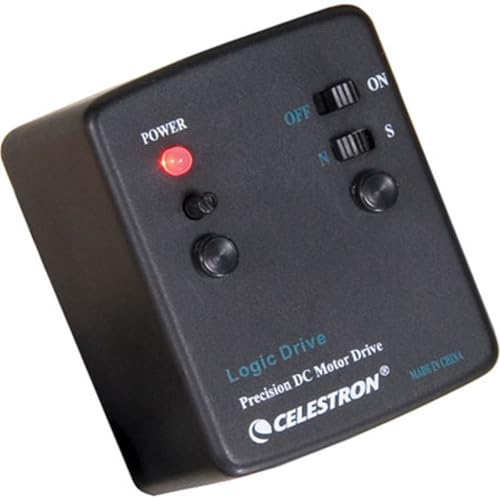
The separate Motor Drive is an add-on for a compatible manual equatorial telescope, not a complete telescope or mount. It drives right ascension to compensate for Earth’s rotation and can be used in either hemisphere; compatibility is specified for Celestron CG-2 and CG-3 mounts. This accessory suits an owner who already has a compatible manual EQ setup and wants tracking without replacing the telescope.
Bottom line: Choose it only for a compatible equatorial telescope you already own.
How to choose an AstroMaster 130EQ
Choose the manual 130EQ if you want to aim and track objects yourself; choose the 130EQ-MD if you want right-ascension tracking after centering. Both use a 130mm Newtonian reflector, but the motor does not find targets for you. A Newtonian uses a primary mirror and a side-mounted eyepiece, while the AstroMaster 70AZ uses a 70mm refractor and an alt-azimuth mount. Equatorial mounts align one axis with Earth’s rotation; alt-azimuth mounts move up/down and left/right. For a first telescope, pick based on how much setup and manual aiming you want to manage, not on claims of magnification alone. A useful rule: choose the motorized version if you expect to observe at high magnification, where drift becomes distracting.
The comparison below separates telescope format from tracking function.
| Need | Choose | Reason |
|---|---|---|
| Manual 130mm reflector | Celestron AstroMaster 130EQ | Manual equatorial controls |
| Tracking while observing | Celestron AstroMaster 130EQ-MD | Motorized right ascension |
| Eyepieces and filters | AstroMaster Accessory Kit | Accessory set for a compatible telescope |
| Simpler daytime and night viewing | Celestron AstroMaster 70AZ | 70mm refractor with alt-azimuth mount |
Equatorial tracking and setup
An equatorial mount tracks the apparent daily motion of the sky by rotating around an axis aligned with Earth’s axis; a motor generally drives right ascension while declination stays fixed during tracking. Polar alignment matters: point the mount’s polar axis toward the celestial pole, then center a target and make small corrections. Beginners often confuse tracking with GoTo operation; a tracking motor does not identify stars or slew to coordinates. The 130EQ-MD retains manual slow-motion controls, so use them to aim before relying on the drive. A drive made for CG-2 and CG-3 mounts should only be paired after confirming the mount model, because a similar-looking equatorial mount is not proof of compatibility.
Eyepieces and filters for a 130mm reflector
Eyepiece focal length sets magnification: telescope focal length divided by eyepiece focal length gives the power, so a shorter eyepiece raises magnification but also narrows the field and dims the view. The 15mm and 6mm eyepieces in the kit therefore serve different magnification levels, while its 2x Barlow doubles the effective magnification of an eyepiece. Magnification is not unlimited; atmospheric turbulence and optical setup often make lower power more useful. Start with the longer eyepiece to find and center an object, then increase power if the image remains steady. Color filters change contrast and color balance, and a Moon filter reduces glare; neither improves focus or corrects poor seeing.
Safe observing and care
Never point a telescope or finder at the Sun without a properly fitted, purpose-made solar filter secured over the front aperture; an eyepiece filter is not safe for solar viewing. The accessory kit’s Moon and color filters are not solar filters. Keep dust off mirror and lens surfaces, and avoid touching optical coatings because cleaning can scratch or damage them. Let a telescope adjust to outdoor temperature before demanding high-power views, since warm air currents inside the tube can soften images. For Newtonian reflectors, collimation—the alignment of the mirrors—can affect sharpness; check alignment if stars look consistently soft even after focusing and allowing the scope to cool.
Frequently Asked Questions
Does the AstroMaster 130EQ find objects automatically?
No; its manual equatorial mount uses slow-motion controls for aiming and tracking. The 130EQ-MD adds motorized right-ascension tracking, but you still locate and center the target yourself.
What does a telescope tracking motor actually do?
A right-ascension motor compensates for Earth’s rotation so a centered object stays in view. It does not select objects or automatically point the telescope at them.
Can I use the accessory kit with other telescopes?
The kit is described as compatible with the AstroMaster or most other telescopes, and its eyepieces are 1.25 inches. Confirm your focuser accepts 1.25-inch accessories before choosing it.
Can the AstroMaster filters be used to view the Sun?
No; the Moon filter and color filters are not safe solar filters. Solar observing requires a purpose-made filter securely fitted over the telescope’s front aperture.
How often should a Newtonian telescope be collimated?
Check collimation before a session if stars remain soft or the telescope has been moved roughly; transport can shift mirror alignment. A star test at moderate to high magnification can reveal misalignment.