
Chalk Markers for Chalkboard: 4 Sets Compared

For most chalkboard signs, Bandle B. is the most versatile pick, with 24 colors and reversible bullet and chisel tips. Chalk markers use liquid ink rather than dry chalk, and their erasability depends on the board surface.
Choose Chalkola instead for dot art or brush lettering; before using any liquid chalk marker, test a small hidden area if you are unsure whether the board is nonporous.
We earn a commission if you buy through links on this page. As an Amazon Associate I earn from qualifying purchases. Products are compared on manufacturer specifications, not hands-on testing.
- Best overall: Bandle B. 24-Color Chalk Markers – Its 24-color set and reversible bullet and chisel tips cover both detail work and broad strokes.
- Best for dot art: Chalkola 24-Color Dot and Brush Markers – A 5 mm dot tip makes consistent dots, and the brush tip varies from 1 to 5 mm.
- Best for a 20-color set: LANA & LUCA 20-Color Markers – It pairs 20 assorted colors with a reversible 6 mm bullet and chisel tip.
- Best for a compact set: CHALKY CROWN 8-Pack Markers – The 8-pack has a 6 mm reversible chisel and bullet tip.
| Product | Best for | Color count | Tip | Cleanup | Shop |
|---|---|---|---|---|---|
| Bandle B. 24-Color Chalk Markers | Versatile signs | 24 colors | 6 mm reversible bullet/chisel | Damp cloth on nonporous surfaces | Check Price on Amazon |
| Chalkola 24-Color Dot and Brush Markers | Dot lettering | 24 colors | 5 mm dot; 1–5 mm brush | Damp cloth on nonporous surfaces | Check Price on Amazon |
| LANA & LUCA 20-Color Markers | Assorted colors | 20 colors | 6 mm reversible bullet/chisel | Wet paper towel on nonporous surfaces | Check Price on Amazon |
| CHALKY CROWN 8-Pack Markers | Smaller color set | 8 colors | 6 mm reversible chisel/bullet | Wet paper towel on nonporous surfaces | Check Price on Amazon |
Chalk Markers for Chalkboard
Compare the tip styles, color counts and cleanup guidance to match a set to your signs or lettering.
Bandle B. 24-Color Chalk Markers

The reversible bullet and chisel tips make this 24-color set a flexible choice for chalkboard lettering, with a fine edge for details and a broader edge for sign strokes. The water-based ink is also intended for glass, whiteboards and metal; the maker recommends shaking before use. A damp cloth removes marks from nonporous surfaces. This set suits menus or changing display signs that need several colors and line widths. Its cleanup guidance is limited to nonporous surfaces, so check a hidden spot before writing on a board with an uncertain finish.
Bottom line: Pick this set for colorful signs that need both detail and broad strokes.
Chalkola 24-Color Dot and Brush Markers
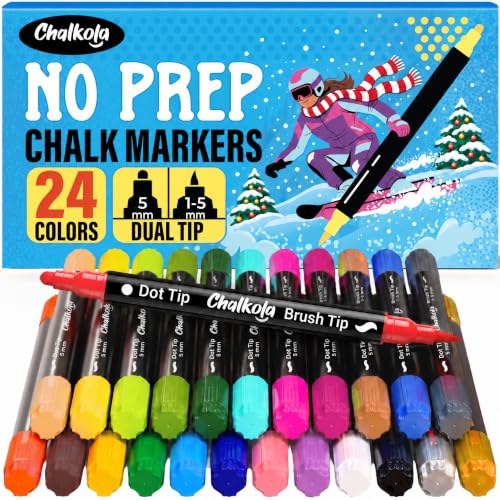
Chalkola is the distinct choice for dot patterns and brush lettering: it pairs a 5 mm dot tip with a brush tip that spans 1 to 5 mm. The maker says the markers need no pumping and can write after a shake. For chalkboard use, the maker specifies wet erasure; glass and mirrors are described as dry-erase surfaces. The set suits decorative work where dots or variable-width lettering matter more than a reversible bullet-and-chisel tip. Porous surfaces can retain the ink, so reserve use for nonporous boards and test first if the surface is uncertain.
Bottom line: Choose this set when dot patterns or variable-width brush lettering are the priority.
LANA & LUCA 20-Color Markers

LANA & LUCA offers 20 assorted colors in a 6 mm reversible bullet-and-chisel tip, a simpler color range than the 24-color sets. The maker describes the formula as water-based, non-toxic and odor-free, and says a wet paper towel removes the ink from nonporous surfaces. This set fits chalkboard signs when a standard reversible tip is more useful than a dot or brush tip. The removal claim is for nonporous surfaces; on a porous board, ink may remain, so verify the finish before making a large design.
Bottom line: Pick this set for assorted colors with a familiar reversible tip.
CHALKY CROWN 8-Pack Markers

CHALKY CROWN is the smallest set here, with 8 colors and a 6 mm reversible chisel-and-bullet tip. The maker describes the formula as non-toxic and odor-free and says a wet paper towel removes marks from nonporous surfaces. That compact selection suits a small menu or a limited-color display rather than artwork requiring a broad palette. Its wet-wipe guidance does not cover porous boards, where liquid ink can be harder to remove; confirm the surface is nonporous before using it for a permanent-looking design.
Bottom line: Choose it for a small palette and reversible tip on a nonporous board.
How to choose chalk markers for chalkboard signs
Choose by surface first, then by tip and color range. Liquid chalk markers use water-based ink rather than dry chalk; on nonporous chalkboards, the ink can generally be wiped away with a damp cloth, while porous surfaces can absorb it. A coated board is typically smoother and less absorbent than slate or unfinished wood. If you cannot identify the finish, test a small hidden area and let the mark sit before wiping.
For lettering, a chisel edge gives broad strokes when held flat and narrower lines when turned; a bullet tip keeps a more consistent width. Brush tips flex for variable-width strokes, while dot tips suit repeated dots and patterns. Choose a reversible chisel/bullet marker for general signage, or a specialty tip when that particular mark is central to the design.
Chalkboard surface and erasure
Nonporous boards are the safer choice for erasable liquid chalk; porous boards can absorb pigment and retain marks. Glass, mirrors and sealed boards are generally nonporous, while unsealed wood and some traditional chalkboards are porous. Surface coating and prior wear can change how a board behaves, so a small test is more reliable than assuming every blackboard wipes clean.
Use a damp cloth or wet paper towel where wet erasure is recommended, and work across a small area rather than spreading residue over the board. Chalkola distinguishes wet erasure on chalkboards from dry erasure on glass and mirrors, so follow the maker’s surface-specific guidance. Keep markers capped when not in use and avoid treating washable claims as permission to write on painted walls or other surfaces you cannot test.
Tip styles and the marks they make
Tip shape determines line character more than color count does. A reversible bullet-and-chisel marker covers fine and broad lettering with one tool, while brush tips change line width as pressure and angle change. Dot tips make repeated circles without needing to draw each one by hand. For a board full of small calendar text, favor a fine edge; for large sign lettering, a broad chisel stroke is easier to read at a distance.
This comparison helps map a project to a tip style without treating all markers as interchangeable:
| Need | Useful tip | Trade-off |
|---|---|---|
| General chalkboard signs | Reversible bullet/chisel | One marker shifts from detail to broad strokes |
| Dot patterns | Dot tip | Designed for dots, not flexible lettering |
| Variable-width lettering | Brush tip | Line width varies with angle and pressure |
Common chalk marker mistakes
The common mistake is using liquid chalk on an absorbent surface and expecting a clean wipe. Test an inconspicuous spot first, especially on older, scratched or unsealed boards; if the mark remains after a damp wipe, do not use the marker across the visible area. Another mistake is choosing a specialty tip for a job that needs ordinary writing: dot tips excel at repeated dots, not menu text, and brush tips require more control than a bullet tip.
For large signs, sketch the layout lightly before committing to broad strokes, and use the marker’s narrow edge for small lettering. Wipe with a damp cloth on nonporous chalkboards, then dry the surface before rewriting to avoid smearing residual moisture.
Frequently Asked Questions
Are liquid chalk markers erasable from every chalkboard?
No; erasability depends on the board surface. Nonporous boards generally wipe with a damp cloth, while porous surfaces can absorb ink and retain marks, so test a hidden area first.
Should chalk markers be removed with a wet cloth?
A damp cloth is the usual approach for nonporous chalkboards. Some markers specify wet erasure on chalkboards, so follow the surface guidance for the particular marker.
Can chalk markers be used on glass and mirrors?
Many water-based chalk markers are intended for glass and mirrors, which are nonporous surfaces. Some formulations call for dry erasure there, so check a small area and use the recommended cleanup method.
What tip is best for chalkboard lettering?
A reversible bullet-and-chisel tip covers both detail and broad lettering. Turn the chisel edge to change line width; a brush tip is better when variable-width strokes are the goal.
How do dot tips differ from brush tips?
A dot tip makes repeated round marks, while a brush tip changes line width with its angle and pressure. Choose a dot tip for patterns and a brush tip for expressive lettering.