
Cheap Electric Dirt Bikes for Adults Compared by Power

SYKERUNS X7 suits the widest range of adult trail riders among these options, with a 5,500W peak motor, 60V 27Ah battery and claimed speeds up to 57 mph. Choose ESKUTE 48V Adult Electric Dirt Bike or Rideplux 5000W Mid-Drive instead if their specific power and climbing claims better match your intended terrain.
Electric dirt bikes use battery power to drive an electric motor rather than a gasoline engine; these models are presented for off-road riding, so check local rules before using one on public roads.
We earn a commission if you buy through links on this page. As an Amazon Associate I earn from qualifying purchases. Products are compared on manufacturer specifications, not hands-on testing.
- Best overall: SYKERUNS X7 – It combines the highest peak motor output, a 60V 27Ah battery and a claimed top speed of up to 57 mph.
- Best for steep climbs: Rideplux 5000W Mid-Drive – Its maker claims climbing capability up to 45° and offers three selectable speed modes.
- Best for a stated charge time: ESKUTE 48V Adult Electric Dirt Bike – Its maker claims a full charge takes 6 hours and a range of up to 53 miles.
| Product | Best for | Peak motor power | Battery | Claimed top speed | Shop |
|---|---|---|---|---|---|
| SYKERUNS X7 | Fast trail riding | 5,500W | 60V 27Ah | Up to 57 mph | Check Price on Amazon |
| Rideplux 5000W Mid-Drive | Steep trail climbs | 5,000W | 48V 22.5Ah | — | Check Price on Amazon |
| ESKUTE 48V Adult Electric Dirt Bike | Overnight charging | 3,500W peak | 48V 23Ah | 38–46 mph | Check Price on Amazon |
Electric Dirt Bikes for Adults Compared
Compare the power and battery figures alongside the makers’ performance claims before matching a bike to your terrain.
SYKERUNS X7

The SYKERUNS X7 has the highest peak motor output here and the largest battery by voltage and amp-hours, making it the strongest match for riders prioritizing power and range claims. Its maker claims speeds up to 57 mph and a range up to 60 miles; actual range depends on rider weight, speed, terrain and riding conditions. It has 17-inch front and 14-inch rear off-road tires, dual hydraulic brakes, full suspension and reverse assist. The limitation is its 143-pound stated weight, which may matter when moving or transporting the bike.
Bottom line: Choose this if power, listed equipment and the maker’s speed claim outweigh the 143-pound weight.
Rideplux 5000W Mid-Drive

The Rideplux is the only option here with three selectable speed modes and a maker-claimed climbing ability of up to 45°, giving riders a way to adapt power to changing trail conditions. Its 5,000W peak mid-drive motor produces a claimed 220 N·m of rear-wheel torque, and the orange large-size model has a removable battery and unibody high-carbon steel frame. The maker does not give a top-speed figure, so this is a less useful choice for shoppers comparing maximum speed claims. Its steep-grade claim also depends on real trail and rider conditions.
Bottom line: Choose this for selectable modes and the maker’s steep-climb claim, not for a top speed.
ESKUTE 48V Adult Electric Dirt Bike
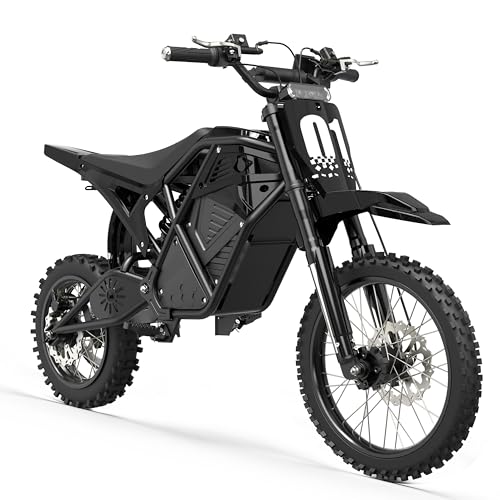
The ESKUTE is the only bike here with a full-charge time, with its maker claiming 6 hours, and it has a range claim of up to 53 miles. It pairs a 48V 23Ah battery with a 3,500W peak mid-drive motor; the maker also claims 220 N·m of torque and a 38–46 mph top-speed range. Hydraulic dual shock absorbers and nitrogen-filled shock technology are part of its feature set. Its peak power is lower than the other two options, which may matter to riders focused on maximum motor output.
Bottom line: Choose this if the charging time and range claim matter more than peak power.
How to Choose an Adult Electric Dirt Bike
Start with the terrain and the ride duration you need, then compare motor and battery figures rather than relying on a single speed claim. Peak watts indicate maximum motor output, while battery voltage and amp-hours describe electrical capacity; multiplying volts by amp-hours gives watt-hours, a useful way to compare batteries when both figures are available. For example, 48V × 23Ah equals 1,104Wh, while 60V × 27Ah equals 1,620Wh. More stored energy can support longer riding, but actual range also changes with speed, terrain and rider weight. If the route includes steep slopes, compare the maker’s climb claim to your actual route and leave a margin rather than treating a maximum angle as a routine operating target.
Electric Dirt Bike Power and Battery Figures
Battery watt-hours offer a more useful capacity comparison than voltage alone because they combine voltage and amp-hours. A 48V battery can have different capacities depending on its amp-hour rating, and a higher number does not guarantee a fixed distance on every trail. The table converts the battery figures into watt-hours where possible; watt-hours are calculated by multiplying volts by amp-hours.
| Bike | Battery capacity | Power / speed reference |
|---|---|---|
| ESKUTE 48V Adult Electric Dirt Bike | 1,104Wh | 3,500W peak; claimed 38–46 mph |
| Rideplux 5000W Mid-Drive | 1,080Wh | 5,000W peak; no speed figure |
| SYKERUNS X7 | 1,620Wh | 5,500W peak; claimed up to 57 mph |
These calculated capacities help compare energy storage, not guaranteed range. A rider covering long distances at high speed or on soft, hilly ground should expect range to differ from a maker’s maximum claim.
Off-Road Fit, Road Rules and Protective Gear
Assume an electric dirt bike is off-road only unless its maker and your local vehicle authority confirm otherwise. Road registration, lighting, mirrors and other equipment rules vary by jurisdiction, and a bike’s speed capability alone does not make it street legal. Before buying, check your local rules for where electric motorcycles may be ridden and whether the model meets road requirements. For motorcycle riding, use a helmet that meets U.S. DOT standards and wear eye protection, gloves, sturdy boots and protective clothing. At speeds approaching 40 mph or more, stopping distance and injury risk rise quickly, so choose riding areas with space, predictable surfaces and no public traffic.
Charging and Range Planning for Electric Dirt Bikes
Plan around usable distance rather than the largest range number: hills, loose dirt, repeated acceleration and higher speeds all draw more energy than steady riding on firm ground. A practical decision rule is to choose a route no longer than about half the maker’s maximum range when you cannot recharge along the way, leaving room for terrain and conditions to reduce distance. Charge with the compatible equipment in a dry, ventilated area and inspect the battery and cable for damage before plugging in. Keep charging equipment away from water and flammable materials, and stop charging if the battery becomes unusually hot, swells or smells abnormal.
Frequently Asked Questions
How far can an adult electric dirt bike travel?
Range depends on battery capacity, rider weight, speed and terrain, so maximum claims are not a route guarantee. For a ride without charging access, keep the planned route to roughly half the maker’s maximum range to allow for hills and loose surfaces.
Does a higher-voltage dirt bike always go faster?
No; speed also depends on motor output, gearing, controller limits, rider load and terrain. Compare the motor power and maker’s speed claim together rather than using battery voltage as a speed rating.
Can an electric dirt bike be ridden on public roads?
Not automatically; off-road capability does not establish road legality. Check your state and local requirements for registration and required equipment before entering a public street.
What protective gear should I wear on an electric dirt bike?
Wear a U.S. DOT-compliant motorcycle helmet, eye protection, gloves, boots and protective clothing. A bike with a claimed top speed over 50 mph makes a controlled riding area and careful speed choice especially important.
How should I plan battery charging before a trail ride?
Start with a fully charged battery and avoid planning a route near the maximum range claim. Charge in a dry, ventilated place with compatible equipment, and do not use a battery or cable that shows damage or unusual heat.