
CHI Enviro Smoothing Treatment: Hair Types Compared

For highlighted, porous, or fine hair, CHI Enviro Smooth for Highlighted, Porous & Fine Hair is the closest match; choose CHI Enviro Smooth for Virgin & Resistant Hair instead if your hair is virgin and resistant. Smoothing treatments are salon chemical services, so match the formula to your hair history rather than choosing by bottle size alone.
CHI Enviro Smoothing Treatment for Color-Treated Hair is named for color- or chemically treated hair, but its size information conflicts; verify the amount before ordering.
We earn a commission if you buy through links on this page. As an Amazon Associate I earn from qualifying purchases. Products are compared on manufacturer specifications, not hands-on testing.
- Best overall: CHI Enviro Smooth for Highlighted, Porous & Fine Hair – Its name targets highlighted, porous, and fine hair, and the features identify silk and pearl.
- Best for resistant hair: CHI Enviro Smooth for Virgin & Resistant Hair – Its name specifically targets virgin and resistant hair.
- Best for color-treated hair: CHI Enviro Smoothing Treatment for Color-Treated Hair – Its name identifies color- or chemically treated hair as the intended fit.
| Product | Best for | Hair type | Size | Formula detail | Shop |
|---|---|---|---|---|---|
| CHI Enviro Smooth for Highlighted, Porous & Fine Hair | Fine highlighted hair | Highlighted, porous, fine | 12 fl oz | Silk and pearl | Check Price on Amazon |
| CHI Enviro Smooth for Virgin & Resistant Hair | Virgin resistant hair | Virgin, resistant | 12 fl oz | Silk and pearl | Check Price on Amazon |
| CHI Enviro Smoothing Treatment for Color-Treated Hair | Color-treated hair | Color- or chemically treated | Verify size | — | Check Price on Amazon |
CHI Enviro smoothing treatments
Match the treatment to your hair type and chemical history, then confirm the size where the measurements conflict.
CHI Enviro Smooth for Highlighted, Porous & Fine Hair

For fine, highlighted, or porous hair, this CHI Enviro option is the most specifically targeted match among the treatments here. The features identify silk and pearl in the formula, and the package is identified as 12 fluid ounces. Those points can help distinguish it from the version intended for virgin and resistant hair. The name does not establish how much smoothing to expect or how the service should be applied, so people with fragile or recently processed hair should have a qualified stylist assess suitability before treatment.
Bottom line: Choose this if your hair is fine, highlighted, or porous and you want the formula named for that combination.
CHI Enviro Smooth for Virgin & Resistant Hair

Unlike the highlighted-hair option, this CHI Enviro treatment is named for virgin and resistant hair. Its features also identify silk and pearl, and the package is identified as 12 fluid ounces. It is the clearest fit of these choices when hair has not been chemically treated and is resistant to styling or other services. Hair condition and prior processing still matter: “virgin” means no chemical color or texture service, while resistant hair can require a stylist to assess strand condition and choose an appropriate process.
Bottom line: Pick this when your hair is virgin and resistant rather than highlighted or porous.
CHI Enviro Smoothing Treatment for Color-Treated Hair
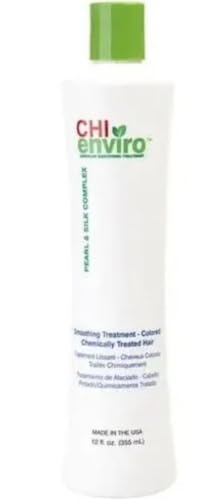
This CHI Enviro treatment is named for color- or chemically treated hair, setting it apart from the options aimed at fine, highlighted hair or virgin, resistant hair. The maker calls it a smoothing treatment, although some feature wording refers to shampoo and cleansing; that wording does not clearly establish the exact service format. That mismatch is the main limitation for buyers comparing quantities.
Bottom line: Consider it for color-treated hair, but confirm the actual bottle size first.
How to choose a CHI Enviro smoothing treatment
Start with hair history and texture: the product names separate treatments for fine, highlighted, or porous hair from those for virgin, resistant hair and color- or chemically treated hair. “Virgin” generally means hair has not had a chemical color or texture service; highlights and permanent color count as chemical processing. Hair that has been lightened can be more fragile, so a stylist should assess its condition before adding another chemical service. If your hair fits more than one group, prioritize recent processing and strand condition over the broadest label. Ask the stylist to explain the service and expected result for your hair before proceeding.
Hair smoothing services are not interchangeable with leave-in serums: a chemical salon service may involve a different process and duration. Confirm the exact treatment format and instructions with the stylist, particularly when the product wording is inconsistent.
What hair history means for treatment fit
Hair history helps narrow the choice, but it does not predict a guaranteed result. A strand test is a small section processed before a full service; it can reveal how the hair responds and whether the stylist should adjust or decline treatment. A useful decision rule is to avoid layering a smoothing service onto freshly lightened or visibly weakened hair until a stylist has assessed a test strand. “Color-treated” includes more than highlights, while “porous” describes hair that absorbs moisture and chemicals readily; those traits can overlap, so share both with the stylist.
Keep a record of recent color, bleach, relaxers, and other chemical services, including when they were done. Do not assume that a treatment intended for one category is automatically suitable for another just because both names include smoothing.
How salon smoothing services differ from leave-in treatments
A salon smoothing service is a different category from a leave-in hair product. A leave-in is applied to hair and remains between washes; it does not become the same service simply because it can make hair feel smoother. The latter is not an exact match for a search for CHI Enviro smoothing treatment.
Heat may be part of salon smoothing procedures, so ask the stylist which tools and temperatures the service requires. Excessive heat can damage hair, especially hair weakened by bleaching. Never improvise a chemical service or combine products based only on a shared brand name.
Questions to settle before a smoothing service
Before booking, identify your hair’s chemical history, current condition, and desired outcome; these factors help determine whether a formula is appropriate. Ask whether the treatment is intended for your particular hair category, how long the process takes, and what aftercare it requires. Those practical points are not established by the product names alone, so a stylist should confirm them before starting.
For any salon treatment, ask the stylist to read the product instructions and discuss precautions; do not rely on a generic category label to establish safe application.
Frequently Asked Questions
Can highlighted hair use a smoothing treatment?
It can be a candidate for a treatment specifically named for highlighted hair, but condition matters. Bleached or fragile strands should be assessed by a stylist, ideally with a test strand before a full service.
What does virgin hair mean for a smoothing treatment?
Virgin hair generally has not had chemical color or texture services. Tell the stylist about any prior bleaching, permanent color, relaxer, or perm, since those change the hair history.
Is porous hair the same as fine hair?
No. Fine hair describes strand thickness, while porosity describes how readily hair takes in and releases moisture. A person can have fine, porous hair or either trait alone.
Should color-treated hair get a strand test first?
A strand test is a prudent check before a chemical service, especially on hair that has been bleached or feels weakened. It lets a stylist assess one small section before deciding whether to proceed.
How can I tell if a product is a leave-in serum?
Check the product name and directions: a leave-in is meant to remain in the hair between washes, unlike a salon smoothing service. Do not treat a leave-in serum as a substitute for a chemical treatment.