
Kodak EasyShare C180 Camera: Models Compared

The Kodak EasyShare C180 in red or teal is the closest match, and both versions share a 10.2-megapixel sensor, 3x optical zoom and 2.4-inch LCD. Choose between them by color; pick Kodak EasyShare C813 instead if you want the related C813’s 8.2-megapixel sensor and 2.4-inch screen.
A compact point-and-shoot camera handles exposure and focus automatically, making it straightforward for everyday snapshots. These older camera models use removable SD or SDHC cards, so check card compatibility and condition before buying.
We earn a commission if you buy through links on this page. As an Amazon Associate I earn from qualifying purchases. Products are compared on manufacturer specifications, not hands-on testing.
- Best overall: Kodak EasyShare C180 Red – The red C180 matches the requested model and has a 10.2-megapixel sensor with 3x optical zoom.
- Best for teal color: Kodak EasyShare C180 Teal – The teal C180 shares the red version’s 10.2-megapixel resolution, zoom and LCD.
- Best for C813 alternative: Kodak EasyShare C813 – The C813 offers an 8.2-megapixel sensor and a 2.4-inch LCD.
| Product | Best for | Resolution | Shop |
|---|---|---|---|
| Kodak EasyShare C180 Red | Red C180 option | 10.2 MP | Check Price on Amazon |
| Kodak EasyShare C180 Teal | Teal C180 option | 10.2 MP | Check Price on Amazon |
| Kodak EasyShare C813 | C813 alternative | 8.2 MP | Check Price on Amazon |
Kodak EasyShare C180 camera options
The C180 versions share their core camera specifications, while the C813 is a related alternative with different resolution.
Kodak EasyShare C180 Red
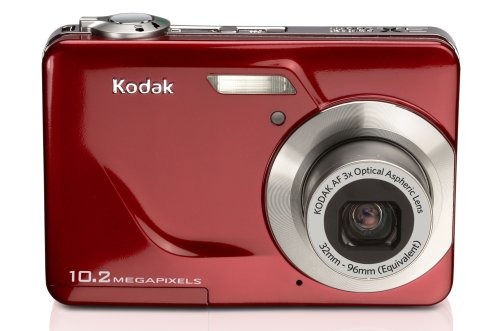
The red finish distinguishes this C180 from the teal version; the core imaging specifications are otherwise the same. It has a 10.2-megapixel resolution, a 3x optical aspheric zoom lens with a 35–96 mm equivalent range, and a 2.4-inch LCD. Face Detection and Blur Reduction are included, and photos can be saved to SD or SDHC cards. Kodak says the camera can capture 16:9 HD pictures for viewing on an HDTV or other HD device. Choose it if red is your preferred color; the modest 3x zoom is a limitation for framing distant subjects.
Bottom line: Choose this version if you want the C180 in red and do not need more than 3x optical zoom.
Kodak EasyShare C180 Teal

The teal C180 gives you the same main camera features as the red version in a different finish. Its 10.2-megapixel resolution, 3x optical aspheric zoom lens and 2.4-inch LCD suit simple point-and-shoot photography. Face Detection and Blur Reduction are also included, and the camera accepts SD and SDHC memory cards. Kodak says it captures 16:9 HD pictures for viewing on an HDTV or another HD device. This is the color choice for buyers who prefer teal; its 3x zoom has less reach than cameras with higher optical zoom ratios.
Bottom line: Pick this version if teal is your preferred finish and the C180’s 3x zoom range suits your subjects.
Kodak EasyShare C813

The C813 is a related EasyShare compact, but it has an 8.2-megapixel resolution rather than the C180’s 10.2 megapixels. It also pairs 3x optical zoom with a 2.4-inch indoor/outdoor color LCD. Digital Image Stabilization is included, and the camera supports SD and SDHC cards sold separately. Kodak says its resolution can produce prints up to 30 by 40 inches; print results also depend on image quality and viewing distance. Choose this model if you specifically want the C813; it is not the C180 requested by the search.
Bottom line: Choose this only if you want the C813 model rather than the C180.
How to choose a Kodak EasyShare C180 camera
Choose between the red and teal C180 by color because their core specifications match. Both versions have 10.2 megapixels, 3x optical zoom, a 2.4-inch LCD, Face Detection, Blur Reduction and SD/SDHC storage. The C813 is the meaningful alternative here: it has 8.2 megapixels and the same 3x zoom and 2.4-inch screen, plus Digital Image Stabilization. Optical zoom changes the lens’s framing; digital zoom enlarges a crop and does not provide the same added optical reach. For distant subjects, prioritize a higher optical zoom ratio over digital zoom. For snapshots of people and nearby scenes, the C180’s 32–96 mm equivalent range covers wide-to-short-telephoto framing.
This quick comparison focuses on differences that can affect the choice.
| Need | Choose | Reason |
|---|---|---|
| Red C180 | Kodak EasyShare C180 Red | Red finish and 10.2 MP |
| Teal C180 | Kodak EasyShare C180 Teal | Teal finish and 10.2 MP |
| C813 model | Kodak EasyShare C813 | 8.2 MP and Digital Image Stabilization |
What 3x optical zoom means for framing
A 3x optical zoom lens reaches three times its widest focal length, and the C180’s 32–96 mm equivalent range shows that span in familiar 35 mm terms. The 32 mm wide end works for groups and indoor scenes when there is room to step back; 96 mm tightens framing for portraits and nearby details. Optical zoom adjusts the lens, while digital zoom crops and enlarges image data, so it cannot add true optical reach. A 3x range is limited for wildlife, sports or subjects across a large field. If those subjects are common, choose a camera with a longer optical zoom rather than relying on digital enlargement.
Choosing an SD or SDHC card
SDHC cards are the SD card format for capacities above 2 GB through 32 GB; standard SD cards cover up to 2 GB. Card speed classes indicate minimum sequential write speeds: Class 2, 4, 6 and 10 correspond to 2, 4, 6 and 10 MB/s. For still snapshots, capacity and compatibility are more important than a very high speed rating. Avoid assuming that an SDXC card will work simply because it physically fits; it is a separate format.
Using resolution and stabilization wisely
Resolution counts pixels, but it does not by itself guarantee a sharp image or a particular print quality. The C180’s 10.2 megapixels and C813’s 8.2 megapixels can both support ordinary prints; motion blur, focus and lighting also affect the result. Face Detection helps the camera identify faces for focus or exposure decisions, while stabilization is intended to reduce blur from camera movement, not a moving subject. Hold the camera with both hands, brace your elbows, and use flash in dim scenes when appropriate. For a static subject, steadier support can help; for a moving subject, a faster shutter is needed to freeze motion.
Frequently Asked Questions
Will an SDHC card work in the Kodak EasyShare C180?
The C180 supports SD and SDHC memory cards. SDHC cards range from above 2 GB through 32 GB, but confirm the card’s capacity and condition before use.
How much optical zoom does the C180 have?
The C180 has 3x optical zoom, with a 35 mm equivalent focal-length range of 32–96 mm. That range suits nearby scenes better than distant wildlife or field sports.
What is the difference between SD and SDHC cards?
Standard SD cards hold up to 2 GB, while SDHC covers capacities above 2 GB through 32 GB. SDXC is a separate format, so do not assume a camera supporting SDHC also supports SDXC.
Does camera stabilization stop moving subjects from blurring?
No; stabilization addresses blur from camera movement, while subject motion requires a faster shutter to freeze. The C813 lists Digital Image Stabilization, and the C180 lists Blur Reduction.
Is 10.2 megapixels enough for a large print?
Megapixel count alone does not determine print quality, because focus, lighting and viewing distance also matter. Kodak says the C180 can capture images for prints up to 30 by 40 inches, but that maximum is not a guarantee of sharp results at close viewing distance.