
Children’s Backpacks With Wheels: 4 Models Compared

For most school-age kids, the J World Sunny J World Sunny Rolling Backpack is a practical pick because it weighs 3.5 pounds and its straps tuck away when rolling. Choose another style if you need more room or a character design; rolling bags also need to be carried on stairs and uneven ground.
We earn a commission if you buy through links on this page. As an Amazon Associate I earn from qualifying purchases. Products are compared on manufacturer specifications, not hands-on testing.
- Best overall: J World Sunny Rolling Backpack – At 3.5 pounds, it is the lightest of these rolling packs with a weight and has tuck-away straps.
- Best for removable trolley: GRUOTEIS 30L Six-Wheel Backpack – Its trolley detaches, so the 30-liter bag can also be carried as a regular backpack.
- Best for character design: Disney Princess 16-Inch Rolling Backpack – This 16-inch rolling backpack features Disney Princess artwork and two carrying modes.
| Product | Best for | Dimensions (inches) | Weight (lb) | Shop |
|---|---|---|---|---|
| J World Sunny Rolling Backpack | Everyday school use | 17 × 12 × 8.5 | 3.5 | Check Price on Amazon |
| GRUOTEIS 30L Six-Wheel Backpack | Removable trolley | 18.5 × 12.5 × 7.8 | 3.53 | Check Price on Amazon |
| J World Sunrise 18-Inch Camo | Larger school load | 18 × 13 × 9 | 4.5 | Check Price on Amazon |
| Disney Princess 16-Inch Rolling Backpack | Princess artwork | 16 × 12 × 7 | 0.2 | Check Price on Amazon |
Children’s Backpacks With Wheels
Compare each rolling backpack’s size, carrying setup and organization to find one that suits the child’s school routine.
J World Sunny Rolling Backpack

At 3.5 pounds, J World Sunny Rolling Backpack is lighter than the other rolling backpacks here with a weight. Its 17 × 12 × 8.5-inch body has a main compartment sized for two textbooks and lunch, plus a front organizer with a key clip, pen holders, card slots and an internal pocket. Two mesh side pockets hold water bottles.
The retractable backpack straps tuck into a back pocket, which is useful for stairs or rough ground. The tradeoff is that its capacity is not given in liters, so families comparing volume with a measured-capacity pack may prefer another option.
Bottom line: Pick this for a lighter stated weight and straps that stow away for rolling.
GRUOTEIS 30L Six-Wheel Backpack
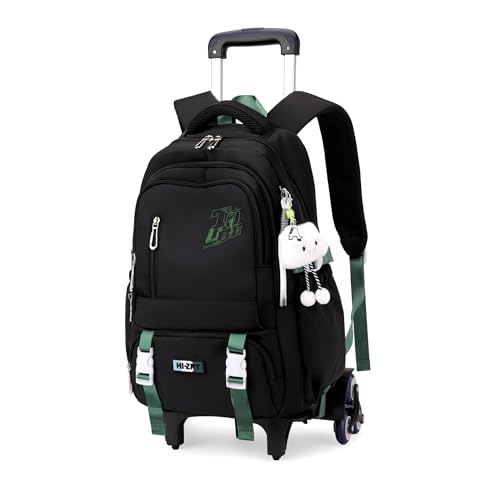
Unlike the other packs here, GRUOTEIS 30L Six-Wheel Backpack has a removable trolley, letting the 30-liter bag switch between rolling and backpack carry. It measures 18.5 × 12.5 × 7.8 inches and uses high-density nylon fabric; the maker describes the fabric as water-resistant. The shoulder straps are widened and breathable, and the back panel is padded.
This is a fit for elementary or middle school use when a detachable trolley matters. At 3.53 pounds, it weighs slightly more than J World Sunny Rolling Backpack, and its larger capacity may be more bag than a younger or smaller child needs to manage when carrying it.
Bottom line: Choose this if you want a larger pack with a trolley that detaches.
J World Sunrise 18-Inch Camo

J World Sunrise 18-Inch Camo is the largest-dimension option here, measuring 18 × 13 × 9 inches, and its maker says the main compartment holds two large textbooks, a laptop and lunch. A front organizer provides a key clip, pen holders, card slots and an internal zip pocket; two mesh pockets add bottle storage. The molded rubber base is made for dragging over pavement.
The bag converts between rolling and backpack carry and is intended for ages 8 and up. Its 4.5-pound weight is the highest here, which matters when a child must carry it rather than roll it.
Bottom line: Pick this for a larger school load and a molded rubber base.
Disney Princess 16-Inch Rolling Backpack

Disney Princess 16-Inch Rolling Backpack stands out for its Disney Princess artwork featuring Belle, Ariel, Rapunzel, Moana, Tiana and Cinderella. The 16 × 12 × 7-inch interior has a roomy main compartment with a top zipper, and the bag can be worn as a backpack or rolled with its pull-up handle. The maker recommends it for ages 3 and up.
Its dimensions are smaller than the 17- and 18-inch options, which can suit a younger child or a lighter school load. The weight is 0.2 pound, notably lower than the other weights, so verify the bag’s actual weight before choosing based on that figure.
Bottom line: Choose this for the character design and a smaller 16-inch format.
How to Choose a Rolling Backpack for a Child
Start with the child’s daily load and the places they must carry the bag, not just roll it. A rolling backpack still needs to be lifted onto a bus, up stairs and over curbs; a retractable handle and stowable straps make switching modes easier. Pediatric guidance commonly recommends keeping a loaded school backpack at or below about 15% of a child’s body weight. Weigh the packed bag, including books and lunch, rather than relying on the empty-bag figure. If the child cannot lift it comfortably or the pack pulls them backward, reduce the load or choose a smaller bag. A broad base and upright handle can make rolling easier, but wheels do not make an overloaded bag safe to carry.
Size and Fit for Children’s Backpacks With Wheels
A child’s backpack should sit close to the back, with its bottom near the waist and no lower than about 4 inches below the waistline; the bag should not be wider than the child’s torso. These fit checks still matter for rolling styles because the child may need to wear one on stairs or rough ground. Measure the child’s back from shoulder level to waist and compare that span with the bag’s height. With under 4 inches of torso clearance below the waist, select a shorter pack rather than letting a tall bag hang low. Check loaded fit with both shoulder straps adjusted evenly, and keep heavier books near the back panel to reduce the feeling of pull.
Rolling Backpacks Versus Regular Backpacks
Rolling backpacks shift much of the load to wheels on smooth routes, while regular backpacks keep the weight on the wearer’s shoulders. A convertible pack adds a second mode, but its wheels, frame or trolley can add weight and bulk even when carried. Use the table as a route-based guide: repeated stairs favor a lightweight carry option, while long smooth corridors make rolling more useful. Any wheeled bag still has to be lifted over curbs and into vehicles. On crowded sidewalks, pull the bag close and keep it out of other pedestrians’ path; a long handle can extend behind the child and create a trip hazard.
| Route or need | Better fit | Reason |
|---|---|---|
| Frequent stairs | Lightweight convertible pack | It can be carried when rolling is impractical |
| Long, smooth corridors | Rolling pack with a retractable handle | Wheels can carry the load across level ground |
| Very small torso | Shorter bag that fits above the waist | A tall pack may hang too low |
How to Pack and Maintain a Wheeled School Bag
Place the heaviest books closest to the back panel and use smaller pockets for light items such as pencils and snacks. That keeps hard objects from pressing far from the child’s body when the backpack is worn. Empty unnecessary items regularly and weigh the filled bag; keep it near or below 15% of the child’s body weight. Check wheels, axles, handle joints and seams periodically for cracks, looseness or trapped debris, especially after rolling over rough pavement. Do not let a child ride or stand on a rolling backpack: the bag is not described as a ride-on device, and the handle and frame can tip or fail under that use. Follow the care method provided for the chosen fabric.
Frequently Asked Questions
How heavy should a child’s rolling backpack be when packed?
Keep a loaded school backpack near or below 15% of the child’s body weight, a common pediatric guideline. Weigh it with books and lunch inside, and reduce the load if the child struggles to lift or carry it.
Are rolling backpacks allowed at school?
School rules vary, so check the school’s policy before buying. Some schools restrict wheeled bags because they take up aisle space; a convertible bag can be carried when rolling is not permitted.
Can a rolling backpack be used on stairs?
Use the shoulder straps to carry it on stairs rather than pulling it behind the child. A pack with straps that stow away makes switching between rolling and carrying simpler.
How should a child’s backpack fit on their back?
The bag should fit close to the back and sit around the waist, with its bottom no more than about 4 inches below the waistline. Choose a shorter pack if its lower edge hangs farther down or extends wider than the child’s torso.
What should I check on a rolling backpack over time?
Inspect the wheels, axles, handle joints and seams for looseness, cracks or debris. Frequent checks matter after rough pavement use, where wheel and frame parts take more wear.