
Cigarette Lighter Voltage Meter: 5 Options Compared

For a standalone cigarette lighter voltage meter, choose Digital Cigarette Lighter Voltmeter: it reads voltage directly and displays it to one decimal place. Choose a charger with a built-in meter instead if you also need USB charging; those options trade a dedicated readout for charging ports.
We earn a commission if you buy through links on this page. As an Amazon Associate I earn from qualifying purchases. Products are compared on manufacturer specifications, not hands-on testing.
- Best overall: Digital Cigarette Lighter Voltmeter – A standalone meter shows the reading to one decimal place and accepts 0–30 volts.
- Best for USB-C charging: Jebsens 30W USB-C Charger – Its two ports include USB-C Power Delivery 3.0 and USB-A Quick Charge 3.0.
- Best for four devices: 4-Port Charger with Voltmeter – It has four charging ports and a voltage display.
| Product | Best for | Meter type | USB ports | Pack | Shop |
|---|---|---|---|---|---|
| Digital Cigarette Lighter Voltmeter | Standalone monitoring | Standalone display | 0 | 1 piece | Check Price on Amazon |
| Jebsens 30W USB-C Charger | USB-C charging | Built-in display | 2 | 1 piece | Check Price on Amazon |
| 130W 3-Port USB-C Charger | Multi-device charging | Built-in display | 3 | 1 piece | Check Price on Amazon |
| 4-Port Charger with Voltmeter | Four-port charging | Built-in display | 4 | 1 piece | Check Price on Amazon |
| 65W USB-C Charger, 3-Pack | Multiple vehicles | Built-in display | 4 | 3 pieces | Check Price on Amazon |
Cigarette Lighter Voltage Meters and Charger Adapters
Choose a standalone meter for monitoring alone, or a charging adapter if you also need powered USB ports.
Digital Cigarette Lighter Voltmeter

Unlike the other options, this is a standalone cigarette-lighter voltmeter rather than a USB charger. It plugs into a 12-volt outlet, draws 0.1 amp, and displays the reading to one decimal place; its input range is 0–30 volts. At 2.80 × 1.57 × 1.17 inches, it suits drivers who want a dedicated readout without adding charging ports. Its limitation is that it does not charge devices, so choose a charger-meter combination if you need USB power from the same socket.
Bottom line: Pick this for a dedicated voltage readout without USB charging.
Jebsens 30W USB-C Charger

Unlike a standalone meter, this adapter combines a voltage display with two charging ports: USB-C Power Delivery 3.0 and USB-A Quick Charge 3.0. The maker says the ports can charge two devices at up to 30 watts combined and gives the display accuracy as ±0.2 volt. Its blue finish distinguishes it from the black adapters here. This suits drivers who want charging and voltage checks in one plug, but the specifications give no display range, so verify compatibility with your vehicle’s outlet before choosing it as a monitor.
Bottom line: Choose it when USB-C charging and a voltage display are both useful.
130W 3-Port USB-C Charger
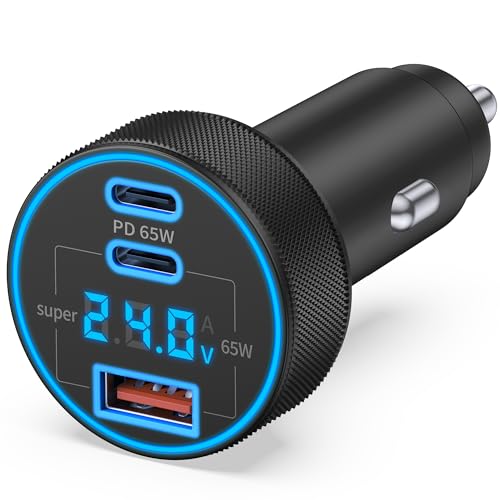
This is the highest-wattage charger among these options, pairing its voltage display with three charging ports and a 130-watt total. Its maker names PPS, Power Delivery, and Quick Charge, and the black adapter is aimed at drivers powering several devices. Those power claims are from the maker; actual charging speed also depends on the connected device and cable.
Bottom line: Pick it for multiple charging connections and a voltage display.
4-Port Charger with Voltmeter

Four charging ports make this adapter the option for the most simultaneous connections; it combines PD and QC 3.0 ports with USB-C and a regular charging port. It also has a voltage display and a blue ambient-light ring. The adapter measures 1.52 × 1.52 × 2.36 inches and is described for 12–24-volt cigarette-lighter sockets.
Bottom line: Choose it when four ports matter more than a specified total output.
65W USB-C Charger, 3-Pack

This is the only three-pack, giving buyers three adapters rather than a single unit. Each charger has four ports, and the maker specifies up to 65 watts total, including up to 30 watts from PD and 18 watts from QC 3.0 simultaneously. The pack suits households that want a charger-meter in more than one vehicle. The claims do not give the voltmeter’s measurement range or accuracy, so drivers choosing it primarily to monitor battery voltage should confirm those before relying on the display.
Bottom line: Pick this if you need several four-port adapters and the charging outputs.
How to Choose a Cigarette Lighter Voltage Meter
Choose a standalone meter when voltage monitoring is the main job; choose a charger-meter when you also need USB ports. A typical 12-volt lead-acid battery reads about 12.6 volts after resting when fully charged, while a running charging system commonly measures about 13.7–14.7 volts. Those are useful reference points, not a diagnosis: temperature, battery type, engine state, and vehicle wiring affect the reading. A meter with 0.1-volt resolution is easier to compare across readings than one that rounds to whole volts. If you need to interpret a small change, favor a model that gives accuracy as well as display resolution; the two are not the same thing.
How to Read Voltage at a 12-Volt Socket
A socket reading is a quick check, not a direct measurement at the battery terminals. With the engine off, many vehicles power the outlet only when the ignition is on; others keep it live, so check the vehicle’s manual before leaving a meter plugged in. Record the reading after the engine has been off for several hours for a more useful resting-voltage comparison. For an engine-running check, a reading around 13.7–14.7 volts is typical, but voltage-regulated charging systems can behave differently. If the outlet reading is unexpectedly low or fluctuates, retest at the battery terminals with a suitable multimeter or have the charging system checked rather than treating one socket reading as a fault diagnosis.
Voltage Checks That Avoid Common Mistakes
Compare readings only under similar conditions: engine off versus engine off, or running versus running. A 12-volt lead-acid battery near 12.6 volts after resting is generally charged, while a value around 12.2 volts suggests it is substantially discharged; temperature and battery chemistry change those reference points. A recently driven vehicle can show surface charge, so wait several hours before judging its resting voltage. Do not use a plug-in meter to test mains voltage, and do not let a loose adapter distract you while driving. If a display repeatedly shows an abnormal reading, verify it at the battery with a correctly rated multimeter; accessories and wiring can make socket voltage differ from terminal voltage.
Frequently Asked Questions
What voltage should a 12-volt car battery show?
A rested lead-acid car battery is typically near 12.6 volts when fully charged. Around 12.2 volts suggests substantial discharge, but temperature and battery chemistry affect the reading.
What voltage should I see with the engine running?
Many conventional charging systems measure about 13.7–14.7 volts while running. Smart charging systems can move outside that range, so check the vehicle manual if the reading seems unusual.
Can a cigarette lighter voltmeter drain the battery?
A meter that stays powered draws current while plugged in; the example standalone model specifies a 0.1-amp draw. Unplug it when parked if the outlet remains live and the vehicle will sit for an extended period.
Why does the socket reading differ from battery voltage?
The outlet circuit and its wiring can cause a voltage drop between the battery and socket, especially while accessories draw current. Compare readings under the same engine and load conditions, or measure at the battery terminals with a suitable multimeter.