
Compression Garments for Thighs: 4 Types Compared

For compression garments for thighs, choose Bioflect Capri Compression Leggings M/L for broad lower-limb coverage, because its high-waist leggings extend from the hips to below the knee. Choose a different style if you need a post-operative garment with adjustable abdominal hooks, or targeted compression around the thigh rather than the whole leg.
We earn a commission if you buy through links on this page. As an Amazon Associate I earn from qualifying purchases. Products are compared on manufacturer specifications, not hands-on testing.
- Best overall: Bioflect Capri Compression Leggings M/L – High-waist capri leggings cover the hips, thighs, and area below the knee.
- Best for post-operative wear: LIPOELASTIC TD Variant Large – Three hook rows adjust abdominal compression, with double-lined outer thighs.
- Best for targeted support: BODYPROX Thigh Compression Sleeves, Medium – A pair of sleeves focuses coverage on the thigh rather than the full leg.
- Best for adjustable wrapping: Ymapinc Adjustable Thigh Compression Wrap – The 1.8-meter wrap has a buckle with 12 adjustment positions.
| Product | Best for | Coverage | Closure | Shop |
|---|---|---|---|---|
| Bioflect Capri Compression Leggings M/L | Broad leg coverage | High waist to below knee | Pull-on | Check Price on Amazon |
| LIPOELASTIC TD Variant Large | Post-op recovery | Tummy, hips, thighs, buttocks, knees | Three hook rows | Check Price on Amazon |
| BODYPROX Thigh Compression Sleeves, Medium | Targeted thigh support | Thigh (one pair) | Pull-on sleeve | Check Price on Amazon |
| Ymapinc Adjustable Thigh Compression Wrap | Adjustable coverage | Cross-wrap coverage | 12-position buckle | Check Price on Amazon |
Compression Garments for Thighs
Match the garment’s coverage and adjustment features to the area and use you have in mind.
Bioflect Capri Compression Leggings M/L

Among these options, the Bioflect capri leggings cover the broadest continuous area, from the hips and upper legs to below the knee. The high-waist design pairs that coverage with a proprietary knit and raised massaging texture; the maker says the fabric provides moderate compression. The Medium-Large size is the size identified for this garment. This style suits someone seeking coverage beyond the thigh, but it is less targeted than a single-thigh sleeve and has no adjustable hook or wrap closure for changing compression.
Bottom line: Choose this for high-waist coverage extending below the knee.
LIPOELASTIC TD Variant Large

The LIPOELASTIC TD Variant is the only option here explicitly designed for post-operative compression after liposuction or Vaser lipo. Double-lined outer thighs add compression in that area, while three rows of abdominal hooks let the wearer adjust the front closure. A hemmed waistband is intended to resist rolling, and the garment includes a crotch opening. Its broad coverage suits recovery needs involving the lower abdomen and several parts of the leg and hip; it is not a targeted sleeve for someone who wants compression only around one thigh. Follow the surgical team’s garment and wear-time guidance.
Bottom line: Choose this when post-operative coverage and adjustable abdominal hooks are needed.
BODYPROX Thigh Compression Sleeves, Medium

The BODYPROX option comes as a pair of sleeves, making it the most direct choice for targeted thigh coverage rather than a full-leg garment. Its size is Medium, and the product is described for men and women. The maker positions the sleeves for hamstrings and quadriceps, including activity such as heavy lifting. A sleeve avoids the broad coverage of leggings or a post-operative garment, but it offers no adjustable closure; fit depends on selecting a suitable size. Check thigh circumference against the maker’s sizing guidance before choosing a size.
Bottom line: Choose this for a pull-on pair focused on thigh muscles.
Ymapinc Adjustable Thigh Compression Wrap
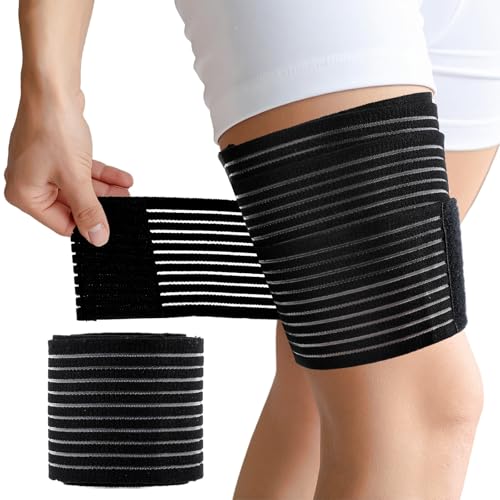
The Ymapinc garment differs from sewn leggings and sleeves: it is a long, narrow wrap that can be cross-wrapped, with a 12-position buckle and silicone grip lining. It measures 70.86 inches long and 2.95 inches wide, and uses nylon. Its adjustable format may suit someone who wants to vary how the wrap sits across an area rather than pull on a fixed garment. The sizing text cuts off before giving its circumference range, so confirm the wrap’s fit range before ordering; a narrow wrap also takes more care to position than a one-piece sleeve.
Bottom line: Choose this if you prefer a buckle-adjusted wrap over a sewn sleeve.
How to choose thigh compression coverage
Start with the area that needs coverage: leggings extend across multiple regions, sleeves target the thigh, and wraps let you position compression over a smaller path. Post-operative garments are a separate category; the surgeon or surgical team should decide the prescribed garment and wear schedule. For a general fit decision, choose a pull-on sleeve when one thigh is the target, and broad leggings when coverage must continue below the knee. A wrap’s adjustable fastening changes placement, not the need to select a suitable fit. Compression should feel supportive, not painful or numb; remove the garment and seek medical advice if you notice unusual pain, numbness, or skin color changes.
Leggings, sleeves, post-op garments, and wraps
These four styles differ mainly in coverage and how they stay in place. Use this guide to connect the garment construction to the intended use; compression strength cannot be compared because numerical pressure ratings are not available for these choices.
| Style | Coverage | Adjustment |
|---|---|---|
| Capri leggings | Hips to below knee | Pull-on |
| Post-op garment | Lower abdomen through knees | Three abdominal hook rows |
| Thigh sleeves | Thigh muscles | Pull-on |
| Wrap | Cross-wrapped area | 12-position buckle |
For post-surgery recovery, do not substitute an exercise sleeve or wrap for a garment prescribed by a clinician. For general activity, a sleeve is more focused than a high-waist legging.
Thigh fit and sizing checks
Measure the thigh where the garment will sit and use the maker’s size chart; a garment that slides or pinches is a poor fit. Sleeves usually rely on their elastic fit, while wraps allow repositioning through a fastening system. The Ymapinc wrap measures 70.86 inches long and 2.95 inches wide, but its fit range is incomplete, so confirm circumference compatibility before ordering. Bioflect’s size is Medium-Large, BODYPROX’s is Medium, and LIPOELASTIC’s is Large; those labels are not interchangeable across brands. If the garment is for post-operative use, the surgical team’s sizing and fit directions take precedence over general sizing advice.
Safe wear and common compression mistakes
Compression garments should not cause numbness, severe discomfort, or skin discoloration; remove a garment that causes these symptoms and contact a health professional. Do not fold or roll an edge to create a tighter band, since a concentrated band can create uncomfortable pressure. For recovery after liposuction, use the specific garment and schedule directed by the care team rather than choosing based on coverage alone. Wash and care requirements vary by fabric and construction, so use the garment’s care instructions to preserve elasticity. A garment is not a substitute for assessment of new swelling, pain, or an injury.
Frequently Asked Questions
How tight should a thigh compression garment feel?
A thigh garment should feel supportive without pain, numbness, or skin color changes. Remove it and contact a health professional if those symptoms occur.
Can thigh sleeves replace post-surgery compression garments?
No; a thigh sleeve is not the same as a post-operative garment designed for multi-area coverage. Use the garment and wear schedule specified by the surgical team.
How do I measure for a thigh compression sleeve?
Measure the circumference of the thigh where the sleeve will sit and compare it with that maker’s size chart. Medium and Large labels are not standardized across brands.
Can I adjust the pressure of a thigh wrap?
A buckle wrap can be repositioned or fastened at its adjustment points, but that does not establish a medical pressure level. Stop if wrapping causes pain, numbness, or color change.