
Compressor Pressure Water Trap: 4 Options Compared

For a compressor pressure water trap, start with the connection size: 3/4-Inch Inline Filter Trap has 3/4-inch FPT ports and a 185 CFM flow rating, while the others use smaller 1/4- or 1/2-inch connections. Choose a different option if you need pressure regulation, since 3/4-Inch Inline Filter Trap is a filter separator rather than a regulator combo.
We earn a commission if you buy through links on this page. As an Amazon Associate I earn from qualifying purchases. Products are compared on manufacturer specifications, not hands-on testing.
- Best overall: 3/4-Inch Inline Filter Trap – The 3/4-inch ports and 185 CFM flow rating suit higher-flow air lines.
- Best for airbrushes: NANPU 1/4-Inch Filter Regulator – It pairs 1/4-inch NPT connections with a 20 SCFM rating and regulator.
- Best for 1/2-inch lines: Hromee 1/2-Inch Filter Regulator – Its 1/2-inch NPT connection and semi-auto drain suit a larger line than the 1/4-inch combos.
| Product | Best for | Port size | Filtration | Drain | Shop |
|---|---|---|---|---|---|
| 3/4-Inch Inline Filter Trap | Higher-flow lines | 3/4 in. FPT | 5 micron | Manual | Check Price on Amazon |
| NANPU 1/4-Inch Filter Regulator | Airbrush setups | 1/4 in. NPT | 5 micron | Semi-auto | Check Price on Amazon |
| Hromee 1/2-Inch Filter Regulator | Mid-size shop lines | 1/2 in. NPT | 5 micron | Semi-auto | Check Price on Amazon |
| Hromee 1/4-Inch Filter Regulator | Compact tool lines | 1/4 in. | Brass element | Manual | Check Price on Amazon |
Compressor Pressure Water Traps Compared
Match the inlet and outlet connection first, then compare filtration and drain style for your setup.
3/4-Inch Inline Filter Trap

Unlike the regulator combos, this inline separator is sized for 3/4-inch air lines and lists a 185 CFM flow rate. It has 3/4-inch FPT inlet and outlet ports, a 5-micron filter element, a wall bracket, and a metal bowl with a sight glass. The manual drain holds 300 ml, and the oil capacity is 350 ml. Brand says the maximum input pressure is 250 psi. This is the match for a larger line that needs moisture separation without an integrated regulator; choose a combo instead if you need adjustable outlet pressure.
Bottom line: Pick this for a 3/4-inch line when filtration and high flow matter more than pressure adjustment.
NANPU 1/4-Inch Filter Regulator

Among these regulator combinations, this one gives a flow rating of 20 SCFM at 90 psi, aligning it with airbrushes, spray guns, and small air tools. Its 1/4-inch NPT connection, reusable brass 5-micron element, clear polycarbonate bowl, and 0–150 psi gauge make the filtration and adjustment functions part of one assembly. Brand specifies a 145 psi maximum supply pressure and a 41–140°F operating temperature range. The semi-automatic drain differs from a manual-only drain; buyers seeking a larger line or higher flow should look at a larger connection option.
Bottom line: Choose this for 1/4-inch NPT equipment where a regulator and 20 SCFM rating fit the job.
Hromee 1/2-Inch Filter Regulator

This is the only 1/2-inch NPT regulator combo here, bridging the smaller 1/4-inch units and the 3/4-inch inline separator. It combines a 5-micron brass filter element with an adjustable pressure regulator, gauge, mounting bracket, and semi-automatic drain. Brand says the drain releases accumulated liquid automatically when the line is unpressurized. Its larger connection makes it the relevant choice when the air line is 1/2-inch NPT and outlet pressure needs adjustment. The specifications do not give a flow rating, so confirm the required flow against the equipment before choosing it for a demanding application.
Bottom line: Pick this when the line is 1/2-inch NPT and you want filtration with pressure regulation.
Hromee 1/4-Inch Filter Regulator
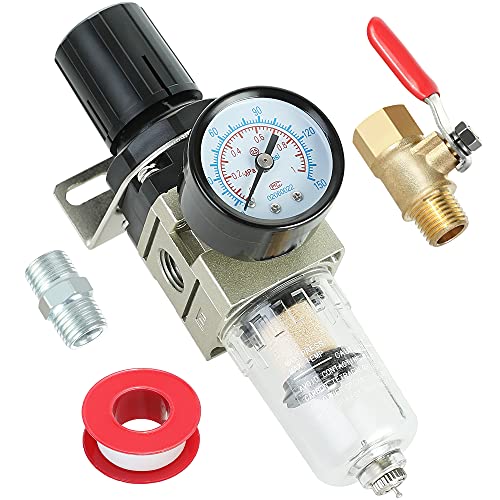
Unlike the 1/4-inch NANPU combo, this Hromee unit uses a manual drain and describes its brass filter element as intended to remove moisture and fine particles. It combines a pressure regulator, pressure gauge, filter cup, ball valve, and mounting bracket. The pull-up adjustment knob lets the user set outlet pressure, and the product says it maintains stable outlet pressure despite inlet pressure and flow fluctuations. Connection size is the key limitation: it is intended for 1/4-inch lines, so it is not the right fit for 1/2- or 3/4-inch piping. Check the port thread type before ordering.
Bottom line: Choose this for a 1/4-inch line when manual draining and pressure adjustment suit your setup.
How to choose a compressor water trap
Choose a trap by matching port size, required flow, and whether the line needs pressure regulation. A filter separator removes water and particles; a filter-regulator adds an adjustable outlet-pressure control, which helps when tools require different working pressures. Use the tool’s air-consumption requirement in SCFM as a baseline and compare it with the trap’s rating at the same pressure: the NANPU rating is 20 SCFM at 90 psi, while the 3/4-inch inline model gives 185 CFM. Those figures are not directly comparable without matching rating conditions. A 5-micron element captures finer particles than a coarser element, but water separation also depends on bowl, drain, and line conditions.
Match air-line ports and threads
Port diameter and thread type both need to match the fittings; 1/4-inch NPT and 3/4-inch FPT are not interchangeable connections. NPT threads are tapered, while FPT identifies female pipe threads, so use compatible male/female fittings and seal tapered pipe threads appropriately. The options range from 1/4-inch connections for smaller tools to 3/4-inch ports for higher-flow lines. A measurable rule: if the existing line is 1/2-inch NPT, select a 1/2-inch unit rather than relying on adapters that reduce the passage. Check the compressor outlet and downstream tool connections before installation, and confirm the required flow so the trap does not become a restriction.
Filter, regulator, and drain types compared
A filter-only separator and a filter-regulator solve different problems: the former separates moisture, while the latter also controls downstream pressure. Drain style affects maintenance; a manual drain needs periodic attention, while semi-automatic designs can discharge liquid when pressure is released. Use this table to narrow the unit type to the job.
| Need | Choose | Trade-off |
|---|---|---|
| Large line with high flow | Inline filter separator | No regulator function |
| Smaller line needing pressure adjustment | Filter-regulator combo | Connection size limits fit |
| Less manual liquid handling | Semi-auto drain model | Drain behavior differs by design |
Keep the unit upright so collected liquid reaches the drain, and depressurize the line before servicing a bowl or filter element. A compressor water trap is not a substitute for safe pressure control or for drying air to a specification required by a sensitive process.
Install and maintain the trap safely
Install the trap downstream of the compressor and before the equipment it protects, with airflow following the body markings and the bowl positioned downward. Drain collected water regularly; moisture accumulation can reduce separation performance and carry liquid farther into the line. Shut off and depressurize the system before removing a bowl or opening a drain, because compressed air can eject parts or liquid. Polycarbonate bowls can be vulnerable to certain solvents and impact, so avoid cleaning them with incompatible chemicals and inspect them for cracks. Metal bowls add physical robustness but still need inspection for corrosion and seal wear. Replace filter elements when airflow drops or maintenance guidance calls for it.
Frequently Asked Questions
Where should an air compressor water trap go?
Install the trap downstream of the compressor and upstream of the tool or spray equipment it protects. Keep the bowl vertical and follow the airflow direction marked on the housing.
How often should I drain a compressor water trap?
Drain manual traps whenever collected liquid approaches the bowl’s safe capacity, and check them during routine compressor use. Humid conditions and frequent compressor cycling can make water accumulate faster.
Does a water trap reduce air pressure?
Any filter can create some pressure drop, especially when its element is dirty or the unit is undersized. Compare the tool’s SCFM demand with a trap’s flow rating at the relevant pressure before installation.
Can an air compressor water trap remove oil?
Some separator combos are described as filtering water, oil, and particles, but a basic water trap is not a complete oil-vapor treatment system. Applications needing clean breathing or process air require appropriately rated filtration stages.
What is the difference between NPT and FPT?
NPT is a tapered pipe-thread standard, while FPT identifies female pipe threads. Match the male and female fittings and thread size; do not assume two connections with the same nominal size are interchangeable.