
Copper Wire for Garden Projects: 5 Options Compared

For flexible copper wire you can shape around a garden stake, 12-Gauge Bare Copper Wire Spool is the direct match: it is a 12-gauge, 1-pound spool of dead-soft bare copper. Choose one of the ready-made antenna stakes instead if you want a preformed plant support rather than wire to wrap yourself.
Bare copper wire can serve for craft or support work, but keep ties loose and avoid leaving tight loops around growing stems.
We earn a commission if you buy through links on this page. As an Amazon Associate I earn from qualifying purchases. Products are compared on manufacturer specifications, not hands-on testing.
- Best overall: 12-Gauge Bare Copper Wire Spool – A one-pound spool of dead-soft 12-gauge wire can be wound around a stick, dowel, branch or bamboo stake.
- Best for short stakes: Flutesan 10-Inch Copper Stake Kit – The kit contains 20 copper stakes measuring about 10 inches each.
- Best for a 10-pack: 10-Piece 13.5-Inch Copper Coil Stakes – Each of the 10 ready-made antennas measures 13.5 inches.
- Best for six plants: Six-Pack 13-Inch Copper Garden Stakes – The set contains six 13-inch stakes with copper wire coils.
| Product | Best for | Gauge | Quantity | Length | Shop |
|---|---|---|---|---|---|
| 12-Gauge Bare Copper Wire Spool | DIY wire projects | 12 gauge | 1-pound spool | — | Check Price on Amazon |
| Flutesan 10-Inch Copper Stake Kit | Short plant stakes | 10 gauge | 20 stakes | 10.04 inches | Check Price on Amazon |
| 10-Piece 13.5-Inch Copper Coil Stakes | Ten ready-made antennas | — | 10 stakes | 13.5 inches | Check Price on Amazon |
| Three-Pack 11.5-Inch Copper Antennas | Three-piece set | 10 gauge | 3 antennas | 11.5 inches | Check Price on Amazon |
| Six-Pack 13-Inch Copper Garden Stakes | Six plant supports | — | 6 stakes | 13 inches | Check Price on Amazon |
Copper Wire for Garden Use
Compare loose wire with ready-made copper antenna stakes by form, gauge and length.
12-Gauge Bare Copper Wire Spool

Unlike the preformed stakes, this is loose dead-soft wire, so you can shape it around a stick, dowel, branch or bamboo stake. The spool holds 1 pound of lead-free, nickel-free bare copper at 12 gauge (2.05 mm), a practical format for garden crafts and other DIY work. The maker also identifies it for electroculture gardening, jewelry and home decor. Its limitation is that it arrives as wire rather than a finished stake, so choose it only if you want to cut and form the support yourself.
Bottom line: Pick this spool if you want to shape copper wire to your own garden project.
Flutesan 10-Inch Copper Stake Kit

The 20-piece count and roughly 10-inch length make this the compact ready-made stake option here, rather than loose wire for custom winding. Each stake is described as 10-gauge, 99% copper, suited to vegetable gardens and houseplants. The maker claims the antenna design supports root development and yields; treat that as a product claim, not a guaranteed gardening result. At about 10 inches long, the stakes may not suit tall plants or deep placement, so choose a longer set when that reach matters.
Bottom line: Choose this set for short, ready-made stakes in a larger quantity.
10-Piece 13.5-Inch Copper Coil Stakes

This set offers 10 pre-wound antennas on wooden sticks, each 13.5 inches long, for farms, beds, pots and indoor use. The maker says the coils use 99.9% copper wire and claims the design can increase plant growth and reduce irrigation and fertilizer needs; those outcomes are not assured by the materials alone. Unlike a bare-wire spool, these are already assembled, which limits how much you can customize their shape or length. Confirm the stick dimensions suit your intended pot or bed before choosing them.
Bottom line: Choose these if you want ten assembled antennas at a 13.5-inch length.
Three-Pack 11.5-Inch Copper Antennas

These three ready-made antennas use 10-gauge, 99% copper wire and measure 11.5 inches, making them a shorter alternative to the 13-inch-plus stake sets. The maker promotes them for vegetable gardens, houseplants and indoor flowers, and claims the coils support stronger roots and yields. They are not loose wire, so they are a poor fit when you need a long continuous length for tying or general craft work. The three-piece quantity also suits a small number of plants better than planting a broad area.
Bottom line: Pick this smaller set when three preformed antennas are enough.
Six-Pack 13-Inch Copper Garden Stakes
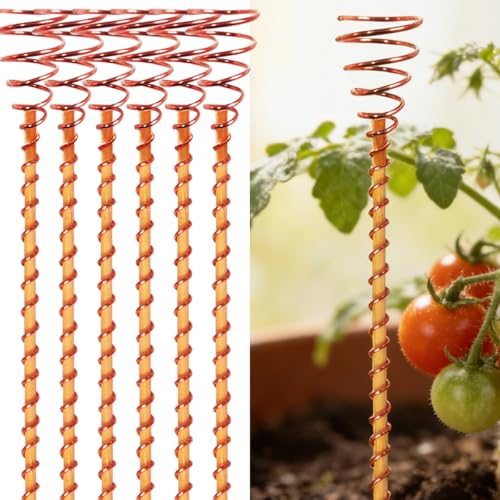
This six-pack supplies 13-inch wooden stakes wrapped with 99.9% copper wire, giving it a mid-size assembled format between the shortest kit and the longer 13.5-inch set. The maker says the antennas are for indoor and outdoor plants and claims they can support growth while reducing water and fertilizer needs. No wire gauge is given in the specifications, so this is not the right choice if gauge is central to a wire-forming project. The maker’s insertion depth is 2 to 3 inches.
Bottom line: Choose this set for six preformed, 13-inch stakes with an insertion depth.
How to choose copper wire for garden projects
Choose loose wire for custom ties or coils, and a finished stake when you want an assembled support. Gauge describes wire thickness: a lower AWG number means thicker wire, and 12-gauge copper is about 0.081 inches (2.05 mm) in diameter. Dead-soft copper is easy to bend but also bends more readily under load than a rigid plant stake. For a simple support tie, leave room for stems to thicken and use a loose loop rather than cinching wire tightly. If you need a specific thickness, prioritize a product that gives its gauge; length and piece count alone cannot tell you how stiff a wire will be.
Wire, coils and ready-made stakes compared
Loose copper wire offers the most freedom to form a project, while an assembled antenna saves winding and cutting. Use this table to match the product form to the task.
| Project need | Suitable form | What to check |
|---|---|---|
| Custom ties or coils | Loose bare wire | Gauge, spool weight and ability to shape it |
| Preformed plant antenna | Wire-wrapped stake | Stake length, count and insertion depth |
| Specific wire thickness | Either form, if gauge is given | Gauge value and intended use |
Electroculture-style growth claims are maker claims, not a substitute for choosing plants suited to the site, soil and watering conditions.
How to use copper wire around plants safely
Keep copper ties loose and inspect them as stems grow; a tight loop can constrict a stem even when the wire is soft. Use a figure-eight tie between a stem and a stake to reduce rubbing, and leave visible slack around the plant. Copper is also used in some fungicide products, but bare wire is not the same as a measured fungicide application. Avoid burying or leaving copper wire in direct contact with roots as a growth treatment: copper can be toxic to plants at elevated concentrations. For antennas, match the insertion depth and stake length to the container or bed without pushing through roots or irrigation lines.
Frequently Asked Questions
What does 12-gauge copper wire measure?
12-gauge copper wire is about 0.081 inches (2.05 mm) in diameter. A lower AWG number indicates thicker wire, so compare gauge values rather than assuming a larger number means thicker.
Can copper wire be used to tie garden plants?
Yes, copper wire can form a plant tie, but leave slack as the stem grows. A loose figure-eight connection between stem and stake helps avoid a tight loop that can constrict the plant.
Does bare copper wire improve plant growth?
Bare copper wire should not be relied on as a growth treatment. Copper can harm plants at elevated concentrations, so avoid burying wire against roots and focus on suitable soil, light and watering.
How long should a garden copper stake be?
Choose a stake long enough to anchor in the soil while leaving the needed support above ground. For a container, compare stake length with pot depth and plant height, and keep the stake clear of roots and irrigation lines.
Does copper wire rust when left outdoors?
Copper does not form iron rust, but exposed copper can oxidize and develop a surface patina. Moisture and garden chemicals can affect its appearance, so inspect ties and coils periodically for loosened or damaged sections.