
COUNTO Smart Scale: Five Models Compared by Fit

For a compact smart scale with 14 body-composition measurements and a 400-pound capacity, choose COUNTO Smart Scale. A smart scale estimates body composition using bioelectrical impedance; choose arboleaf Dual-Frequency Smart Scale or LOFTILLA 8-Electrode Smart Scale instead if you want handle electrodes for full-body readings.
We earn a commission if you buy through links on this page. As an Amazon Associate I earn from qualifying purchases. Products are compared on manufacturer specifications, not hands-on testing.
- Best overall: COUNTO Smart Scale – Its 10-inch square footprint, 14 metrics and 400-pound capacity make it the most compact match for routine tracking.
- Best for full-body readings: arboleaf Dual-Frequency Smart Scale – Its handle and foot electrodes use dual-frequency BIA, with 7 metrics on the display and 50+ in the app.
- Best for a large display: LOFTILLA 8-Electrode Smart Scale – Its 5.4-inch screen shows 8 metrics, and its 8 electrodes measure through the hands and feet.
| Product | Best for | Body metrics | Electrode setup | Dimensions | Shop |
|---|---|---|---|---|---|
| COUNTO Smart Scale | Compact footprint | 14 | — | 10 × 10 × 0.7 in | Check Price on Amazon |
| arboleaf Dual-Frequency Smart Scale | Full-body analysis | 50+ in app | 8 electrodes, handle and feet | — | Check Price on Amazon |
| LOFTILLA 8-Electrode Smart Scale | Large screen | 50+ | 8 electrodes, hands and feet | 11.8 × 11.8 × 1.37 in | Check Price on Amazon |
| WITHINGS Body Smart | Heart-rate tracking | Body composition; heart rate | — | 12.7 × 12.7 × 1 in | Check Price on Amazon |
| Alcedo Color-Changing Body Fat Scale | Color lighting | 20 | 4 G-sensors | — | Check Price on Amazon |
COUNTO Smart Scale and Alternatives
Compare the measurement approach, on-scale readouts and footprint to find a smart scale that fits your routine.
COUNTO Smart Scale

COUNTO Smart Scale is the most compact option here, measuring 10 × 10 × 0.7 inches and weighing 2.3 pounds. It uses Bluetooth and an app to report 14 body-composition measurements, including weight, BMI, body fat, muscle mass, body water, and visceral fat. The maker says its high-precision sensor system supports readings up to 400 pounds. Its 10-inch platform suits buyers with limited storage space, but those who want a handle-and-foot electrode system should consider a different model.
Bottom line: Choose this if a 10-inch platform and broad app metrics matter more than a handle electrode system.
arboleaf Dual-Frequency Smart Scale
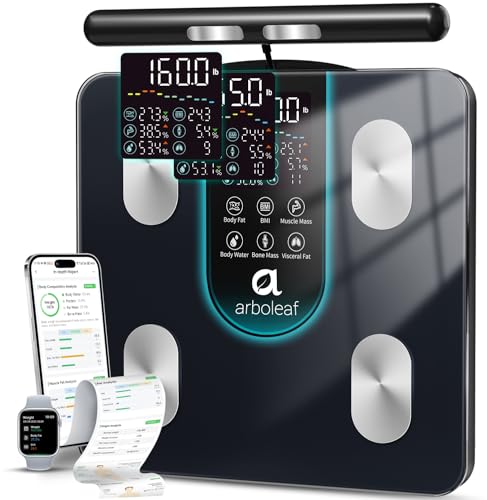
arboleaf Dual-Frequency Smart Scale stands apart with a handle and foot electrodes, using dual-frequency bioelectrical impedance analysis for full-body readings. Its screen shows seven values—weight, BMI, body fat, muscle mass, body water, bone mass, and visceral fat—while the app provides more than 50 metrics, segmental views, trend charts, family profiles, syncing, and reports. Pairing with the Arboleaf app is required before first use. The handle-based setup may suit buyers seeking segmental data, but it adds a separate component compared with a compact foot-only scale.
Bottom line: Choose this for handle electrodes, segmental views, and a broad set of app metrics.
LOFTILLA 8-Electrode Smart Scale

LOFTILLA 8-Electrode Smart Scale is the display-focused alternative, with a 5.4-inch screen showing eight core metrics, including body weight, body fat percentage, muscle mass, BMI, and body type. Its 8-electrode, dual-frequency design measures through the hands and feet and analyzes limbs and torso; the app syncs by Bluetooth and offers more than 50 body-composition metrics. At 11.8 × 11.8 inches, the platform takes more floor space than COUNTO Smart Scale. The larger format and handle setup suit buyers who want more information visible at weigh-in, but not those prioritizing the smallest footprint.
Bottom line: Choose this for a large built-in display and hand-and-foot measurements.
WITHINGS Body Smart

WITHINGS Body Smart adds heart-rate readings at weigh-in and shows weight trends on a high-resolution color display, distinguishing it from models focused on body-composition metrics alone. It supports up to eight users and connects by Wi-Fi and Bluetooth with iOS and Android. The maker says weight readings are within 50 grams and describes the scale as clinically validated. Its 12.7-inch square platform is larger than COUNTO Smart Scale’s 10-inch footprint. Buyers seeking heart-rate tracking and multiple profiles may prefer it; those wanting handle electrodes should look to another option.
Bottom line: Choose this if heart-rate readings, trend display, and multiple user profiles are priorities.
Alcedo Color-Changing Body Fat Scale

Alcedo Color-Changing Body Fat Scale differentiates itself with app-customizable lighting in seven colors and weight-variation color changes. It tracks 20 metrics, including weight, body fat, BMI, and muscle mass, and syncs data to an app over Bluetooth. Its product name gives a 400-pound capacity, while the dimensions are only described as compact, so it is less useful for buyers comparing exact footprints. The color feature may appeal to someone who wants visual feedback; buyers who want a large on-scale metric display or handle electrodes should choose a different type.
Bottom line: Choose this if customizable color lighting is a feature you want in a connected scale.
How smart scales estimate body composition
Smart scales estimate body composition with bioelectrical impedance analysis (BIA), sending a low-level electrical signal through the body and using the measured impedance in an estimate. Hydration, meals, exercise, and time of day can shift the result, so compare readings taken under similar conditions rather than treating one weigh-in as definitive. A typical home scale uses foot electrodes and estimates mostly lower-body composition; handle electrodes add hand-to-foot measurement paths and can provide segmental estimates. Neither method directly measures fat or muscle. For consistent tracking, use the same scale on a hard, level surface and weigh at a similar time, preferably before eating or exercising.
Choosing between foot-only and handle-electrode scales
Foot-only scales are the simpler choice for weight trends and estimates, while handle-and-foot models add electrodes for readings across the limbs and torso. Choose a handle model if segmental estimates are a priority; choose a foot-only model if easy storage and a quick step-on routine matter more. Screen metrics and app metrics are not the same: some scales show a smaller set immediately and reserve additional measures for the app. The table compares the measurement approach and display emphasis of the models here.
| Scale type | Measurement path | Useful when |
|---|---|---|
| Foot-electrode | Feet through lower body | Weight trends and compact setup matter |
| Handle and foot electrodes | Hands and feet; segmental estimates | Broader body-composition views matter |
Getting consistent readings from a smart scale
Consistent conditions matter more than small day-to-day changes in BIA estimates. Place the scale on a hard, level floor, since carpet can make weight readings less reliable, and stand with bare, dry feet on the electrode areas. Take readings at a similar time and under similar hydration, meal, and exercise conditions; a workout or large meal can change water distribution. Use the app’s trend view to follow longer-term direction rather than reacting to one body-fat estimate. If the scale is shared, select the correct user profile when the model supports profiles; otherwise, measurements may be attributed to the wrong person.
Smart-scale safety and fit checks
People with an implanted electronic medical device, such as a pacemaker, should check the scale maker’s safety guidance and ask their clinician before using BIA measurement. Pregnancy and certain medical conditions can also make body-composition estimates inappropriate or misleading; use weight-only mode if the maker permits it and a clinician advises it. Platform size is a practical fit issue: measure the available floor space and compare it with the scale’s length and width, leaving room to stand comfortably. Before choosing a model with an app, confirm that its phone operating system and account setup fit your household; Bluetooth or Wi-Fi features do not guarantee the same compatibility or profile options.
Frequently Asked Questions
How accurate are smart-scale body-fat readings?
Smart-scale body-fat values are estimates, not direct measurements, and hydration can shift BIA results. Compare readings taken under similar conditions and focus on trends over time.
Should I weigh myself before or after exercising?
Weigh before exercising for a more consistent comparison, since exercise can change fluid distribution. Use a similar time and routine for each check-in.
Can I put a smart scale on carpet?
Use a hard, level floor rather than carpet, which can interfere with stable contact and weight readings. Keep the scale in the same spot for repeat measurements.
Can people with pacemakers use a BIA scale?
People with pacemakers or other implanted electronic devices should check the scale maker’s safety guidance and ask a clinician before using its BIA function. BIA sends a low-level electrical signal through the body.
Do smart scales measure muscle directly?
No; BIA scales estimate muscle mass from electrical impedance and other inputs rather than measuring muscle directly. Hydration and measurement conditions can affect that estimate.