
Best Stove Gap Covers: 3 Models Compared by Fit

For most kitchens, Linda’s Essentials 21-Inch Silicone Covers is the best stove gap cover because its 21-inch silicone strip fits gaps up to 2.3 inches wide; measure first to confirm the fit. Choose an adjustable steel design instead if you need a narrower strip or a length that can be changed.
Stove gap covers bridge the space between a range and countertop to catch crumbs and spills. Check the gap width and the available length before choosing, since the products have different fit limits.
We earn a commission if you buy through links on this page. As an Amazon Associate I earn from qualifying purchases. Products are compared on manufacturer specifications, not hands-on testing.
- Best overall: Linda’s Essentials 21-Inch Silicone Covers – The 21-inch silicone pair covers gaps up to 2.3 inches wide.
- Best for narrow gaps: Adjustable Stainless Steel Covers, 0.79-Inch – Telescoping steel strips fit gaps from 1 to 18 mm and need at least 3.9 inches of depth.
- Best for wider steel coverage: Adjustable Stainless Steel T Covers, 1.5-Inch – Its 1.5-inch-wide strip fits gaps from 8 to 30 mm.
| Product | Best for | Material | Length | Gap width | Shop |
|---|---|---|---|---|---|
| Linda’s Essentials 21-Inch Silicone Covers | silicone coverage | Silicone | 21 in | Up to 2.3 in | Check Price on Amazon |
| Adjustable Stainless Steel Covers, 0.79-Inch | shallow narrow gaps | Stainless steel | 13.8–27.5 in | 0.04–0.7 in | Check Price on Amazon |
| Adjustable Stainless Steel T Covers, 1.5-Inch | wider steel strips | Stainless steel | 13.8–27.5 in | 0.31–1.18 in | Check Price on Amazon |
Best stove gap covers
Measure the gap width and available run before choosing among fixed silicone and adjustable steel designs.
Linda’s Essentials 21-Inch Silicone Covers
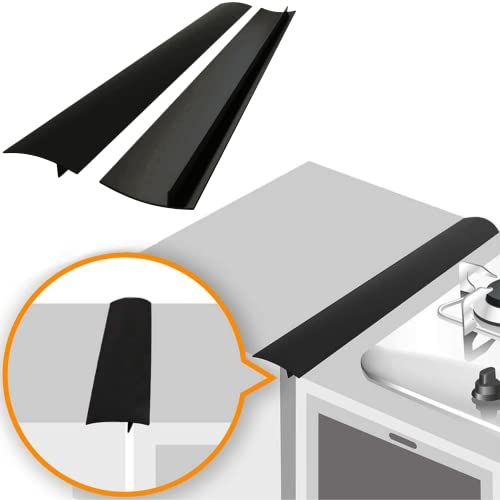
Unlike the adjustable steel strips, these fixed-length silicone covers are 21 inches long and accommodate gaps up to 2.3 inches wide. The pair is made to form a barrier between the stove and countertop against crumbs and spills. The maker says the food-grade silicone is heat resistant; the maker gives no temperature rating, so buyers needing a specific heat limit should confirm it before choosing. This is the straightforward fit when the measured run is 21 inches and the gap stays within the width.
Bottom line: Choose this pair if your gap is within 2.3 inches and the 21-inch length suits your stove.
Adjustable Stainless Steel Covers, 0.79-Inch
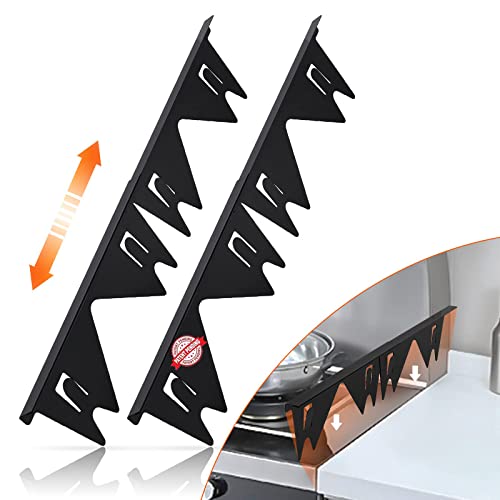
Compared with the other steel options, this telescoping pair is the only one with a minimum depth requirement: at least 3.9 inches. Each strip adjusts from 13.8 to 27.5 inches and is 0.79 inches wide; the compatible gap range is 0.04 to 0.7 inches. The maker says the design works with flat and uneven stove and countertop surfaces, a useful distinction from rigid designs. Choose it for a narrow gap with enough depth and a run that benefits from length adjustment; it will not suit gaps wider than 0.7 inches.
Bottom line: Pick this when the gap is no wider than 0.7 inches and there is at least 3.9 inches of depth.
Adjustable Stainless Steel T Covers, 1.5-Inch
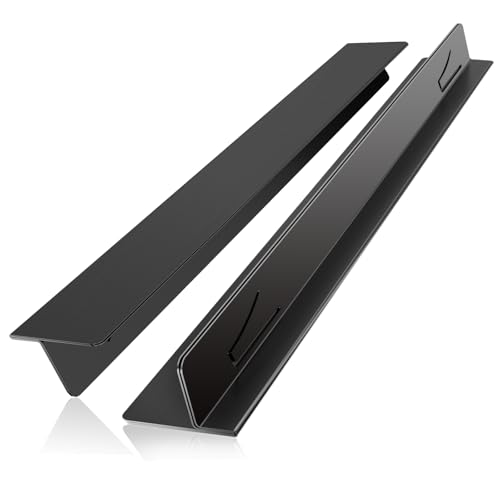
The 1.5-inch-wide strip and 0.31-to-1.18-inch gap range set this adjustable steel pair apart from the narrower steel designs. Its right-angle T shape extends over the counter and stove edge, and the length adjusts from 13.8 to 27.5 inches. The maker says it is not suitable for sloped or uneven surfaces, so a level, flush fit matters here. This is the steel choice for a wider gap within its range, but measure both the gap and surface level before selecting it.
Bottom line: Choose this if your gap measures 0.31 to 1.18 inches and the surfaces are level.
How to choose stove gap covers
Measure the gap width, the length along the range, and any needed depth before choosing a cover. A flexible silicone strip is a simple option when its fixed length covers the run; adjustable steel designs can be extended between 13.8 and 27.5 inches. Use the width as the first filter: for gaps above 18 mm, the 1.5-inch steel option covers up to 30 mm, while the 0.79-inch steel styles stop at 18 mm. For a gap under 8 mm, the steel product with a 1 mm minimum is the one whose range begins low enough. Do not assume that a wider strip fits every counter—the cover must sit steadily without interfering with the range.
Measuring the gap and checking fit
Measure the narrowest and widest points along both sides of the stove, because counters and ranges may not align evenly. A flexible cover can follow some irregularity, but rigid steel choices may require level surfaces; one steel model specifically excludes uneven surfaces. Check the available depth as well as width: one adjustable model requires at least 3.9 inches of depth. For a practical rule, if the measured gap exceeds 18 mm but is no more than 30 mm, the 1.5-inch-wide steel design is the only option whose range reaches it. If the gap is wider than 30 mm, these choices do not establish a fit.
The table shows how each cover type differs on fit.
| Type | Length | Width fit | Surface note |
|---|---|---|---|
| Silicone pair | 21 in | Up to 2.3 in | Flexible material |
| Adjustable steel, narrow | 13.8–27.5 in | 1–18 mm | One option allows uneven surfaces |
| Adjustable steel, wide | 13.8–27.5 in | 8–30 mm | Requires level surfaces |
Silicone and stainless steel compared
Silicone and stainless steel differ most in flexibility and how fit is adjusted. Silicone is flexible and the pair here has a fixed 21-inch length; the steel designs extend to fit runs from 13.8 to 27.5 inches. Stainless steel does not melt like silicone, according to one product’s maker, while the silicone maker describes its material as heat resistant. Neither claim supplies a temperature limit, so confirm the allowable heat exposure if the cover may contact a hot surface. For either material, keep the strip clear of burners and moving range parts; gap covers are barriers for the crevice, not stove-top cooking surfaces.
Frequently Asked Questions
How wide should stove gap covers be?
Choose a cover whose gap range includes the widest measured point. The options here cover up to 2.3 inches for silicone or up to 30 mm for the widest steel style.
Can stove gap covers be cut to length?
The steel options described here adjust by telescoping between 13.8 and 27.5 inches rather than by cutting. The silicone pair is a fixed 21-inch length.
Do stove gap covers work with uneven counters?
Some fit irregular surfaces, but not all. One adjustable steel option is described as compatible with uneven surfaces, while another excludes sloped or uneven stove and counter surfaces.
Are stove gap covers safe near burners?
Keep gap covers between the range and counter, away from burner flames and hot cooking surfaces. The maker claims of heat resistance do not provide a specific temperature limit.