
DC Motor Controllers for Lithium Battery E-Bikes Compared

For a 250W to 350W e-bike motor on a 36V or 48V system, Universal 17A Controller, 36V/48V is the closest match because it supports both voltages and up to 17A. Choose 15A Brushless Controller Kit with LCD Throttle instead if you need a brushless controller kit with an LCD throttle; confirm the motor type and wiring before ordering.
We earn a commission if you buy through links on this page. As an Amazon Associate I earn from qualifying purchases. Products are compared on manufacturer specifications, not hands-on testing.
- Best overall: Universal 17A Controller, 36V/48V – Supports 36V and 48V systems, 250W to 350W motors, and up to 17A.
- Best for included controls: 15A Brushless Controller Kit with LCD Throttle – Combines a brushless controller with an LCD throttle and three-speed control.
- Best for compact fit: 17A Controller, 36V/48V – Gives its controller dimensions as 10 × 2 × 2.7 inches.
| Product | Best for | Voltage | Maximum current | Motor match | Shop |
|---|---|---|---|---|---|
| Universal 17A Controller, 36V/48V | Dual-voltage builds | 36V / 48V | 17A | 250W–350W motors | Check Price on Amazon |
| 17A Controller, 36V/48V | Known dimensions | 36V / 48V | 17A | 250W–350W motors | Check Price on Amazon |
| 15A Brushless Controller Kit with LCD Throttle | LCD throttle kit | 24V / 36V / 48V | 15A | Brushless, 250W | Check Price on Amazon |
DC Motor Controllers for Lithium Battery E-Bikes
Match battery voltage, motor type, and current capacity before choosing a controller.
Universal 17A Controller, 36V/48V

Dual-voltage support is the key distinction of this controller: it is intended for 36V or 48V e-bike systems and 250W to 350W motors, with a maximum current of 17A. Its aluminum-alloy cover has grooves for heat dissipation, and it includes a wire harness. That makes it a straightforward match when the battery and motor already fall within those ratings. The product does not identify a motor type, so verify that it matches your motor and connector pinout before purchase; voltage compatibility alone does not establish electrical compatibility.
Bottom line: Choose this for a 36V or 48V, 250W–350W setup when its wiring matches.
17A Controller, 36V/48V

The 10 × 2 × 2.7-inch housing dimensions distinguish this 17A controller from the otherwise similar dual-voltage option. It supports 36V and 48V systems and 250W to 350W motors, and its harness uses standard wiring and interfaces. The grooved shell is intended to help dissipate heat. Consider the dimensions when space around the frame or battery compartment is tight, but allow room for airflow rather than enclosing the controller.
Bottom line: Choose this when the housing dimensions fit and the motor connection is verified.
15A Brushless Controller Kit with LCD Throttle
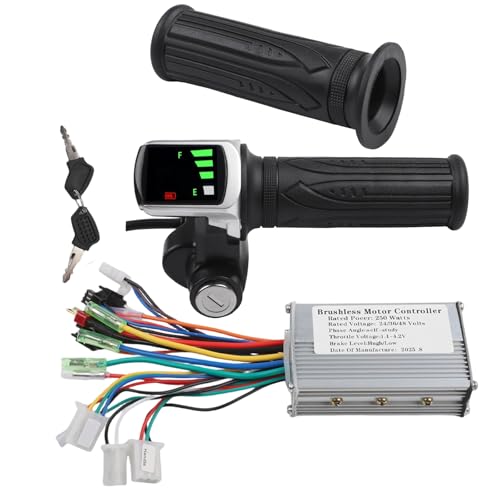
An LCD throttle handlebar is included with this brushless controller, unlike the standalone controller options. The kit supports 24V, 36V, and 48V lithium-battery systems, is rated at 15A, and is intended for 250W motors. Its controls include three speed settings, and the aluminum-alloy controller is designed for heat dissipation. This is the clearest fit for a 250W brushless build that also needs a throttle display. It is rated below the 17A alternatives, so do not choose it for a system that requires more than 15A or a motor above 250W.
Bottom line: Choose this for a 250W brushless system that needs the included LCD throttle.
How to match a lithium battery to a controller
Match the controller to the battery’s nominal voltage and charged voltage, not just the number printed on the pack. A typical 36V lithium-ion pack is 10 cells in series and reaches 42.0V when full; a typical 48V pack is 13 cells in series and reaches 54.6V. The controller must accept that full-charge voltage. Also compare the controller’s current limit with the battery’s continuous discharge rating: a 17A controller can demand more than a battery rated for 15A continuous output. Check the battery label or battery-maker specification for its discharge limit before connecting the system.
How motor type and wiring affect fit
Motor type determines which controller can work: brushless motors use three phase wires plus Hall sensor wires on many systems, while brushed motors use two motor power wires. Those designs are not interchangeable. For a brushless setup, confirm that the controller supports the motor’s sensor arrangement and that the throttle, brake cutoffs, and display connectors use compatible pinouts. Wire colors are not a dependable substitute for a wiring diagram because manufacturers can assign different functions to the same color. If the motor type or connector pinout cannot be confirmed, do not connect the battery until it is identified.
Choosing current and motor wattage
Use the motor’s rated wattage and the controller’s maximum current together, rather than selecting by voltage alone. At 48V, 17A corresponds to 816W of electrical input at the controller’s current ceiling; actual motor output is lower after losses, and controller current may be limited by its design. A 250W motor paired with a high-current controller can be overloaded even when both components share the same voltage. For these choices, keep the motor rating within the range and select a controller whose current limit does not exceed what the motor and battery can support. A higher amp rating is not automatically a better fit.
Safe installation checks before connecting power
Disconnect the battery before handling controller wiring; a lithium pack can deliver enough current to overheat a shorted wire. Check that the connector polarity, battery voltage, motor type, and wire functions match before reconnecting power. Secure exposed connectors against water and movement, and keep the controller’s heat-dissipating surface unobstructed. A controller that fits in the frame can still overheat if buried in insulation or mounted where airflow is blocked. If the wiring diagram or pinout is uncertain, have an e-bike technician identify the connections rather than testing unknown wires while the battery is attached.
Frequently Asked Questions
What voltage does a fully charged 36V lithium battery reach?
A typical 36V lithium-ion e-bike battery reaches 42.0V when fully charged. The controller must tolerate that pack voltage, not only its nominal 36V rating.
Can a 48V controller run a 36V lithium battery?
Only if the controller explicitly supports 36V operation. A typical 36V pack ranges up to 42.0V at full charge, so verify the controller’s accepted voltage range before connecting it.
How do I tell whether an e-bike motor is brushed or brushless?
A brushed motor commonly has two power leads, while a brushless motor uses three phase leads and may also have Hall sensor wiring. Confirm with the motor documentation or wiring diagram because wire colors alone are not conclusive.
What battery discharge rating does a 17A controller need?
The battery should support at least the controller’s maximum 17A continuous draw. Check the pack’s continuous discharge rating, since a lower-rated battery may be overloaded even if its voltage matches.