
Large Scale Radio Controlled Helicopters Compared by Fit

For a large scale radio controlled helicopter, wheelfun FLYWING 470L Airwolf is the closest fit because it is a 470-class scale-inspired model, while the other options use smaller 1:25 to 1:48 scale labels. Choose a smaller replica if compact display size or indoor-friendly hovering aids matter more than a large-scale appearance.
We earn a commission if you buy through links on this page. As an Amazon Associate I earn from qualifying purchases. Products are compared on manufacturer specifications, not hands-on testing.
- Best overall: wheelfun FLYWING 470L Airwolf – Its 470-class scale-inspired fuselage is the largest class identified among these options.
- Best for 1:25 scale: Hylukon BO105 1:25 – It pairs its 1:25 scale label with altitude hold and optical-flow positioning.
- Best for optical-flow positioning: NBJIALIN C170 1:48 – It combines optical flow, TOF ranging, and barometric altitude hold.
| Product | Best for | Scale or class | Flight aids | Rotor / channels | Shop |
|---|---|---|---|---|---|
| wheelfun FLYWING 470L Airwolf | Largest class | 470-class | ACE GPS/ATT, GNSS | 2-blade rotor | Check Price on Amazon |
| Carmanon Airwolf 1:27 | TV-inspired replica | 1:27 scale | Auto-hover, 6-axis gyro | 6-channel | Check Price on Amazon |
| Hylukon BO105 1:25 | Scale ratio | 1:25 scale | Altitude hold, optical flow | 6-channel | Check Price on Amazon |
| NBJIALIN C170 1:48 | Positioning aids | 1:48 scale | Altitude hold, optical flow, TOF | 6-channel | Check Price on Amazon |
Large Scale Radio Controlled Helicopters
Compare the model scale and flight-control features first, since the available options range from a 470-class helicopter to smaller scale replicas.
wheelfun FLYWING 470L Airwolf

The 470-class scale-inspired fuselage sets this model apart from the smaller ratio-scale helicopters here. Its black-and-white finish, panel textures, two-blade rotor, and retractable landing gear emphasize scale appearance; the gear can also be controlled manually from the transmitter. The ACE GPS/ATT system and multi-link GNSS provide outdoor hovering assistance, according to the maker. Choose this option when a larger class and detailed Airwolf styling matter most. Its scale focus and retractable gear add complexity compared with simpler hovering-oriented models, so it suits a buyer prepared to learn its transmitter controls.
Bottom line: Pick this if a 470-class scale appearance matters more than a compact replica.
Carmanon Airwolf 1:27
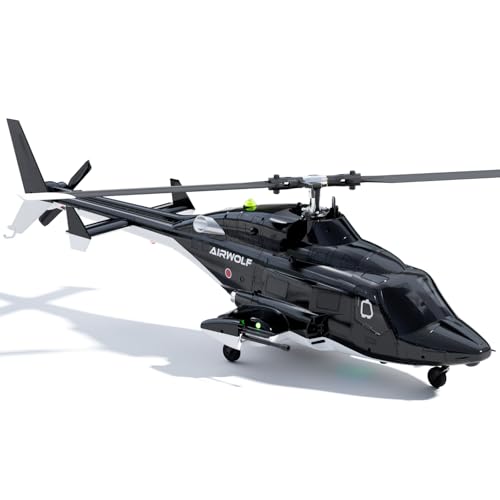
The 1:27 scale designation makes this Airwolf a smaller replica rather than a large-class helicopter. Its black-and-white paint scheme and cabin-door details put the emphasis on a TV-inspired miniature, while the 6-channel controller offers auto-hover and manual modes. The maker says its coaxial dual motors and 6-axis gyro support stable flight, including in winds up to 15 mph. Choose it for the compact replica look and selectable flight modes. Its smaller scale is the main limitation for buyers specifically seeking a large display or flying presence.
Bottom line: Pick this for a compact Airwolf replica with selectable flight modes.
Hylukon BO105 1:25

The 1:25 scale BO105 is the largest ratio-scale label among the smaller helicopters in this comparison, though it remains a replica rather than a 470-class model. It has a flybarless rotor design, 6-axis gyroscope, altitude hold, optical-flow positioning, and one-key takeoff and landing. The feature set also includes 3D inverted flight. Choose it if a specific BO105 shape and a broad range of flight actions matter more than the larger class of wheelfun FLYWING 470L Airwolf. The extra maneuvers make it a less direct match for someone who only wants a large scale display model.
Bottom line: Pick this if the BO105 form and 1:25 scale label are your priorities.
NBJIALIN C170 1:48

The 1:48 scale C170 is the smallest ratio-scale model in this group, but its positioning aids are unusually specific: barometric altitude hold, optical flow, and TOF ranging. The maker also identifies a 7.4V brushless motor, a 6-axis gyroscope, and three digital servos. Its main-rotor-only design distinguishes it from the coaxial dual-motor approach named for Carmanon Airwolf 1:27. Choose this model when hovering assistance is a higher priority than a large fuselage. The 1:48 scale makes it a weaker fit for buyers focused on large scale appearance.
Bottom line: Pick this for multiple positioning aids in a smaller scale helicopter.
How to choose a large scale radio controlled helicopter
Start with the scale label and class, not the number of flight modes. A ratio such as 1:25 means the model is one twenty-fifth the length of the real aircraft; a smaller denominator represents a larger replica when comparing the same full-size aircraft. A class label such as 470-class is a different convention and does not directly translate to a scale ratio. For a larger visual presence, favor the 470-class model here; choose a ratio-scale model when matching a particular aircraft’s proportions matters more. GPS, altitude hold, optical flow, and gyroscopes assist in different ways, so compare the named aids rather than assuming every stabilizer provides the same positioning.
Scale labels and physical fit
A scale ratio alone does not give a helicopter’s finished dimensions unless the real aircraft being modeled is known. Among these ratio-labeled choices, 1:25 is larger than 1:27, which is larger than 1:48; those comparisons apply to their respective full-size aircraft, not to exact model lengths. The 470-class designation should not be converted into a scale ratio without a rotor measurement. Before choosing, measure the shelf, case, or transport space against the model’s length and width; the figures use no unit, so confirm the measurement unit before relying on them. For a buyer whose main goal is a large silhouette, class and actual dimensions matter more than decorative detail.
Flight aids and rotor designs compared
Flight aids describe separate functions: a gyroscope senses rotation, altitude hold maintains height, and optical flow helps estimate movement relative to a visible surface. GNSS adds satellite positioning outdoors, while TOF uses distance measurement; these systems should not be treated as interchangeable. Coaxial dual motors place two rotors on a shared axis, while a main-rotor-only design uses one main rotor system. Use this comparison to match the control emphasis to the flying space and learning goal.
| Need | Relevant feature | Models |
|---|---|---|
| Outdoor hover assistance | GNSS with GPS/ATT | wheelfun FLYWING 470L Airwolf |
| Altitude and surface-position assistance | Altitude hold and optical flow | NBJIALIN C170 1:48, Hylukon BO105 1:25 |
| Selectable hover or manual mode | Auto-hover and manual modes | Carmanon Airwolf 1:27 |
Optical flow depends on usable visual texture and lighting, so it should not be expected to hold position equally over every surface.
Safe space for flying a scale helicopter
Fly an RC helicopter in a clear area, away from people, pets, overhead wires, and fragile objects; rotor blades can injure or damage even on a small model. Beginners should use a wide, open space rather than a room with furniture, because forward movement and turning need room beyond the helicopter’s length. Wind matters outdoors: a model with hovering assistance is not automatically windproof, and the 15 mph capability mentioned for Carmanon Airwolf 1:27 is the maker’s claim rather than a general safe-flight threshold. Keep spectators outside the rotor area and stop flying if control becomes uncertain. Check local rules for outdoor operation, especially near airports or other restricted airspace.
Frequently Asked Questions
What does 470-class mean for an RC helicopter?
A 470-class label identifies a hobby helicopter class, not a scale ratio such as 1:25.
Is a 1:25 helicopter larger than a 1:48 model?
For replicas of the same full-size aircraft, 1:25 is larger than 1:48 because the model is divided into fewer parts of the full-size length. Different aircraft can produce different actual model sizes even at the same ratio.
What does optical flow do on a helicopter?
Optical flow estimates motion against the surface below to help a model maintain position. It needs visible surface texture and adequate light, so plain, reflective, or dark surfaces can reduce its usefulness.
Can a GPS-assisted helicopter fly indoors?
GNSS positioning relies on signals from satellites and is generally intended for outdoor use with a clear view of the sky. Indoor hovering features such as optical flow and altitude hold work differently and have their own surface and space limits.
How much clear space should a beginner allow?
Use an open area with several model lengths of clearance on every side rather than trying to fly beside furniture or people. A 470-class model needs more room to recover from drift than a compact display-scale helicopter, and outdoor wind can increase that space requirement.