
Disc Ball for Dogs: 4 Transforming Toys Compared

For a disc ball for dogs that changes from a ball into a disc, Magic Bouncing Ball, Blue is the most direct match because its design switches shape with one press. Choose another option if you want lights or a two-toy set, and supervise play because these transforming toys are for interactive games, not unattended chewing.
We earn a commission if you buy through links on this page. As an Amazon Associate I earn from qualifying purchases. Products are compared on manufacturer specifications, not hands-on testing.
- Best overall: Magic Bouncing Ball, Blue – Its press-to-transform design changes between ball and disc shapes.
- Best for lights: BADWALT Magic Bouncing Ball, 2-Pack – The two-piece set has three LED lights and colorful illumination when pressed.
- Best for soft rubber: BADWALT Doggy Disc Ball, 2-Pack – The maker identifies soft rubber as its material.
- Best for six lights: Magic Meta Ball with 6 Lights, Blue – Its maker specifies six lights and TPR material.
| Product | Best for | Pack size | Lighting | Material | Shop |
|---|---|---|---|---|---|
| Magic Bouncing Ball, Blue | Simple shape changing | 1 toy | — | — | Check Price on Amazon |
| BADWALT Magic Bouncing Ball, 2-Pack | Light-up play | 2 toys | 3 LED lights | — | Check Price on Amazon |
| BADWALT Doggy Disc Ball, 2-Pack | Soft rubber feel | 2 toys | Lights mentioned; count unspecified | Soft rubber | Check Price on Amazon |
| Magic Meta Ball with 6 Lights, Blue | More light effects | 1 toy | 6 lights | TPR | Check Price on Amazon |
Disc Ball for Dogs
These shape-changing toys combine ball play with a disc form; compare the light features and material claims before choosing.
Magic Bouncing Ball, Blue

Magic Bouncing Ball, Blue focuses on a simple ball-to-disc change rather than a light feature or multi-toy pack. The maker says one press switches its shape, and describes the surface as soft; its compact, lightweight design is intended for indoor and outdoor play. That suits owners looking for one transforming toy for supervised fetch. The main limitation is that its fields do not give a measurable size, so it is harder to judge whether the toy suits a particular dog’s mouth; check the physical dimensions before choosing if fit is a concern.
Bottom line: Pick this if you want one transforming toy without a specified light feature.
BADWALT Magic Bouncing Ball, 2-Pack

BADWALT Magic Bouncing Ball, 2-Pack stands out for its two-piece set and three LED lights, which the maker says illuminate when the toy is pressed. Its ball form changes into a flying saucer and returns to a ball after a few seconds, making the transformation part of an interactive game. The maker explicitly cautions that this toy is not suitable for chewing, so it suits supervised play rather than a dog left alone with a toy.
Bottom line: Choose this for a two-toy set with lights, provided you can supervise play.
BADWALT Doggy Disc Ball, 2-Pack
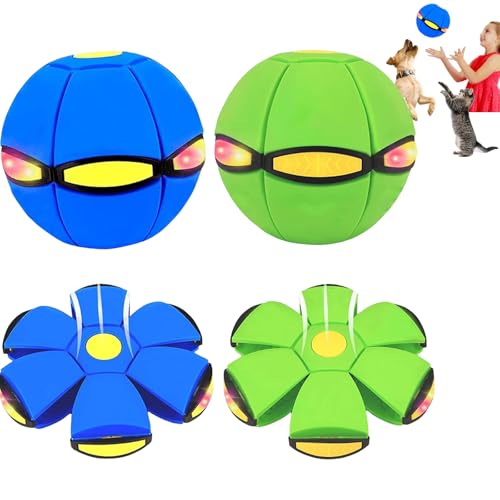
BADWALT Doggy Disc Ball, 2-Pack is the only option that names soft rubber as its material, a useful distinction for buyers comparing feel. The maker describes a pop-up disc form for catching and retrieving, and presents it as a toy for active games. This two-piece set suits owners who want the named rubber material and a pair of toys.
Bottom line: Pick this if soft rubber is your material preference and you will supervise play.
Magic Meta Ball with 6 Lights, Blue

Magic Meta Ball with 6 Lights, Blue distinguishes itself with six lights and TPR, or thermoplastic rubber, as its material. The maker says its lightweight ball transforms into a flying saucer and is intended for indoor and outdoor play across surfaces including grass, carpet, pavement and tile. That makes it a fit for buyers who want light effects and a named material in one toy. The physical dimensions are given, but the size may not suit every dog; assess the toy against your dog’s mouth and play style before use.
Bottom line: Choose this if six lights and TPR are the deciding features.
How to Choose a Disc Ball for Dogs
Choose by the kind of play and supervision you can provide: a transforming disc ball is for interactive tossing and retrieval, not a chew toy. A regular flying disc is generally easier to size around a dog’s mouth, while a pop-up ball adds a shape-change feature. Match the toy’s width to your dog so it can pick it up without struggling or swallowing it. For nighttime play, lights can improve visibility, but they do not replace keeping the dog within sight. Stop play if the toy cracks, separates, or develops a sharp edge; a damaged toy can injure the mouth or become a choking hazard.
Disc Ball Safety During Fetch
Use a disc ball only while you can watch the dog, especially when the toy has moving or folding parts. A dog should be able to carry the toy without forcing it into the back of its mouth; if it can swallow or become lodged, choose a larger toy. Toss low and level rather than high, since jumping and twisting can strain a dog’s legs and back. Avoid play on slick floors and uneven ground, where sudden stops or awkward landings raise injury risk. Inspect the toy before and after each session, and put it away if the surface tears or the shape no longer holds together.
Ball, Disc, and Light-Up Features Compared
Pick a feature based on how you plan to play: the ball shape supports rolling and bouncing, while the disc shape is meant for a toss-and-catch game. Lights are useful for visibility in dim settings, but they do not make a toy safe to use out of sight. A transforming toy combines formats, although the changeable design adds seams and moving sections that deserve inspection. The table compares the practical choice rather than assuming one style suits every dog.
| Need | Choose | Reason |
|---|---|---|
| Rolling or bouncing play | Ball form | It can be rolled or bounced for pursuit. |
| Short-range catch | Disc form | A disc form can be tossed for retrieval. |
| Dim-light visibility | Light-up option | Illumination can make the toy easier to see. |
Keeping a Transforming Dog Toy in Good Shape
Inspect a transforming toy before every play session; cracks, loose sections, and torn material are reasons to retire it. Dirt and saliva can collect around folds, so rinse the toy after outdoor play and let it dry fully before storage. Do not leave a dog alone with a toy that is intended for interactive play, particularly if the dog chews toys apart. Keep the toy out of reach between sessions if the dog tends to chew unsupervised. These steps help catch wear early, but they cannot make a damaged or poorly fitting toy safe.
Frequently Asked Questions
Can dogs chew on transforming disc balls?
These toys are best used for supervised interactive play, not routine chewing. One option specifically warns against chewing, and any toy with cracks or loose sections should be removed.
How do I know if a disc ball fits my dog?
Choose a toy your dog can comfortably pick up without being able to swallow or lodge it in the mouth. If the maker gives no useful measurements, check the toy’s physical size before play.
Are light-up dog disc balls safe at night?
Lights may make the toy easier to see in dim conditions, but they do not make nighttime play risk-free. Keep the dog in sight and use a clear, nonslip play area.
What should I check before throwing a dog disc ball?
Check for cracks, tears, loose parts, or sharp edges before every session. Stop use at the first sign of damage, since a broken piece may create a choking or mouth-injury hazard.
Is a flying disc or ball better for fetch?
A disc form suits a low, short toss and retrieval, while a ball form works for rolling or bouncing pursuit. Choose the form your dog can carry comfortably and avoid high jumps or slippery ground.