
Double Cutting Board Rack Options Compared by Fit

For a double-layer cutting board rack, choose Double-Layer Under-Cabinet Rack if you want under-cabinet storage and its 10-by-10-inch footprint fits your space. Choose a countertop stand instead if you want a freestanding organizer, or a dish-drying rack if you need broader dish storage rather than a dedicated board rack.
Cutting board racks keep boards upright or separated, helping them dry between uses; fit depends on board thickness, available space, and mounting style.
We earn a commission if you buy through links on this page. As an Amazon Associate I earn from qualifying purchases. Products are compared on manufacturer specifications, not hands-on testing.
- Best overall: Double-Layer Under-Cabinet Rack – The double-layer under-cabinet design stores boards and lids off the counter.
- Best for countertop versatility: SUNFICON 4-Slot Countertop Rack – Four 1.18-inch slots and a grooved top slot accommodate boards, lids, and utensils.
- Best for multiple boards: Fikoksol 5-Slot Cabinet Organizer – Five 1.2-inch slots separate boards and trays, within the thickness limit.
| Product | Best for | Storage style | Slot count | Dimensions | Shop |
|---|---|---|---|---|---|
| Double-Layer Under-Cabinet Rack | Under-cabinet storage | Under-cabinet | Double layer | 10 × 10 × 3 in. | Check Price on Amazon |
| SUNFICON 4-Slot Countertop Rack | Countertop versatility | Countertop stand | 4 slots | 4.92 × 5.7 × 8.47 in. | Check Price on Amazon |
| Fikoksol 5-Slot Cabinet Organizer | Boards and trays | Cabinet organizer | 5 slots | 7.87 × 7.24 × 3.28 in. | Check Price on Amazon |
| Teensery 2-Slot Stainless Steel Holder | Two board widths | Countertop wire stand | 2 slots | 5.12 × 3.94 × 3.94 in. | Check Price on Amazon |
| Expandable 2-Tier Dish Drying Rack | Dish drying capacity | Expandable dish rack | Multi-slot holder | 15–22.4 × 12.8 × 13.78 in. | Check Price on Amazon |
Double Cutting Board Racks Compared
Compare mounting style, slot capacity, and dimensions to find a rack that fits your boards and kitchen space.
Double-Layer Under-Cabinet Rack
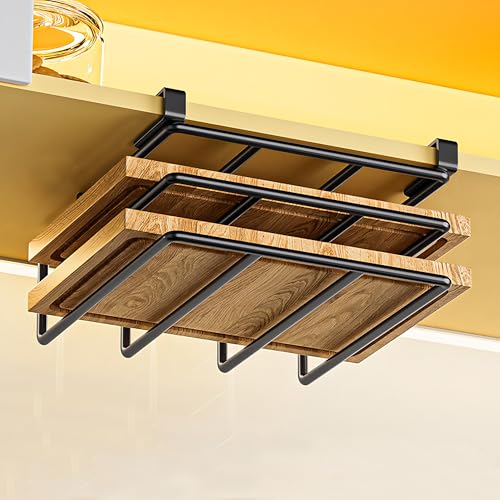
Unlike the freestanding countertop stands, this double-layer rack is designed to store cutting boards and lids under a cabinet or shelf. Its 10-by-10-inch footprint and 3-inch depth make it a space-saving option when counter space is limited, and the maker says installation involves sliding it onto a cabinet shelf. It also suits buyers who want a dedicated spot for baking sheets. The main limitation is fit: measure the available shelf space and verify shelf thickness and clearance before ordering, since the mounting dimensions can determine whether it works in your cabinet.
Bottom line: Pick this if you want under-cabinet storage and have verified the shelf fit.
SUNFICON 4-Slot Countertop Rack
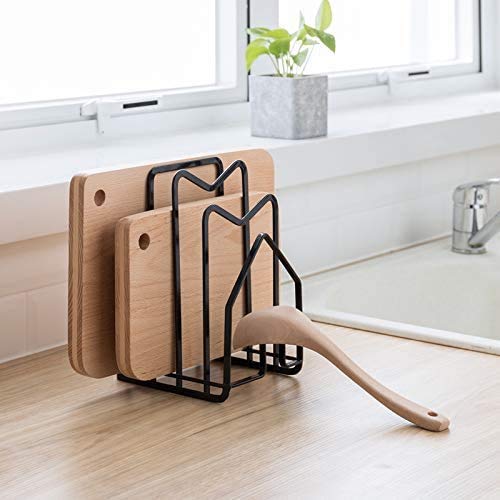
This countertop stand differs from the under-cabinet rack by offering four upright slots for a mix of kitchen items. Each slot is 1.18 inches wide, and a V-shaped groove on the top slot is intended to hold pot lids. The house-shaped black steel stand can also organize chopping boards, cooking spoons, and recipe books, so it suits a counter where several small items need a place. Its limitation is that the slots are not adjustable; check your thickest board or lid against the 1.18-inch opening before choosing it.
Bottom line: Choose this for a compact countertop stand with several uses.
Fikoksol 5-Slot Cabinet Organizer

Five individual slots make this organizer distinct from the two-slot wire holder and four-slot stand. The current model dimensions are 7.87 by 7.24 by 3.28 inches, with 1.2-inch-wide slots, and the product is made of coated iron wire. It is intended for cutting boards, baking sheets, and plates, making it a fit for someone separating several flat items in a cabinet. Its firm thickness limit is important: the manufacturer says it is unsuitable for utensils thicker than 1.2 inches, including pots and deep bakeware.
Bottom line: Pick this for several flat boards or trays no thicker than 1.2 inches.
Teensery 2-Slot Stainless Steel Holder
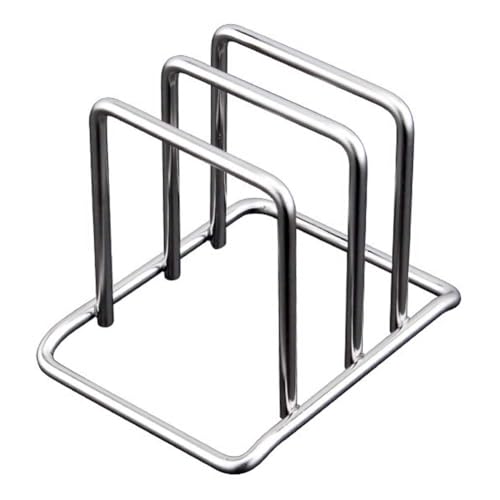
The two different-width openings set this compact wire holder apart: one slot is 0.79 inches wide and the other is 1.18 inches wide. Its stainless steel construction and small 5.12-by-3.94-by-3.94-inch size suit a buyer who needs a simple counter stand for two boards, trays, or flat pans rather than a multi-item organizer. It can also hold cookie sheets and baking sheets. The tradeoff is limited capacity; buyers organizing more than two pieces at once should consider a rack with additional slots.
Bottom line: Choose this when two differently sized slots are enough.
Expandable 2-Tier Dish Drying Rack

This is a full dish-drying rack rather than a dedicated cutting board stand, so it is the broadest option for plates, bowls, mugs, and cookware. Its width expands from 15 to 22.4 inches, and it has a rotatable plate holder, a drainboard, and a detachable three-compartment utensil caddy; cutting board storage is one part of the larger setup. Choose it if you need dish-drying capacity alongside board storage. The tradeoff is its larger footprint and height: at 13.78 inches tall, it needs more counter and overhead space than a small board holder.
Bottom line: Choose this if you need a larger dish rack that also accommodates a cutting board.
How to choose a double cutting board rack
Start with where the rack will sit: under-cabinet storage frees counter space, while a countertop stand is easier to move and access. Then measure the thickest board you plan to store and compare it with the slot width; a 1.2-inch slot cannot accept an item thicker than 1.2 inches. Count what you need to separate, since a two-slot holder and a five-slot organizer solve different storage problems. For a countertop rack, also measure the footprint and overhead clearance. For an under-shelf design, verify shelf thickness and clearance before ordering. Match the rack to the boards you actually own rather than assuming all cutting boards share a standard thickness.
Countertop and cabinet rack styles
Countertop stands place boards upright in individual slots, while under-cabinet organizers use otherwise-unused shelf space. A dish-drying rack is a third category: it combines board storage with room for plates and utensils, but takes more counter area. Use this comparison to narrow the style before checking dimensions.
| Need | Rack style | Check first |
|---|---|---|
| Keep one or two boards handy | Compact countertop stand | Slot width and footprint |
| Store several flat pieces | Multi-slot organizer | Item thickness and slot count |
| Free counter space | Under-cabinet rack | Shelf fit and clearance |
| Dry dishes and boards together | Expandable dish rack | Expanded width and height |
Fit boards and lids to the slots
Measure the widest thickness point, including handles or raised edges, because an item may not slide into a slot even if its main panel is thin enough. Leave a little room for easy removal rather than selecting a slot that exactly matches the measurement. Pot lids can have knobs that change their effective thickness, and baking sheets may have rolled rims. Store heavy pans only in a rack intended to support them, and avoid forcing any item into a narrow opening; bending a wire stand can make storage unstable. For a cabinet-mounted rack, check that stored boards do not interfere with a door or shelf above. Verify mounting compatibility before ordering any under-shelf organizer.
Keep cutting boards clean and dry
Wash cutting boards with hot, soapy water after food preparation, then dry them before returning them to storage; upright slots help air reach both sides. Boards used for raw meat, poultry, seafood, or eggs should be kept separate from ready-to-eat foods to limit cross-contamination. A rack does not sanitize a board, and wet boards stacked tightly can stay damp longer. Clean the rack regularly too, especially around wire joints or tray edges where crumbs and moisture can collect. Replace a board that develops deep grooves or cracks that are difficult to clean, and keep boards stable on the work surface while cutting.
Frequently Asked Questions
How wide should a cutting board rack slot be?
Choose a slot wider than the thickest board, lid, or tray you plan to store. A 1.2-inch opening will not fit an item thicker than 1.2 inches, and knobs or rolled edges can add thickness.
Can cutting boards be stored while wet?
Let boards drain and dry before putting them away. Upright storage exposes more surface to air, but trapped moisture between tightly packed boards can prolong drying.
How many cutting boards should one rack hold?
Match slot count to the number of pieces you want separated at once. A two-slot rack accommodates fewer items than a four- or five-slot organizer, but its total capacity also depends on item thickness.
How do I prevent cross-contamination with cutting boards?
Use separate boards for raw animal foods and ready-to-eat foods, and wash each board with hot, soapy water after use. A rack keeps boards apart for drying but does not replace cleaning.
Will a cutting board fit under my cabinet?
Measure shelf clearance and the rack’s full dimensions before choosing an under-cabinet model. Include board height and any lid handle, and verify the shelf thickness needed for the mounting style.