
Best Planner for Therapists: 3 Appointment Books Compared

2027 Appointment Book, 15-Minute Slots suits most therapists who schedule tightly packed days because its 15-minute slots run from 7 a.m. to 8 p.m. A paper planner is a book for recording appointments and related tasks; choose 2027 Appointment Book, 30-Minute Slots if half-hour slots better match your schedule, or Clever Fox Undated Appointment Book if you want an undated book.
Therapists who need a structured guide for treatment planning rather than a calendar should choose a different kind of resource.
We earn a commission if you buy through links on this page. As an Amazon Associate I earn from qualifying purchases. Products are compared on manufacturer specifications, not hands-on testing.
- Best overall: 2027 Appointment Book, 15-Minute Slots – Its dated weekly schedule provides 15-minute slots from 7 a.m. to 8 p.m.
- Best for half-hour sessions: 2027 Appointment Book, 30-Minute Slots – Its weekday schedule uses 30-minute slots from 7 a.m. to 8 p.m.
- Best for flexible starts: Clever Fox Undated Appointment Book – Its undated format can be started at any time and lasts 12 months.
| Product | Best for | Appointment intervals | Schedule hours | Date range | Shop |
|---|---|---|---|---|---|
| 2027 Appointment Book, 15-Minute Slots | Packed appointment days | 15 minutes | 7 a.m.–8 p.m. | Nov. 2026–Dec. 2027 | Check Price on Amazon |
| 2027 Appointment Book, 30-Minute Slots | Half-hour sessions | 30 minutes | Weekdays 7 a.m.–8 p.m.; Sat. 7 a.m.–5 p.m. | Jan.–Dec. 2027 | Check Price on Amazon |
| Clever Fox Undated Appointment Book | Flexible start dates | 15 minutes | 7 a.m.–9 p.m. | Undated; 12 months | Check Price on Amazon |
Appointment Planners for Therapists
Compare each book’s time slots and calendar format with the rhythm of your clinical work.
2027 Appointment Book, 15-Minute Slots
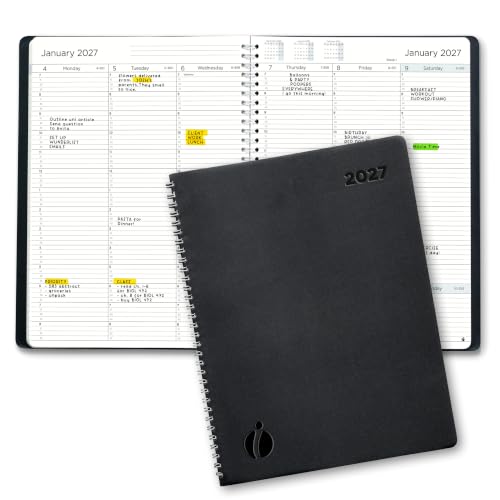
For closely spaced sessions, this dated appointment book has 15-minute slots and weekly schedules laid out across two pages. The maker says it covers November 2026 through December 2027 and includes weekly and monthly views, a notes column, and thick paper designed to resist ink bleed-through. It suits therapists who want a paper calendar with room to note between-session tasks alongside appointments. Its fixed date range is the tradeoff: therapists who need a book beginning at another time should consider an undated format instead.
Bottom line: Choose this if you want a dated calendar with 15-minute appointment slots.
2027 Appointment Book, 30-Minute Slots

Compared with a 15-minute layout, this 2027 planner divides weekday appointments into 30-minute blocks, with Saturday hours running from 7 a.m. to 5 p.m. The maker says it covers January through December 2027 and includes weekly and monthly views, a contacts section, important dates, notes, and an annual plan. That format fits a practice whose appointments and work blocks are usually planned in half-hour increments. The larger 8.5-by-11-inch size takes more desk or bag space than a compact notebook, so it is less suited to therapists who prioritize portability.
Bottom line: Choose this for a large-format, dated calendar organized in half-hour blocks.
Clever Fox Undated Appointment Book

Unlike the dated books, this undated appointment planner lets a therapist begin whenever needed and use it for 12 months. The maker says its 8.3-by-11-inch pages have 15-minute slots from 7 a.m. to 9 p.m., plus monthly calendars, weekly pages, goals, a to-do list, and contacts. The wider daily span may help therapists whose workday extends past the 8 p.m. cutoff in the dated options. Its undated format requires the user to enter dates rather than opening to a preprinted calendar, which may be inconvenient for someone who wants dates already filled in.
Bottom line: Choose this if you need a 15-minute schedule and flexible start date.
How to Choose an Appointment Planner for Therapy
Choose the time grid that matches your typical appointment length, then check whether the book covers your intended planning period. Therapy sessions commonly run about 45 to 60 minutes, but intake visits, groups, consultations, and administrative blocks may need different amounts of time. A 15-minute grid can make starts and buffers easier to distinguish; a 30-minute grid uses fewer divisions for a day built around half-hour blocks. If most sessions are 50 minutes, reserve the remaining 10 minutes deliberately for notes or a transition rather than letting the next appointment begin immediately. Also compare daily span and weekend coverage against your actual office hours.
A paper calendar can be useful for time blocking, but it is not automatically a secure clinical record. Avoid writing client names or other identifying health information in a planner that could be misplaced or seen by others; use initials only if your privacy procedures allow it.
Appointment Intervals and Session Buffers
A 15-minute grid offers finer scheduling than a 30-minute grid, but it does not guarantee that appointments will run on time. Many individual therapy sessions are scheduled for 45 or 50 minutes, with the remaining time used for documentation, a break, or resetting the room. If your sessions routinely last 50 minutes, a 15-minute grid can help show the appointment start and finish, while a 30-minute grid may require writing across or between blocks. Match the planner to your practice’s standard session length and leave a visible buffer when possible. With fewer than 10 minutes between clients, consider whether you can complete notes and transition safely without running late.
The usable schedule span matters as much as the interval: compare the first and last printed times with your workday before choosing.
Privacy and Safe Paper Scheduling
Keep client-identifying information out of a general appointment book unless your privacy and security procedures explicitly permit it. The HIPAA Privacy Rule protects individually identifiable health information, and covered entities must use appropriate safeguards; a paper planner should not become an unsecured substitute for an authorized record system. A practical approach is to block time without names, diagnoses, or session notes, then record clinical content in the designated secure record. Store the planner where visitors and other clients cannot read it, and avoid leaving it visible in shared spaces or a vehicle. A lockable drawer can add a physical safeguard, but it does not replace the privacy procedures your practice must follow.
The table summarizes which schedule format fits common planning needs.
| Planning need | Useful format | Decision rule |
|---|---|---|
| Closely spaced sessions | 15-minute grid | Choose it when you need to distinguish appointment starts within a quarter-hour. |
| Half-hour blocks | 30-minute grid | Choose it when most appointments and work tasks fit half-hour increments. |
| Uncertain start date | Undated planner | Choose it when a pre-dated calendar would waste unused months. |
| Planning ahead across a fixed year | Dated planner | Check that its printed date range matches your intended period. |
Frequently Asked Questions
How long should I schedule a therapy session?
Individual therapy appointments commonly run about 45 to 60 minutes, though intake, group, and other visits may differ. Set the calendar block to the actual appointment length and reserve any transition time separately.
Should I write client names in a paper planner?
Avoid putting identifiable health information in a general planner unless your practice’s privacy and security procedures explicitly allow it. Use the authorized clinical record for session content, and keep the planner secured from public view.
Is a 15-minute planner useful for 50-minute sessions?
A 15-minute grid can help show a 50-minute appointment’s start and finish more precisely than a 30-minute grid. Leave a separate buffer for notes or transitions rather than assuming the next quarter-hour block is free.
How much time should I leave between therapy clients?
There is no single buffer that suits every practice, but 5 to 15 minutes is a common planning range for documentation and transition. If notes routinely take longer than 15 minutes, schedule a larger block or protect documentation time elsewhere.
Can I use a paper planner as a clinical record?
A general appointment planner is best used for time blocking, not as a substitute for an authorized clinical record. HIPAA-covered practices must use appropriate safeguards for individually identifiable health information, including information on paper.