
Down Pants for Men: 5 Insulated Styles Compared

For down pants for men, Naturehike DW 800FP Down Pants stands out for its 800 fill-power down, while Tumjay 90% White Duck Down Pants offers 90% white duck down and a packable design. Choose another style if you need side zippers for easy on-and-off or more pocket options.
Down pants are insulated trousers worn as a warm layer; layering over a base layer can help keep the insulation clean and comfortable.
We earn a commission if you buy through links on this page. As an Amazon Associate I earn from qualifying purchases. Products are compared on manufacturer specifications, not hands-on testing.
- Best overall: Naturehike DW 800FP Down Pants – Its 800 fill-power down is the clearest insulation specification.
- Best for packing: Tumjay 90% White Duck Down Pants – The maker says the pants compress to about the size of a can.
- Best for quick changes: Naturehike Side-Zipper Down Pants – Dual side zippers run from the waist to the leg.
| Product | Best for | Down fill | Shell fabric | Closure or access | Shop |
|---|---|---|---|---|---|
| Naturehike DW 800FP Down Pants | Hiking layers | 90% down; 800 fill power | 20D 400T nylon | — | Check Price on Amazon |
| Tapasimme Utility Down Pants | Pocket storage | Down; percentage — | Waterproof nylon | Elastic waist; ankle closure | Check Price on Amazon |
| Gihuo 75% Down Pants | Navy color | 75% down | — | Elastic waist; elastic legs | Check Price on Amazon |
| Tumjay 90% White Duck Down Pants | Compact packing | 90% white duck down | Waterproof nylon | Elastic waist; stretch cuffs | Check Price on Amazon |
| Naturehike Side-Zipper Down Pants | Easy changing | 90% duck down | Waterproof nylon | Full-length side zippers | Check Price on Amazon |
Down Pants for Men Compared
Compare insulation specifications and design features to choose a pair that suits how you plan to layer and move.
Naturehike DW 800FP Down Pants
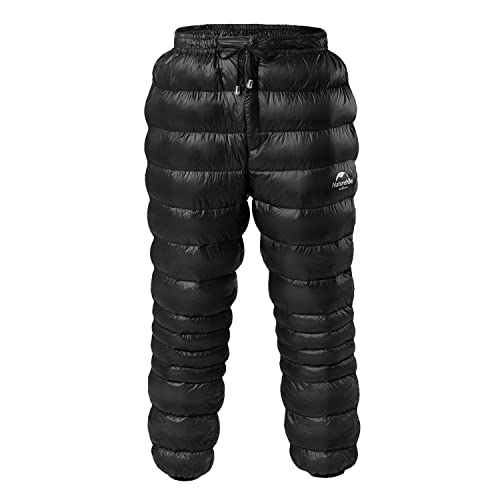
Naturehike DW 800FP Down Pants is the only pair here with a fill-power rating: 800. The maker says the shell and liner use 20D 400T nylon and describes the fabric as water-resistant; the fill is 90% down. The size is medium in black. This combination suits a buyer comparing insulation quality and shell weight for winter layering. Fill power measures loft per ounce, not a guaranteed warmth rating, so it does not establish how warm the pants will feel by itself. Choose another option if side zippers or a pocket layout matter more.
Bottom line: Pick these if you want a pair with a 800 fill-power rating.
Tapasimme Utility Down Pants

Tapasimme Utility Down Pants differentiates itself with a three-pocket layout and double-thickened knee panels. The maker describes a waterproof nylon outer fabric, a soft nylon lining, an adjustable elastic waist and elastic closures at the leg bottoms. The size is large in black. Those features may suit someone who wants storage and extra knee coverage in a loose winter trouser. No down percentage is given, so this pair is harder to compare directly with options that quantify the fill; prioritize it for its construction features rather than a measurable insulation specification.
Bottom line: Choose these if knee panels and three pockets matter most.
Gihuo 75% Down Pants

Gihuo 75% Down Pants is the only pair with a 75% down content and a navy color option. The maker describes an adjustable elastic waist, elastic leg openings and three hidden pockets, along with a lightweight design. The size is X-Large. This is a useful fit for someone who prefers navy and wants pockets without prominent external storage.
Bottom line: Pick these for navy styling and a quantified down percentage.
Tumjay 90% White Duck Down Pants

Tumjay 90% White Duck Down Pants combines 90% white duck down with an expressly packable design: the maker says it compresses to about the size of a can. It has a waterproof nylon outer, breathable lining, adjustable elastic waist, stretchy ankle cuffs and three pockets, including a rear patch pocket. The size is medium in black. These features suit a buyer who wants to stow insulated trousers in a pack.
Bottom line: Choose these when compressibility is a priority.
Naturehike Side-Zipper Down Pants

Naturehike Side-Zipper Down Pants stands apart with dual side zippers extending from waist to leg, which provide a different kind of access than a standard pull-on design. The maker describes a waterproof nylon fabric and 90% duck-down fill; it also mentions a hook-and-loop waist adjustment. The size is large in black. Side zippers may suit someone changing layers over boots or other clothing. The temperature range printed in the product text is malformed, so it cannot serve as a useful cold-weather rating; compare this pair by its materials and zipper layout instead.
Bottom line: Pick these if full-length side access is useful.
How to choose men’s down pants
Start with the insulation measurement, then match the construction to how you will wear the pants. Fill power measures the volume, in cubic inches, occupied by one ounce of down; it describes loft efficiency rather than a direct temperature rating. Down percentage describes the share of the filling that is down, but it does not replace fill power or tell you the total amount of insulation in the garment. If a precise warmth comparison matters, prefer a pair with fill power and total fill weight given. For occasional layering, prioritize access and waistband adjustment; for carrying them in a pack, look for a compression feature. Down can lose loft when wet, so use a shell layer in persistent rain or wet snow.
Fit down pants over a base layer
Choose a fit that leaves room for your base layer without pulling at the waist, seat or knees. A snug fit can compress down and reduce the space that traps warm air, while excessive looseness can let cold air circulate. Measure your waist and inseam while wearing the layer you expect underneath, then compare those measurements with the garment’s size chart before choosing a size. Adjustable waistbands help accommodate layering, but they cannot compensate for legs that are too short or too long. With side zippers, consider whether the opening is wide enough to clear footwear and other layers. No product here provides a complete sizing chart, so confirm the garment measurements before ordering.
Down insulation and synthetic layers
Down offers high loft for its weight and compresses readily, but moisture can flatten its insulating clusters; synthetic insulation generally retains more warmth when damp and often dries faster. For a dry cold trip where pack size matters, down can be a practical choice. For wet snow or repeated exposure to rain, add a waterproof shell rather than relying on a water-resistant or waterproof claim about the pants alone. A shell’s fit matters: it should cover the insulated layer without squeezing it. The table compares only traits supplied for these choices, not a warmth ranking.
| Need | Useful feature | Choice among these pairs |
|---|---|---|
| Compare loft efficiency | Stated fill power | Naturehike DW 800FP Down Pants |
| Pack compactly | Compression claim | Tumjay 90% White Duck Down Pants |
| Change layers easily | Full-length side access | Naturehike Side-Zipper Down Pants |
| Extra knee panels | Reinforced construction | Tapasimme Utility Down Pants |
Care for down pants after use
Keep down insulation dry when possible and let damp pants dry fully before storing them; long-term compression can reduce loft. For washing, use a down-specific detergent and follow the garment’s care label, since shell coatings and construction can change the safe method. Avoid fabric softener, which can leave residue on insulating materials. Tumble drying on low heat with clean dryer balls is a common way to restore loft, but check the care label first and pause periodically to break up clumps. Store down garments loosely rather than compressed in a stuff sack between trips. Clean promptly after sweat or dirt buildup, because residue can impair loft over time.
Frequently Asked Questions
Does 800 fill power mean warmer down pants?
800 fill power indicates greater loft per ounce than a lower fill-power figure, not a specific temperature rating. Total down weight, fit, wind exposure and layers also affect warmth.
Can down pants be worn in wet snow?
Down can lose loft when wet, so a waterproof shell layer is prudent in wet snow or rain. A water-resistant fabric claim is not the same as a fully waterproof outfit.
Should down pants fit tightly over layers?
No; leave room for a base layer without compressing the insulation. Measure waist and inseam over the layers you plan to wear and check the garment’s size chart.
How should down pants be stored between trips?
Store them clean, fully dry and loosely rather than compressed for long periods. Extended compression can reduce the loft that helps trap warm air.
What does down percentage tell me about pants?
Down percentage gives the share of the filling that is down, but not its total weight or fill power. Those additional measurements are needed for a fuller insulation comparison.