
Drill Attachments to Mix Paint: 5 Mixers Compared

For mixing paint in a 5-gallon bucket, choose Edward Tools 5-Gallon No-Splash Mixer because its maker describes a no-splash paddle designed to reach the bucket edges and bottom. Choose Edward Tools 1-Gallon Helix Mixer for 1-gallon batches, or Edward Tools Paint and Mud Mixer if you also need a mixer sized for paint and mud in 1- to 3-gallon containers.
We earn a commission if you buy through links on this page. As an Amazon Associate I earn from qualifying purchases. Products are compared on manufacturer specifications, not hands-on testing.
- Best overall: Edward Tools 5-Gallon No-Splash Mixer – The no-splash design and edge-to-edge mixing suit larger buckets.
- Best for 1-gallon batches: Edward Tools 1-Gallon Helix Mixer – Its helix design is made for 1 gallon of paint, epoxy or resin.
- Best for 1- to 5-gallon batches: Youtex 4-Blade Helix Mixer – The 2.76-inch, four-blade head is intended for buckets from 1 to 5 gallons.
- Best for paint and mud: Edward Tools Paint and Mud Mixer – Its zinc-plated steel paddle is made for 1 to 3 gallons of paint or mud.
| Product | Best for | Recommended capacity | Head design | Shaft material | Shop |
|---|---|---|---|---|---|
| Edward Tools 5-Gallon No-Splash Mixer | Large paint buckets | 5-gallon bucket | Ribbon paddle | Steel | Check Price on Amazon |
| Edward Tools 1-Gallon Helix Mixer | Small paint cans | 1 gallon | Helix paddle | Metal and plastic | Check Price on Amazon |
| Youtex 4-Blade Helix Mixer | Versatile bucket sizes | 1–5 gallons | 4-blade helix | Zinc-plated steel | Check Price on Amazon |
| Edward Tools Paint and Mud Mixer | Paint and mud | 1–3 gallons | 2.5 × 2.5 inches | Zinc-plated steel | Check Price on Amazon |
| Viganoc Paint and Mud Mixer | Mixed DIY materials | 1–5 gallons | Screw-style bar | — | Check Price on Amazon |
Drill Attachments to Mix Paint
Match the paddle to your bucket size and the materials you plan to stir.
Edward Tools 5-Gallon No-Splash Mixer

For larger buckets, this mixer stands out for its ribbon-style head, which the maker says mixes to the edges and bottom while limiting splashes. Its 5/16-inch hex shaft is made for standard 3/8-inch drills, and the maker says the attachment can mix paint, resin and epoxy. That combination suits someone who wants to stir a full bucket without a narrow paddle path. The head is plastic, so buyers looking for an all-metal mixer should choose another option; confirm that the shaft fits your drill before mixing.
Bottom line: Choose it for a 5-gallon bucket and a splash-conscious paddle design.
Edward Tools 1-Gallon Helix Mixer
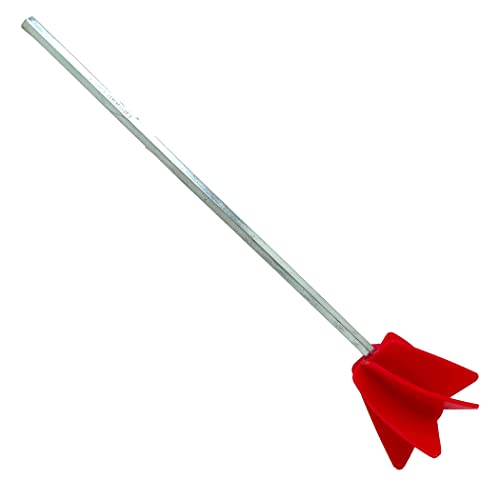
This helix mixer is the small-batch option in the group: its maker recommends it for 1 gallon of paint, epoxy, resin or silicone. The Even Flow design is intended to produce consistent circulation, and its metal-and-plastic surfaces are described as easy to clean for reuse. It fits 3/8-inch and larger hand drills. That makes it a practical match for users who regularly mix smaller quantities or viscous craft materials. Its capacity is narrower than the 1- to 5-gallon options, so it is not the pick for larger buckets.
Bottom line: Pick it for repeat small-batch mixing and a helix-style head.
Youtex 4-Blade Helix Mixer

The four-blade helix and 2.76-inch head distinguish this mixer from the single-ribbon and smaller-batch options. The maker positions it for 1- to 5-gallon buckets and materials including paint, resin, epoxy, concrete and slurry. Its 16.54-inch length and zinc-plated, rust-resistant steel construction suit users who want one paddle for a range of jobs. It is compatible with standard drills and impact drivers, according to the maker. The broader material range may be unnecessary for someone who only mixes small cans of paint.
Bottom line: Choose it when one head needs to cover a range of bucket sizes.
Edward Tools Paint and Mud Mixer

This mixer is specified for both paint and mud in 1- to 3-gallon containers, making it the focused choice for those materials. Its 15 3/4-inch shaft has a 5/16-inch hex head, a reinforced weld and a 2.5-by-2.5-inch paddle; the zinc-plated steel is intended to resist rust and ease cleanup. The hex design is also meant to reduce slipping in a drill chuck. Its capacity tops out below the larger-bucket models, so choose another attachment for batches above 3 gallons.
Bottom line: Pick it for paint or mud in containers up to 3 gallons.
Viganoc Paint and Mud Mixer

This mixer emphasizes broad DIY use: its maker recommends it for 1- to 5-gallon drums and materials such as paint, adhesive, cement, mortar and slurry. The screw-style mixing bar has a hex handle for standard drills, and a plastic cap at the shaft top provides a hanging point for storage. That range suits workshops where the same attachment may be used on several medium-size projects. The specifications do not establish its shaft material, so buyers who need a particular metal or coating should confirm that before choosing it.
Bottom line: Choose it for varied DIY mixing and storage by its capped shaft.
How to Choose a Drill Mixer for Paint
Choose a drill mixer by matching its capacity to the bucket and its head to the paint job. The options span 1 gallon, 1 to 3 gallons, and 1 to 5 gallons; do not assume a paddle rated for a smaller batch will circulate a full bucket evenly. A narrow helix suits small quantities, while broader or multi-blade heads are aimed at larger containers. Check the drill chuck size too: some options specify a 5/16-inch hex shaft for standard 3/8-inch drills, while another specifies compatibility with 3/8-inch and larger drills. If a bucket holds more than 3 gallons, select an attachment explicitly intended for up to 5 gallons.
How to Mix Paint Without Making a Mess
Start the drill at its lowest speed with the paddle fully submerged, then increase speed gradually until the paint circulates. A fast start can throw paint out of the bucket and whip air into the mixture; keep the head below the surface and avoid lifting it while spinning. Move the paddle slowly around the bucket so paint at the sides and bottom joins the flow, then stop the drill before raising the attachment. A 5-gallon bucket needs more coverage than a small can, so use a head sized for that capacity rather than relying on extra drill speed. Keep sleeves, hair and loose items clear of the rotating shaft.
Paint Mixer Paddle Types and Materials
Helix and ribbon paddles move paint through different head shapes, while a four-blade helix adds multiple mixing surfaces. The product options include plastic, metal-and-plastic and zinc-plated steel constructions; match the material to cleanup habits and intended substances. For water-based paint, clean the paddle promptly in water; for other coatings, use the solvent specified by the coating maker. A coating left to dry can be harder to remove, especially around welds and joints. If you plan to mix mud, epoxy or cementitious material as well as paint, choose a product whose uses include that material rather than assuming every paint mixer is interchangeable.
Drill and Bucket Fit Checks
Confirm the shaft, drill and bucket fit before starting: listed shafts include 5/16-inch hex, and several products specify standard 3/8-inch drills. A loose or incompatible chuck can let the shaft slip under load, so secure the chuck and keep the drill handle under control. Leave enough room to insert the paddle without scraping the bucket rim, and use a larger capacity rating when working near the full volume of a container. For example, a 1- to 3-gallon mixer is not the match for a 5-gallon batch. Disconnect a corded drill or remove a cordless battery before cleaning around the shaft or head.
Frequently Asked Questions
What drill size fits a paint mixer attachment?
Check the shaft specification against the drill chuck before use. Several options here specify a 5/16-inch hex shaft for standard 3/8-inch drills, while one specifies drills of 3/8 inch and larger.
How long should I mix paint with a drill?
Mix until the paint has a uniform appearance and no settled material remains at the bottom; the needed time depends on the paint and how long it has sat. Start slowly with the paddle submerged, and stop before raising it to avoid splashing.
Can a paint mixer stir epoxy or resin?
Some drill mixer attachments are intended for epoxy and resin, but compatibility depends on the specific paddle and material. Use a slow start and keep the head submerged so the mixing action does not pull excess air into the material.
Can I use a paint mixer for drywall mud?
Use a mixer whose maker specifies mud, such as an option intended for 1 to 3 gallons of paint or mud. Match the capacity to the amount being mixed, since a smaller-batch paddle is not a substitute for a larger-capacity head.
How do I clean a drill paint mixer?
Clean the paddle promptly after mixing, using water for water-based paint or the coating maker’s recommended cleaner for other materials. Disconnect power or remove the battery before cleaning around the shaft, and do not touch the head while it is rotating.