
Hangkai Outboard Motor Problems and Models Compared

Hangkai 6.5 HP 4-Stroke is the Hangkai option for buyers seeking a 6.5-horsepower, four-stroke motor with water cooling; the other Hangkai choices here differ in power or cooling. These specifications do not establish whether Hangkai motors have recurring problems, so choose by your boat’s rated capacity, transom height and required shaft length.
Confirm that the motor’s shaft fits your transom and that its horsepower stays within the boat builder’s rating before purchase.
We earn a commission if you buy through links on this page. As an Amazon Associate I earn from qualifying purchases. Products are compared on manufacturer specifications, not hands-on testing.
- Best overall: Hangkai 6.5 HP 4-Stroke – A 6.5-horsepower four-stroke with water cooling is the middle-power option in this group.
- Best for 12-hp power: Hangkai 12 HP 2-Stroke, 169CC – A 12-horsepower two-stroke with forward, neutral and reverse gears.
- Best for air cooling: Hangkai 6 HP 4-Stroke Air-Cooled – A 6-horsepower four-stroke with an air-cooled system.
| Product | Best for | Power | Engine type | Cooling | Shop |
|---|---|---|---|---|---|
| Hangkai 6.5 HP 4-Stroke | Moderate power | 6.5 hp | 4-stroke | Water-cooled | Check Price on Amazon |
| Hangkai 12 HP 2-Stroke, 169CC | Gear selection | 12 hp | 2-stroke | Water-cooled | Check Price on Amazon |
| Hangkai 12 HP 2-Stroke Short Shaft | Short-transom fit | 12 hp | 2-stroke | Water-cooled | Check Price on Amazon |
| Hangkai 6 HP 4-Stroke Air-Cooled | Air-cooled setup | 6 hp | 4-stroke | Air-cooled | Check Price on Amazon |
Hangkai Outboard Motors
Compare the Hangkai motors by power, engine stroke and cooling type, then check boat and transom fit.
Hangkai 6.5 HP 4-Stroke

At 6.5 horsepower, this four-stroke sits between the 6-horsepower and 12-horsepower options here. Hangkai says it has water cooling, a 12-liter fuel tank and fuel consumption of about 2 liters per hour; actual run time depends on operating conditions. The short-shaft configuration suits a boat whose transom calls for that shaft length, not every small boat. Its power may be insufficient if a boat’s rated needs exceed 6.5 horsepower, so check the builder’s horsepower range and transom measurement before choosing.
Bottom line: Choose this if your boat calls for a short shaft and up to 6.5 horsepower.
Hangkai 12 HP 2-Stroke, 169CC

Unlike the lower-power Hangkai choices, this 12-horsepower, two-stroke model has three gear positions: forward, neutral and reverse. Hangkai describes its engine as water-cooled and gives a 4,500–5,500-rpm range. The dimensions include a 40.16-inch height, but that overall measurement is not a substitute for confirming shaft length against a boat transom. This is the higher-power choice in the group; it is unsuitable for a boat rated below 12 horsepower, so verify the hull rating before selecting it.
Bottom line: Choose this when the boat is rated for 12 horsepower and you want three gear positions.
Hangkai 12 HP 2-Stroke Short Shaft
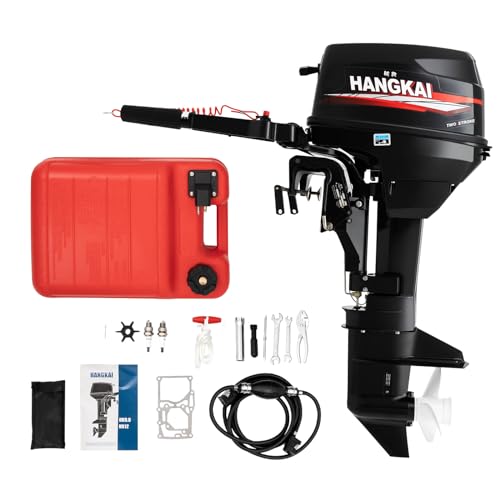
This 12-horsepower Hangkai is explicitly identified as a short-shaft model, making transom fit its key distinction from the other 12-horsepower choice. It is a two-stroke with water cooling and a three-blade propeller; Hangkai gives a speed range of 8–30 kilometers per hour, which can change with boat, load and conditions. The short shaft is not a universal fit: a transom designed for a longer shaft can place the propeller poorly in the water. Measure the transom and check the boat’s maximum horsepower.
Bottom line: Choose this if your transom requires a short shaft and supports 12 horsepower.
Hangkai 6 HP 4-Stroke Air-Cooled

This is the only air-cooled motor among these Hangkai choices, and its 6-horsepower output is the lowest. The four-stroke design and air cooling distinguish it from the water-cooled options. Hangkai describes a three-blade plastic propeller, 360-degree steering and manual lift/tilt. The maker does not establish shaft fit for a particular boat, so check the motor’s shaft dimension and the boat’s transom requirements before buying. A 6-horsepower motor is not appropriate if the hull requires more power or exceeds its rated limit.
Bottom line: Choose this if you need a 6-horsepower motor and specifically want air cooling.
How to Choose a Hangkai Outboard Motor
Start with the boat’s capacity plate: the motor must not exceed the maximum horsepower, and too little power may not move a heavily loaded boat effectively. These choices span 6 to 12 horsepower, with both two- and four-stroke engines. A two-stroke completes its power cycle in two piston strokes; a four-stroke uses four, with different fuel and maintenance requirements. Match the motor to the boat’s intended load and use, not horsepower alone. For example, a 12-horsepower option is not suitable for a hull rated below 12 horsepower. Also compare shaft length with transom height; a poor match can put the propeller too high or too low. Confirm these two fit points before choosing among models.
Short-Shaft Fit and Transom Height
Measure from the top of the transom where the motor clamps to the bottom of the hull, then compare that measurement with the motor maker’s shaft-length guidance. A common rule of thumb is about 15 inches for a short shaft and 20 inches for a long shaft, but boat designs vary, so use the boat and motor specifications rather than the label alone. The 12-horsepower Hangkai 12 HP 2-Stroke Short Shaft is identified as short-shaft; Hangkai 6.5 HP 4-Stroke and Hangkai 12 HP 2-Stroke, 169CC are also described as short-shaft in their names or specifications. Do not infer shaft length from overall motor height. A mismatched shaft can compromise propeller immersion and handling, so verify the fit before operating.
Two-Stroke, Four-Stroke and Cooling Types
Two-stroke and four-stroke describe engine cycles, while air- and water-cooled describe how engine heat is managed; these are separate characteristics. Among these options, the 12-horsepower motors are two-stroke and water-cooled, while the lower-power models are four-stroke, with Hangkai 6.5 HP 4-Stroke water-cooled and Hangkai 6 HP 4-Stroke Air-Cooled air-cooled. Water-cooled outboards use a water pump and cooling passages, so blocked water intakes or a weak telltale stream require attention. Air-cooled designs do not rely on that water-pump circuit, but still need clear airflow and unobstructed cooling surfaces. Don’t treat cooling type as proof of reliability or suitability; match it to the conditions and the maintenance you can perform.
| Need | Option to compare | Distinguishing specification |
|---|---|---|
| Lower horsepower, water cooling | Hangkai 6.5 HP 4-Stroke | 6.5 hp, four-stroke |
| Lower horsepower, air cooling | Hangkai 6 HP 4-Stroke Air-Cooled | 6 hp, four-stroke |
| 12 hp with three gear positions | Hangkai 12 HP 2-Stroke, 169CC | Two-stroke; forward, neutral, reverse |
| 12 hp explicitly labeled short shaft | Hangkai 12 HP 2-Stroke Short Shaft | Two-stroke; short shaft |
Common Outboard Checks Before Launch
A product specification cannot show how an individual motor will perform or whether a particular problem is recurring. Before each outing, check that the motor is securely clamped, the propeller is clear of damage or line, and the cooling-water intake is unobstructed; a water-cooled motor should show its telltale stream once running. Outboards produce carbon monoxide, so never run one in an enclosed space or where exhaust can collect near people. Use the engine’s emergency stop lanyard where equipped, and keep fuel away from ignition sources. For a used or newly acquired motor, inspect for fuel leaks, damaged wiring and corrosion, then confirm the maker’s maintenance schedule and required fuel/oil mix for that exact engine.
Frequently Asked Questions
What shaft length does my small boat need?
Many small boats use a roughly 15-inch short shaft or a 20-inch long shaft, but transom design can change the fit. Measure the transom and compare it with the boat and motor specifications before choosing.
Can a 12-horsepower outboard go on any boat?
No; the boat’s maximum horsepower rating is the upper limit, and the motor must also suit its load and transom. Never fit a 12-horsepower engine to a hull rated below 12 horsepower.
How often should an outboard water pump be checked?
Inspect the cooling-water intake before every outing and confirm a strong telltale stream after starting a water-cooled engine. Many makers recommend impeller replacement about every 2 to 3 years, sooner if cooling flow weakens or the engine runs dry.
Is an air-cooled outboard suitable for salt water?
Air cooling avoids the water-pump cooling circuit, but salt spray can still corrode exposed metal and fasteners. Rinse exterior surfaces with fresh water after saltwater use and follow the motor maker’s storage and corrosion-care guidance.
What does a weak telltale stream mean?
A weak or absent stream can indicate a blocked intake, debris in the telltale passage or a cooling-system problem. Shut the motor down promptly rather than continuing to run it, since overheating can damage an engine.