
Dry Erase Markers for Black Boards: 4 Options Compared

For black boards, choose liquid chalk markers made for chalkboards, such as CDDLR Liquid Chalk Markers, 8 Pack for 6 mm tips or Timart Fine Tip Chalk Markers, 8 Pack for fine 1 mm writing. Liquid chalk is usually wet-erase rather than ordinary dry-erase ink, so it typically needs a damp cloth.
Choose a different marker type if your board is porous slate or unfinished wood: chalk-marker ink may soak in or leave residue, while nonporous surfaces are the intended fit for these options.
We earn a commission if you buy through links on this page. As an Amazon Associate I earn from qualifying purchases. Products are compared on manufacturer specifications, not hands-on testing.
- Best overall: CDDLR Liquid Chalk Markers, 8 Pack – Its 8-color set includes 6 mm bullet and chisel tips and is promoted for blackboards.
- Best for fine lettering: Timart Fine Tip Chalk Markers, 8 Pack – Its 1 mm point suits small writing on a blackboard or other smooth surface.
- Best for multicolor calendars: SFSASO Liquid Chalk Markers, 10 Colors – The 10-color set is aimed at acrylic boards, glass, and other smooth surfaces.
| Product | Best for | Tip size | Color count | Erasal surface | Shop |
|---|---|---|---|---|---|
| CDDLR Liquid Chalk Markers, 8 Pack | Bold board lettering | 6 mm bullet/chisel | 8 | Nonporous surfaces | Check Price on Amazon |
| Timart Fine Tip Chalk Markers, 8 Pack | Small neat writing | 1 mm | 8 | Nonporous surfaces | Check Price on Amazon |
| SFSASO Liquid Chalk Markers, 10 Colors | Acrylic board colors | 1 mm fine point | 10 | Smooth surfaces | Check Price on Amazon |
| Magnetic Liquid Chalk Markers, 8 Colors | Magnetic board use | 1 mm fine tip | 8 | Acrylic and glass | Check Price on Amazon |
Dry erase markers for black boards
Match the marker to the board surface first, then choose a tip width that fits the writing.
CDDLR Liquid Chalk Markers, 8 Pack

CDDLR Liquid Chalk Markers, 8 Pack stands out for its two tip shapes: 6 mm bullet and chisel tips give menu writers options for broad strokes and angled lettering. The eight assorted markers use fluorescent liquid chalk and are intended for blackboards, menu boards, glass, and other nonporous surfaces. The maker says the water-based ink wipes away with a damp cloth and is non-toxic and xylene-free. Choose this set for larger headings and signs; its 6 mm tips are less suited to tightly packed notes than a 1 mm marker.
Bottom line: Pick this set for bright, larger lettering when the board has a nonporous writing surface.
Timart Fine Tip Chalk Markers, 8 Pack
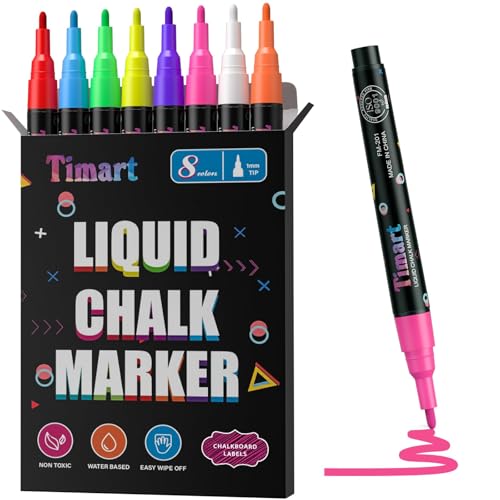
Timart Fine Tip Chalk Markers, 8 Pack is the fine-tip choice, with 1 mm points for narrow calendar spaces, small labels, or detailed lettering. The eight-marker set has vivid neon colors and is intended for blackboards, glass, mirrors, and windows. Its maker says the ink wipes off nonporous surfaces with a damp cloth or paper towel. This thinner line trades broad, distance-visible strokes for precision, so it is a better match for compact writing than large menu headings. Use only on a smooth, nonporous board surface.
Bottom line: Choose this set when small lettering matters more than bold strokes.
SFSASO Liquid Chalk Markers, 10 Colors

SFSASO Liquid Chalk Markers, 10 Colors differs from the blackboard-focused sets by centering on acrylic fridge calendars and clear glass boards. Its 10 colors include black and white alongside bright shades, and its 1 mm fine points suit compact writing. The maker describes it as a wet-erase marker for smooth surfaces, including windows, mirrors, and whiteboards. That makes it relevant for a smooth black board, but less specifically targeted to blackboards than the chalkboard-focused choices. Select it when a broad color range and acrylic-board use are priorities.
Bottom line: Choose it for a smooth acrylic planning board where color variety is useful.
Magnetic Liquid Chalk Markers, 8 Colors

Magnetic Liquid Chalk Markers, 8 Colors adds magnetic caps to an eight-color, 1 mm fine-tip set aimed mainly at acrylic calendars and clear glass boards. The product also names chalkboards among its intended surfaces, making it a possible fit for a smooth black board. Its magnetic feature helps keep the markers on metal surfaces, while the fine tips favor small writing over broad lettering. The cap magnet does not make the marker suitable for every board material; confirm that the writing surface is smooth and nonporous before using liquid chalk.
Bottom line: Pick this set when magnetic caps matter and the board surface is smooth.
How liquid chalk markers differ from dry erase
Liquid chalk markers generally erase with a damp cloth, not a dry eraser, so “dry erase” on a product name does not guarantee conventional dry-erase behavior. Ordinary dry-erase ink is designed for whiteboards and may be hard to see on a black background; liquid chalk is commonly offered in vivid colors for darker boards. The key distinction is the surface: marker ink wipes more reliably from smooth, nonporous materials such as glass or coated board than from porous surfaces. Before writing a full menu or calendar, try one mark in an inconspicuous area and erase it using the intended damp method. If the board is unsealed wood or porous slate, use traditional chalk unless its maker confirms compatibility.
Choose a tip width for the writing
Tip width controls how much writing fits in a given space: a 1 mm point supports compact notes, while 6 mm tips make substantially broader strokes. Choose a fine point when calendar boxes or small labels are narrower than about 1 inch; choose a broader bullet or chisel tip when headings need to read from a few feet away. Chisel tips can produce varied strokes by changing the angle, whereas round fine tips keep line width consistent. Color visibility also depends on contrast: light colors tend to stand out more clearly against a dark board than black ink. Test the actual color and line size at the viewing distance you expect before filling a whole board.
Surface fit and board compatibility
Liquid chalk is best matched to a smooth, nonporous writing surface, including glass, acrylic, or a sealed chalkboard coating. A rough or absorbent surface can trap pigment in texture or fibers, making removal difficult even when the marker wipes cleanly from glass. Product names sometimes group chalkboards, acrylic boards, and whiteboards together, but these surfaces are not interchangeable. Use a small test mark and wait for it to dry before wiping; an immediate wipe may not reveal whether dried pigment leaves a trace. If the board has a manufacturer care guide, check its material and cleaning restrictions before applying marker ink. Avoid treating a surface as erasable based only on its color.
Plan removal and safe use
Most liquid chalk markers call for a damp cloth or paper towel for removal, so keep water and a soft cloth nearby when updating a board. Do not assume a dry eraser will remove wet-erase ink; rubbing dry can spread pigment instead of lifting it. The marker set in this comparison that specifies ASTM D-4236 is intended for whiteboards, not a blackboard match, and that certification does not establish surface compatibility. Keep caps on between uses and follow the marker’s own handling directions, especially around children. For food-container labels or window writing, make sure the writing is on a surface that can be cleaned fully and is not part of a food-contact area unless the manufacturer explicitly permits that use.
Frequently Asked Questions
Do liquid chalk markers erase from blackboards?
They generally wipe from smooth, nonporous boards with a damp cloth, but porous slate or unsealed wood may retain pigment. Test a small area before writing across the board.
Can I use these markers on a regular chalkboard?
Use them on a chalkboard only if its writing surface is smooth and nonporous. Rough or absorbent boards can hold the ink, so confirm the surface and make a test mark first.
Do liquid chalk markers erase with a dry cloth?
Many liquid chalk markers are wet-erase and need a damp cloth or paper towel. A dry eraser may not lift the ink cleanly, especially after it dries.
What tip size works for small calendar writing?
A 1 mm point is the more suitable choice for compact writing because it makes a narrower line than a 6 mm tip. Check that the color remains visible at the distance where the calendar will be read.
How can I keep chalk-marker ink from staining a board?
Use the marker only on a smooth, nonporous surface and test an inconspicuous spot before filling the board. Avoid porous or unsealed materials, which can hold pigment in their texture.