
Dual Brushless Motor ESCs: 5 Options Compared

Spektrum Avian 40A Dual Brushless Smart ESC is the strongest fit for a dual brushless ESC search because its name specifies a 40-amp controller for 3S–4S packs. Choose Spektrum Dual Brushless ESC for 230 S instead if your target is a 230 S setup; the remaining options are for brushed motors, not brushless ones.
We earn a commission if you buy through links on this page. As an Amazon Associate I earn from qualifying purchases. Products are compared on manufacturer specifications, not hands-on testing.
- Best overall: Spektrum Avian 40A Dual Brushless Smart ESC – Its name specifies dual brushless operation, 40 amps, and 3S–4S compatibility.
- Best for 230 S: Spektrum Dual Brushless ESC for 230 S – This Spektrum controller is specifically named for the 230 S and includes Smart.
- Best for higher current: HOBBYWING QUICRUN 880 Brushed ESC – The brushed-motor controller gives an 80A continuous and 400A peak current rating.
| Product | Best for | Motor type | Battery support | Shop |
|---|---|---|---|---|
| Spektrum Avian 40A Dual Brushless Smart ESC | 3S–4S brushless | Brushless | 3S–4S | Check Price on Amazon |
| Spektrum Dual Brushless ESC for 230 S | 230 S setup | Brushless | — | Check Price on Amazon |
| HOBBYWING QUICRUN 880 Brushed ESC | High-current brushed | Brushed | 2–4S LiPo; 5–12S NiMH | Check Price on Amazon |
| FPVDrone 5A Bidirectional Brushed ESC, 4-Pack | Small brushed builds | Brushed | 2S–3S LiPo | Check Price on Amazon |
| 30A Dual Brushed ESC with XT60 | Dual brushed RC | Brushed | — | Check Price on Amazon |
Dual Brushless Motor ESC Options
Match the ESC’s motor type and battery range to your setup before comparing current ratings or size.
Spektrum Avian 40A Dual Brushless Smart ESC

Spektrum Avian 40A Dual Brushless Smart ESC is the only option here whose name combines dual brushless operation, a 40-amp rating, and 3S–4S battery support. Its dimensions are 8 inches long, 5 inches wide, and 1 inch high, so check the available installation space against those measurements. The orange unit weighs 0.24 pounds. It suits a setup that matches the cell range and needs a dual brushless controller. The main limitation is that the maker does not identify a connector or BEC output, which matters if your wiring or receiver setup requires a particular interface.
Bottom line: Choose it when your dual brushless setup uses 3S–4S and the dimensions fit.
Spektrum Dual Brushless ESC for 230 S

Spektrum Dual Brushless ESC for 230 S stands apart as the option explicitly named for a 230 S aircraft and Smart functionality. Its dimensions are 7 inches long, 4.2 inches wide, and 0.6 inch high; the unit weighs 0.07 pounds. That makes it a candidate for buyers selecting an ESC around the named airframe rather than choosing by an explicitly stated current or cell rating. Confirm battery and motor compatibility before using it outside the named 230 S application.
Bottom line: Pick it for a 230 S setup rather than a general-purpose upgrade.
HOBBYWING QUICRUN 880 Brushed ESC

HOBBYWING QUICRUN 880 Brushed ESC is a dual-motor controller for brushed motors, so it is not a substitute for a brushless ESC; its distinction is an 80A continuous and 400A peak rating. It supports 2–4S LiPo or 5–12S NiMH packs and 540, 550, and 775-size brushed motors. The switch-mode BEC output is 6V at 4A, and the controller is waterproof. Its size is 45.9 × 34.7 × 26.5 mm and weight is 75 g. This is relevant to higher-current brushed builds, but wrong for brushless motors.
Bottom line: Choose it only for a compatible dual brushed-motor build.
FPVDrone 5A Bidirectional Brushed ESC, 4-Pack

FPVDrone 5A Bidirectional Brushed ESC, 4-Pack differs from the brushless options by being a four-piece set of 5A bidirectional brushed ESCs for 2S–3S LiPo packs. It is intended for small RC models such as cars, tanks, and boats, and the named motor sizes are 130 and 180. The feature set includes a built-in capacitor module, heat dissipation, and throttle-signal-loss protection. This is a specialized low-current option for small brushed motors, not a dual brushless controller. Its compatibility and 5A rating make it unsuitable when the motor type or current demand exceeds those limits.
Bottom line: Use it for small 130 or 180 brushed-motor RC projects.
30A Dual Brushed ESC with XT60
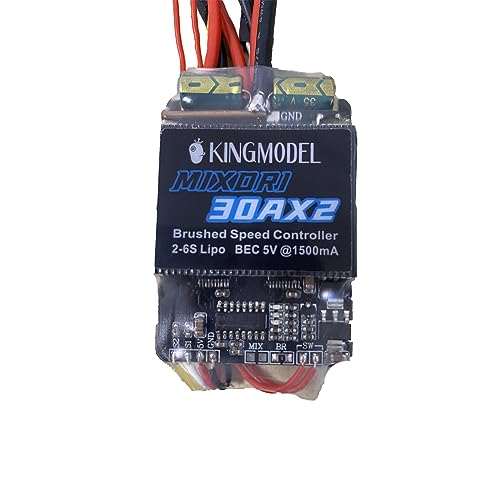
30A Dual Brushed ESC with XT60 is a 30A dual brushed controller for RC tanks, boats, and crawlers, making motor type its key difference from the brushless matches. The included XT60 connector is a useful wiring distinction, and the size is 63 × 41 × 9.6 mm. Its operating notes warn that left and right motor leads must not be swapped, and say overheating protection takes effect only when both circuits are used. The guidance also cautions against connecting certain additional capacitors and says motors drawing less than 2A cannot be used. Those restrictions make it a poor fit for brushless builds.
Bottom line: Choose it for a dual brushed tank, boat, or crawler setup.
How to choose a dual brushless ESC
Start by matching motor type and battery voltage, then check current capacity and installation space. A brushless ESC must be designed for brushless motors; a dual brushed controller is not interchangeable just because it has two motor outputs. Battery cell count matters because a 3S pack and a 4S pack have different operating voltages, and exceeding an ESC’s supported range can damage equipment. Compare the controller’s current rating with the motor’s expected draw, allowing headroom for load and cooling. For fit, measure the mounting area and leave room for wiring and airflow; the controller dimensions alone do not account for connector clearance.
Brushless and brushed dual ESCs compared
Brushless and brushed ESCs serve different motor designs, so choose by motor type before comparing features. A brushed motor typically has two power leads and uses mechanical brushes; a brushless motor generally needs electronic commutation through three phase wires. Dual-motor support does not mean dual brushless support, and a controller for brushed motors should not be connected to a brushless motor. The chart separates motor type from the battery and current figures supplied for each option. Treat missing electrical ratings as a reason to verify compatibility for a planned installation, not as evidence that an ESC will work with every setup.
| Controller type | Motor match | Selection rule |
|---|---|---|
| Dual brushless | Brushless motors | Choose only when the battery range and motor current match |
| Dual brushed | Brushed motors | Match motor size, current, and pack voltage |
Match battery cells and current
Cell-count compatibility is a hard limit, not a rough suggestion. For example, Spektrum Avian 40A Dual Brushless Smart ESC is identified for 3S–4S packs, while FPVDrone 5A Bidirectional Brushed ESC, 4-Pack specifies 2S–3S LiPo; the ranges overlap at 3S but do not make the ESCs interchangeable because their motor types and current ratings differ. Current figures also need context: continuous current is the relevant ongoing rating, while peak current describes a brief transient and should not be treated as a continuous load target. Compare the motor’s expected current under load with the ESC’s continuous capacity, and make sure the battery connector and wiring suit the current path.
Installation and safe setup checks
Before powering an RC ESC, verify polarity, motor wiring, and the battery’s cell count; reversing connections or exceeding voltage limits can cause rapid damage. Dual brushed controllers can have separate left and right outputs, so keep each motor on its intended channel. For 30A Dual Brushed ESC with XT60, the operating notes specifically warn that swapping the marked motor leads can burn the ESC quickly and that overheating protection relies on both circuits being used. Secure the controller so it cannot contact moving parts, and allow airflow where the design depends on cooling. Check connector fit, mounting clearance, and receiver or BEC requirements before installation.
Frequently Asked Questions
Can a dual brushed ESC run a brushless motor?
No; a brushed controller is designed for brushed motors, while brushless motors require electronic commutation. Confirm the motor type before connecting the ESC.
Does a 3S–4S ESC work with a 2S battery?
Only if the controller explicitly supports 2S; a 3S–4S range does not include 2S. Check both the ESC’s cell range and the motor’s voltage requirements.
What does an ESC peak current rating mean?
Peak current is a short-duration limit, not the rating for continuous operation. Use the continuous rating when matching an ESC to expected motor load.
Why does a dual brushed ESC have separate motor leads?
Separate leads let the controller drive two brushed motors independently or in coordinated directions. Keep each motor connected to its intended output, since reversed wiring can damage some controllers.
How much clearance should an RC ESC have?
Allow space for the unit, connectors, and wire bends rather than relying only on the ESC body dimensions. Leave airflow around components that depend on cooling, especially in high-load installations.