
Dyna-Glo Indoor Kerosene Heater Models Compared

The Dyna-Glo WK95C8 suits most people seeking an indoor kerosene heater because its maker rates it for up to 1,000 square feet and 23,000 BTU per hour. Choose a different model if your room is smaller or you want a portable heater with built-in tip-over protection.
Kerosene convection heaters warm air throughout a room without relying on electricity, but they burn fuel indoors; check the heater’s indoor-use approval and ventilation requirements before use.
We earn a commission if you buy through links on this page. As an Amazon Associate I earn from qualifying purchases. Products are compared on manufacturer specifications, not hands-on testing.
- Best overall: Dyna-Glo WK95C8 Convection Heater – The maker rates it for up to 1,000 square feet, and it operates without electricity.
- Best for a black finish: Dyna-Glo RMC-95C6B Convection Heater – This Dyna-Glo convection model has a black finish, unlike the ivory WK95C8.
- Best for tip-over protection: Kero World 10,500-BTU Convection Heater – The Sengoku includes an automatic safety shut-off and a tip-over switch.
| Product | Best for | Heat output | Heating area | Tank capacity | Shop |
|---|---|---|---|---|---|
| Dyna-Glo WK95C8 Convection Heater | Large rooms | 23,000 BTU/hour | Up to 1,000 sq. ft. | — | Check Price on Amazon |
| Dyna-Glo RMC-95C6B Convection Heater | Black finish | 23,000 BTU | — | — | Check Price on Amazon |
| Kero World 10,500-BTU Convection Heater | Compact spaces | 10,500 BTU | Up to 450 sq. ft. | 1.1 gal | Check Price on Amazon |
| Sengoku HeatMate 110 | Tip-over protection | 10,000 BTU | Up to 400 sq. ft. | 1.2 gal | Check Price on Amazon |
| VEVOR 215,000-BTU Forced-Air Heater | Large workspaces | 215,000 BTU | — | 13.2 gal | Check Price on Amazon |
Dyna-Glo Indoor Kerosene Heaters and Alternatives
Compare the two Dyna-Glo convection heaters with smaller portable models and a high-output forced-air option.
Dyna-Glo WK95C8 Convection Heater

Among these choices, the Dyna-Glo WK95C8 has the largest heating area for a convection heater: up to 1,000 square feet. Its maker gives the output as 23,000 BTU per hour and says it needs no electricity, which can matter during an outage. The ivory heater weighs 28 pounds. It suits buyers who need broad-area heat from a non-electric model, but the figures do not establish how much fuel it holds or how long it runs per fill. Match the rated area to the room rather than assuming it will heat an entire home.
Bottom line: Choose this model for a larger space where its 1,000-square-foot rating fits.
Dyna-Glo RMC-95C6B Convection Heater

The Dyna-Glo RMC-95C6B is the black-finish alternative to the ivory WK95C8, and its name gives a 23,000-BTU output. It is a kerosene convection heater, so it is the closer match for shoppers seeking a Dyna-Glo room-heating format rather than a forced-air unit. The maker establishes its color and output but do not give a room-area rating, so it is harder to match to a specific room than the WK95C8. Choose it when the black finish matters and confirm its heating-area rating and fuel requirements before relying on it for a particular space.
Bottom line: Pick it if you want a black Dyna-Glo convection heater and can confirm room fit.
Kero World 10,500-BTU Convection Heater

The Kero World heater targets a smaller space than either Dyna-Glo model, with 10,500 BTU and coverage up to 450 square feet. It combines radiant and convective heat, weighs 12 pounds, and has a 1.1-gallon tank; its maker says it can run up to 15 hours per fill. The Sure Seat Chimney System is a named feature. This is a portable alternative, not a Dyna-Glo heater, and its lower output makes it a poor match for shoppers trying to heat a large area. Use the coverage figure as a starting point, not a promise for rooms with high ceilings or poor insulation.
Bottom line: Choose it for a smaller area when portability matters more than broad coverage.
Sengoku HeatMate 110
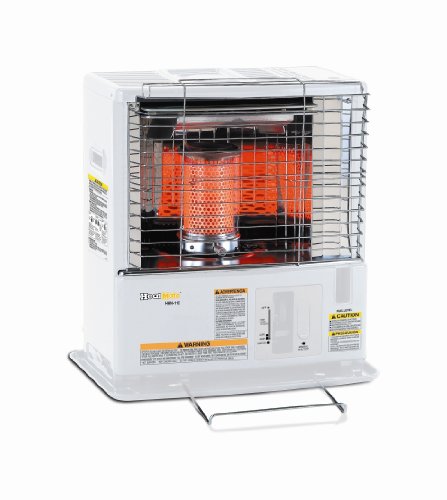
The Sengoku HeatMate 110 stands out among the smaller room heaters for its tip-over switch and automatic safety shut-off. It produces 10,000 BTU, is rated for up to 400 square feet, and has a 1.2-gallon tank; its maker says it can run up to 14 hours. Push-button starting avoids the need for matches or electricity, according to the maker. At about 22.5 pounds, it is heavier than the Kero World unit despite its compact purpose. It suits buyers who prioritize the safety features, but its smaller coverage is not a substitute for the Dyna-Glo’s larger-area rating.
Bottom line: Pick it for a smaller space where its tip-over protection is useful.
VEVOR 215,000-BTU Forced-Air Heater

The VEVOR is a very different alternative: a forced-air heater rated at 215,000 BTU, rather than a room-sized convection heater. Its maker gives a workspace capacity of up to 44,496.6 cubic feet and a 13.2-gallon tank, and says it accepts kerosene or diesel, one fuel type at a time. It has a thermostat adjustable from 40°F to 110°F and overheat protection that shuts it off at 176°F, according to the maker. Its scale and forced-air design suit large work areas, not ordinary room heating. Do not treat the indoor-area claim as confirmation of suitability for occupied rooms; verify ventilation and approved use first.
Bottom line: Consider it for a large workspace only after confirming the site is suitable for its exhaust and ventilation needs.
How to Choose an Indoor Kerosene Heater
Start with the room area and the heater’s heat output, then account for insulation and ceiling height. A heater rated for 1,000 square feet may fall short in a drafty room or one with a high ceiling, while a 400-square-foot model is a more sensible scale for a smaller enclosed area. Convection heaters distribute warmth through moving air; radiant elements emphasize heat directed toward nearby people and objects. Forced-air heaters move heated air with a fan and are usually aimed at larger work areas. For spaces below 450 square feet, compare the Kero World and Sengoku ratings; for a larger area, the Dyna-Glo WK95C8 has the highest area among the convection models here. Confirm indoor-use approval and ventilation before choosing any combustion heater.
Fuel and runtime matter as much as output. A tank size alone does not establish how many hours a heater will run, because consumption depends on its burn rate and heat setting. The figures give the Kero World and Sengoku both a tank size and a maker-claimed maximum runtime, which makes them easier to compare on refill intervals than models without both figures.
Indoor Kerosene Heater Types Compared
Convection heaters and forced-air heaters serve different spaces: room-sized models circulate warmth more gently, while forced-air units deliver much higher output for large work areas. This table compares the heater types represented here and the condition that should guide a choice.
| Type | Typical use in this group | Decision rule |
|---|---|---|
| Convection | Room heat; 400–1,000 sq. ft. ratings shown | Choose by room area and output |
| Radiant and convection | Small spaces; 450 sq. ft. rating shown | Favor when a compact heater fits the space |
| Forced air | Large work areas; 215,000 BTU model | Use only where its approved application and ventilation fit |
Do not compare the VEVOR’s cubic-foot workspace figure directly with square-foot room ratings: cubic feet measure volume, while square feet measure floor area. Ceiling height changes the volume a given floor area contains, so a high-output unit can be excessive for an ordinary room even when the floor area seems large.
Indoor Kerosene Heater Safety and Ventilation
Combustion heaters consume oxygen and can produce carbon monoxide, so ventilation and a working carbon-monoxide alarm are essential when using a fuel-burning heater indoors. Keep the heater on a stable, level surface with clear space around it, and keep fuel away from flames and hot surfaces. Kerosene heaters should use the fuel type approved for that model; never substitute gasoline. A tip-over switch or automatic shut-off is a useful safeguard, but it does not replace supervision or safe placement. Before selecting any model for a bedroom or living area, confirm that the manufacturer permits that indoor use and follow the required ventilation clearances. Stop using a heater if it produces unusual smoke, odor, or flame behavior.
Room Size, Runtime, and Refilling
Match the heater’s rated floor area to the room, then leave margin for cold climates, drafts, and weak insulation. A room below 400 square feet falls within both small heater ratings shown here, while a space approaching 1,000 square feet points toward the larger Dyna-Glo model’s area. Runtime claims are maximums, not guaranteed burn times at every setting; higher heat output generally consumes fuel faster. Refuel only after the heater is off and completely cool, and move fuel containers away before relighting. The table’s tank capacities differ, but neither capacity nor a maximum runtime should be treated as a substitute for monitoring fuel and maintaining ventilation.
Frequently Asked Questions
Can an indoor kerosene heater run without electricity?
Some convection models can, including the Dyna-Glo WK95C8, whose maker says it needs no electricity. A heater with powered features may have different requirements, so check the particular model’s operation and ignition method.
What size kerosene heater fits a 400-square-foot room?
The Sengoku is rated for up to 400 square feet, while the Kero World is rated for up to 450 square feet. Poor insulation, drafts, and high ceilings can reduce how well either rating matches a real room.
How often should I refill a kerosene heater?
Refill frequency depends on the burn rate and heat setting, not just tank capacity. The Kero World maker claims up to 15 hours from a 1.1-gallon tank, while the Sengoku maker claims up to 14 hours from 1.2 gallons; treat these as maximums.
Is a kerosene heater safe to use indoors?
Only use a model approved for indoor use with its required ventilation, and keep a working carbon-monoxide alarm in the space. Never run a fuel-burning heater in a sealed room or refuel it while hot.
Can I use diesel in a kerosene heater?
Use only the fuel types the specific model allows; fuels are not interchangeable by default. The VEVOR forced-air model is described as supporting kerosene or diesel, one type at a time, but that does not apply to the Dyna-Glo convection models.