
End of Life Planner by Lamorial: 4 Planners Compared

The Lamorial End of Life Planner suits people who want a guided, bound journal with 83 prompted pages across 9 sections, including digital access and final wishes. Choose a different format if you prefer a binder with tabs and pockets or need larger print.
An end of life planner is an organizer for personal, financial and final-wish information; it does not replace a will or other legal documents.
We earn a commission if you buy through links on this page. As an Amazon Associate I earn from qualifying purchases. Products are compared on manufacturer specifications, not hands-on testing.
- Best overall: Lamorial End of Life Planner & Journal – Its 83 guided pages cover 9 sections, including passwords, accounts, digital access and final wishes.
- Best for large print: 7-by-10-Inch Seniors Planner – The 7-by-10-inch binder has large print, 16 tabs and inner pockets.
- Best for section depth: Clever Fox End of Life Planner – Its 16 sections organize records spanning medical, financial and personal information.
| Product | Best for | Format | Page organization | Size | Shop |
|---|---|---|---|---|---|
| Lamorial End of Life Planner & Journal | Guided journal | Bound journal | 83 pages; 9 sections | A4 | Check Price on Amazon |
| 7-by-10-Inch Seniors Planner | Large-print binder | Binder | 16 tabs | 7 × 10 in | Check Price on Amazon |
| Clever Fox End of Life Planner | Many sections | Planner | 16 sections | 8.5 × 11 in | Check Price on Amazon |
| Peace of Mind Planner | Durable hardcover | Hardcover, wire-o | — | 8.5 × 11 in | Check Price on Amazon |
End of Life Planners
Compare the formats and organization features to choose a planner you can complete and keep securely accessible to the right person.
Lamorial End of Life Planner & Journal

The Lamorial planner stands out for its prompted journal format: 83 pages across 9 sections guide entries rather than leaving blank pages. Its topics include phone passcodes, two-factor authentication backup codes, recovery emails, banking, pensions, subscriptions, property, contacts and final wishes. The A4 book has a premium cover and is designed for writing directly on its bound pages.
This format suits someone who prefers a section-by-section writing process. Its pages cannot be added or removed, so it is less flexible than a binder when records grow or need frequent rearranging.
Bottom line: Choose this if you want guided prompts in a bound journal rather than a rearrangeable binder.
7-by-10-Inch Seniors Planner
The 7-by-10-inch planner differs from Lamorial’s bound journal with a binder format, large print, 16 tabs and inner pockets. Its name also specifies 120 GSM paper, and it is presented as an organizer for final wishes and last wishes. Those features can suit a writer who wants tabbed sections and pocket storage alongside a more readable layout.
The smaller page size may offer less writing area than an A4 book, so consider how much space you need for longer notes. A binder can make it easier to organize pages, but check how its sections match the records you plan to keep.
Bottom line: Pick this if large print, tabs and pockets matter more than an A4 writing surface.
Clever Fox End of Life Planner

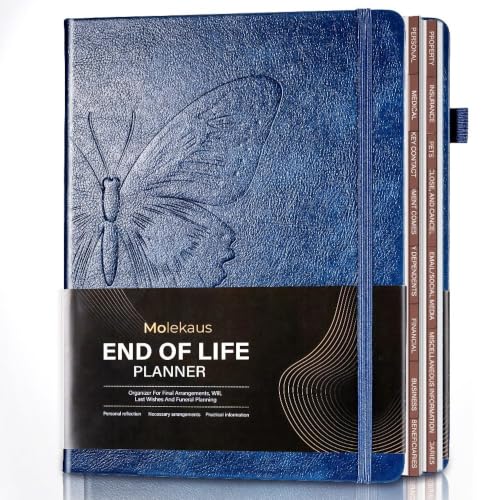
The Clever Fox planner offers 16 sections, compared with Lamorial’s 9, and its 8.5-by-11-inch format provides a broad page for writing. Its subject areas include medical and financial information, insurance, memberships, dependent and pet care, property, business and passwords. That breadth suits someone who wants to divide a range of records into many labeled chapters.
The feature summary emphasizes section coverage rather than a prompted-page count or binder accessories. If you want pockets or removable pages, confirm the format before choosing; the available product facts establish the section count and size, not those features.
Bottom line: Choose this if you want 16 sections and an 8.5-by-11-inch format for varied records.
Peace of Mind Planner

The Peace of Mind Planner is distinguished by its durable hardcover, concealed wire-o binding and archival, acid-free paper. Its title frames the organizer around belongings, business affairs and wishes, making it a fit for someone focused on those subjects and interested in paper intended to help preserve written records.
The product facts do not give a section count or guided-page structure, so it is harder to compare its organization with Lamorial’s prompted layout or the 16-section alternatives. Choose it for its cover and paper characteristics, not on an assumption that it has the same prompts or topic coverage.
Bottom line: Pick this if a hardcover and archival, acid-free paper are your priorities.
How to choose an end of life planner
Choose a planner by matching its organization to the records you need to maintain and the person who may need to find them. A prompted journal can help someone work through topics in sequence; tabs and pockets can help separate or hold papers. Make a short inventory first: personal contacts, financial accounts, care instructions and final wishes are distinct record groups, and a planner may not cover each one equally. If you expect records to change often, favor a format that can accommodate updates; if you prefer a guided process, compare prompt and section counts. Keep the completed planner in a secure, known place and tell the appropriate trusted person how to access it. A record is useful only if the right person can locate it when needed.
Keeping passwords and account access safer
Account access records need stronger protection than an ordinary household notebook because passwords and two-factor recovery codes can unlock private accounts. Keep a written access record in a locked location, restrict access to the people who need it, and avoid leaving it in an unattended or shared space. Two-factor authentication adds a separate verification step, but recovery methods differ by account; record enough guidance for a trusted person to find the account’s official recovery process. Do not assume one password or code works across services. When changing a password or phone, update the planner promptly so the written record does not point to obsolete credentials. For accounts with financial or sensitive data, check the provider’s delegation or legacy-access options instead of relying only on a handwritten password.
Planner formats and their tradeoffs
Bound journals, tabbed binders and hardcovers trade structure against flexibility. A prompted bound book gives a fixed sequence and page count; a binder’s tabs and pockets can make loose records easier to sort. A hardcover with wire-o binding offers a different paper-and-cover approach, but those physical features alone do not establish what topics its pages cover. Match the format to how you will update and retrieve records, not just the cover style. Use this comparison to identify the organizational form that fits your routine; confirm any specific topic or storage feature you need before choosing.
| Format | Useful when | Tradeoff |
|---|---|---|
| Prompted bound journal | You want a guided sequence | Pages stay in place |
| Tabbed binder | You want labeled sections and pockets | Check section coverage and page space |
| Hardcover, wire-o | Cover and paper characteristics matter | Check the page organization |
Legal documents and final wishes
An organizer can collect instructions and point loved ones toward important records, but it is not itself a will, power of attorney or health care directive. Those legal documents have different purposes, and execution rules can depend on the jurisdiction and document type. Keep signed originals where they can be found, and make the organizer’s references consistent with current documents. For example, if a named contact or account changes, update both the record and any relevant legal paperwork through the appropriate professional. Use the planner for practical context and location notes; do not rely on it to create legal authority or substitute for a properly prepared and executed document.
Frequently Asked Questions
What should I write in an end of life planner?
Record the information a trusted person would need to find, such as key contacts, account access guidance, care instructions and final wishes. Keep sensitive credentials secure and make the entries specific enough to identify the relevant account or document.
Where should I keep a completed end of life planner?
Keep it in a secure, known location and tell the appropriate trusted person how to access it. A locked cabinet or safe can limit casual access, but the person expected to use the planner needs a workable way to reach it.
How often should I update an end of life planner?
Update it whenever a password, contact, account or instruction changes, rather than waiting for a yearly review. A brief check every 6 to 12 months can also help catch changes that were missed.
Does an end of life planner replace a will?
No, a planner organizes information and wishes but does not replace a will or grant legal authority. Will and directive execution rules vary by jurisdiction, so use the applicable legal process for those documents.
How can I record two-factor authentication safely?
Record where recovery methods are managed and how a trusted person can locate them, then protect the planner from unauthorized access. Recovery codes and backup methods are account-specific, so update the record when settings or devices change.