
Exhaust Pipe Separator Tool: 5 Options Compared

For reshaping or expanding a pipe end, choose 32000 Pipe End Shaper: it works on pipe sizes from 1 1/2 to 3 5/8 inches. If you mean separating rubber exhaust hangers from metal posts, choose one of the hanger removal pliers instead; those tools do not reshape pipe ends.
Choose by the repair: Heavy-Duty Offset Hanger Pliers, Heavy-Duty Exhaust Hanger Pliers, Blue-Handle Hanger Removal Pliers, and WORKPRO Hanger Tool with 4 Hangers remove rubber hangers, while 32000 Pipe End Shaper reforms tubular ends.
We earn a commission if you buy through links on this page. As an Amazon Associate I earn from qualifying purchases. Products are compared on manufacturer specifications, not hands-on testing.
- Best overall: 32000 Pipe End Shaper – The only pipe end shaper here; its working range is 1 1/2 to 3 5/8 inches.
- Best for tight access: Heavy-Duty Offset Hanger Pliers – Its 25-degree offset head is designed to reach recessed hanger brackets.
- Best for spare hangers: WORKPRO Hanger Tool with 4 Hangers – The package includes four rubber hangers along with the removal tool.
| Product | Best for | Tool function | Length | Shop |
|---|---|---|---|---|
| 32000 Pipe End Shaper | Pipe end reshaping | Pipe-end shaper | 6.38 in | Check Price on Amazon |
| Heavy-Duty Offset Hanger Pliers | Recessed hangers | Hanger removal | 11.5 in | Check Price on Amazon |
| Heavy-Duty Exhaust Hanger Pliers | Stuck hangers | Hanger removal | 11.81 in | Check Price on Amazon |
| Blue-Handle Hanger Removal Pliers | Controlled grip | Hanger removal | — | Check Price on Amazon |
| WORKPRO Hanger Tool with 4 Hangers | Hanger replacements | Hanger removal | — | Check Price on Amazon |
Exhaust Pipe Separator Tools Compared
Match the tool to the joint: only one reshapes pipe ends, while the others separate rubber hangers from metal posts.
32000 Pipe End Shaper

Unlike the hanger pliers, this tool reshapes pipe ends inward or outward. Its dual-ended conical design is intended to round damaged muffler, exhaust, and other tubular-component ends, helping adjust alignment at a connection. The maker gives a working range of 1 1/2 to 3 5/8 inches and identifies it as a replacement for OEM part 32000. It suits repair work where an end needs reforming rather than a rubber mount being pulled from a post. Its limitation is purpose: it does not remove rubber hangers.
Bottom line: Choose it when the repair involves reshaping an exhaust pipe end within its range.
Heavy-Duty Offset Hanger Pliers

The 25-degree offset head is the distinguishing feature here, aimed at hanger brackets set farther in under a vehicle. The pliers are 11.5 inches long and use carbon steel with an anti-rust coating and non-slip handles. They are intended to squeeze rubber exhaust hangers off their metal supports on most car and truck systems. That makes them a better match for difficult access than for pipe end shaping. Choose another tool if the pipe itself needs expanding or rounding.
Bottom line: Pick these pliers for rubber mounts positioned in a recessed area.
Heavy-Duty Exhaust Hanger Pliers

These pliers emphasize leverage for stubborn mounts, with heat-treated steel and a reinforced riveted structure. At 11.81 inches long, they are described for separating rubber supports from metal hangers on cars, trucks, SUVs, and light-duty vehicles. The tool fits exhaust repair jobs such as muffler replacement, but its function is hanger removal, not pipe end forming. The maker does not identify a jaw offset, so it is not the clearest choice when a particular reach angle is the deciding factor.
Bottom line: Choose these for stuck rubber supports when added leverage is the priority.
Blue-Handle Hanger Removal Pliers

The curved hook and forked tip distinguish these pliers, helping grip and push rubber mounts away from metal hanger posts. Blue coated handles provide a grip surface, and the long-handle design is intended to add leverage during removal. They suit muffler, tailpipe, and exhaust repair where a rubber hanger is the part being separated. No pipe-forming function is described, so they are not a substitute for an exhaust pipe expander or shaper. The measurements do not establish a specific reach or pipe-size fit.
Bottom line: Pick these for the hook-and-fork approach to removing rubber mounts.
WORKPRO Hanger Tool with 4 Hangers
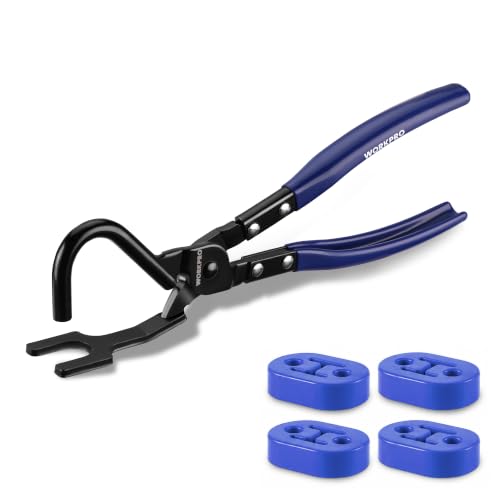
This package pairs a hanger removal tool with four rubber hangers, unlike the other options that are described primarily as tools. Its carbon-steel construction, rust-resistant coating, non-slip grip, and slim offset head are intended for work in tight spaces on most domestic and imported vehicles with rubber hangers. It suits a job that includes replacing mounts as well as removing them. It still does not reshape metal pipe ends; choose a pipe end shaper for that task.
Bottom line: Choose this package when replacement rubber hangers are also needed.
Choose by the exhaust joint you need to separate
A rubber hanger tool and a pipe end shaper solve different problems: identify the material and joint before choosing. Hanger pliers push or pull a rubber isolator off a metal peg; a cone-style shaper rounds or expands the end of a metal tube. For a rubber loop stuck on its support, select hanger removal pliers. For a pipe end that is crushed or out of round, use a pipe shaper sized for the tube. A simple decision rule is to measure the pipe opening: if it is outside 1 1/2 to 3 5/8 inches, the range for the shaper here does not cover it. This avoids using a hanger tool on a pipe-fit problem.
Exhaust work should be done only after the system is cool and the vehicle is securely supported on properly rated stands; never rely on a jack alone.
Understand rubber hanger removal versus pipe shaping
Rubber hanger removal acts at the mount, while pipe shaping acts on the tube’s circumference. Rubber exhaust isolators support the exhaust and allow movement as the engine and body move; their rubber can bind tightly around a metal peg, especially when aged or distorted. A hanger removal tool uses a hook, fork, or offset jaws to separate that connection. Pipe end shapers instead use tapered forms to round inward or outward, correcting a distorted end so adjoining sections align. These are not interchangeable tool types. The products here include four hanger removal tools and one pipe end shaper. Choose the category first, then compare access, construction, and included replacement mounts.
Compare tool types by repair need
The repair target is the useful dividing line: use the row that matches the part you need to move.
| Repair need | Tool type | Deciding fit |
|---|---|---|
| Rubber hanger stuck on metal post | Hanger removal pliers | Head shape and access angle |
| Damaged or out-of-round pipe end | Pipe end shaper | Measured pipe diameter within tool range |
| Mount removal plus replacement | Hanger tool with spare hangers | Replacement hanger matches existing mount |
Measure the pipe’s outside diameter where the shaper will work, and compare it with the tool’s range. For hanger tools, inspect the space around the rubber loop and metal peg; an offset or slim head can matter more than overall handle length when access is limited.
Work safely around an exhaust system
Let exhaust components cool completely before touching them; metal pipes and mufflers can retain burn-level heat after the engine stops. Support the vehicle on a level surface with wheel chocks and correctly rated jack stands, because hanger removal may require force that can shift an unsupported vehicle. Exhaust tubing can also move when a rubber support comes free, so keep hands clear of pinch points and support the section being released. Wear eye protection under a vehicle, where rust and debris can fall. If the pipe or hanger is heavily corroded, stop rather than applying uncontrolled force; corrosion can weaken the component and cause it to break rather than separate cleanly.
Frequently Asked Questions
How do I know whether I need hanger pliers or a pipe shaper?
Use hanger pliers when a rubber isolator must come off a metal support; use a pipe shaper when the metal tube end is crushed or out of round. Measure the tube opening before selecting a shaper, since the option here covers 1 1/2 to 3 5/8 inches.
Can I use a pipe expander to remove a rubber hanger?
No, a pipe shaper works on the metal tube end, not the rubber mount. Hanger pliers are designed to separate the rubber loop from its metal peg.
Should I remove an exhaust hanger while the exhaust is hot?
No, wait until the exhaust is completely cool before handling it. Pipes and mufflers can remain hot after shutdown, and working underneath also requires stable jack stands rather than a jack alone.
What should I measure before using an exhaust pipe shaper?
Measure the pipe diameter at the end being reformed and confirm it falls within the shaper’s 1 1/2- to 3 5/8-inch range. A tube outside that span needs a tool with a compatible working range.
Why are exhaust hangers made from rubber?
Rubber isolators support the exhaust while allowing movement between the exhaust and vehicle body. A hardened or damaged mount can make removal difficult, so inspect the replacement mount for a matching shape and fit before installation.