
Low Loss Refrigerant Fittings: 3 Types Compared

For a 90-degree, 1/4-inch male-to-female low-loss quick coupler, choose Yellow Jacket 1/4-Inch 90-Degree Coupler; its angle and connection type are the deciding fit. Choose SURIEEN 1/4-Inch 45-Degree Ball Valve for a 45-degree ball valve, or Wolfride Two-Piece Charging Valve Set for a two-piece set spanning 1/4- and 5/16-inch fittings.
Low-loss fittings are hose-end connections designed to limit refrigerant release during disconnection, but they do not make refrigerant handling risk-free. Match the fitting to the equipment service port and hose before use.
We earn a commission if you buy through links on this page. As an Amazon Associate I earn from qualifying purchases. Products are compared on manufacturer specifications, not hands-on testing.
- Best overall: Yellow Jacket 1/4-Inch 90-Degree Coupler – A 90-degree, 1/4-inch male-to-female coupler with 800 psi working pressure.
- Best for angled shutoff: SURIEEN 1/4-Inch 45-Degree Ball Valve – A 45-degree manual ball valve with a 1/4-inch SAE male-to-female connection.
- Best for two connection sizes: Wolfride Two-Piece Charging Valve Set – The set includes one 1/4-inch valve and one 5/16-inch valve.
| Product | Best for | Connection | Angle | Working pressure | Shop |
|---|---|---|---|---|---|
| Yellow Jacket 1/4-Inch 90-Degree Coupler | 90-degree access | 1/4 in M x 1/4 in F | 90° | 800 psi | Check Price on Amazon |
| SURIEEN 1/4-Inch 45-Degree Ball Valve | Angled shutoff | 1/4 in SAE M x F | 45° | 800 psi max | Check Price on Amazon |
| Wolfride Two-Piece Charging Valve Set | Two-size set | 1/4 in and 5/16 in | — | — | Check Price on Amazon |
Low Loss Refrigerant Fittings Compared
Compare connection size and valve style first, then confirm the fitting matches your hose and equipment port.
Yellow Jacket 1/4-Inch 90-Degree Coupler

The 90-degree bend distinguishes this quick coupler from the straight or 45-degree choices, making it a fit to consider when hose routing needs an angle. It has 1/4-inch male-to-female connections and a brass body. The manufacturer specifies an 800 psi working pressure and 4,000 psi burst pressure. Choose it for a compatible 1/4-inch connection where a right-angle coupler suits the setup. Its fixed 90-degree form is a limitation when a straight connection or a different angle is needed; confirm the fitting orientation clears nearby components.
Bottom line: Pick this when a 90-degree bend and 1/4-inch male-to-female connection match the setup.
SURIEEN 1/4-Inch 45-Degree Ball Valve

A manually operated ball valve at 45 degrees sets this fitting apart from the fixed-angle coupler and the two-piece valve set. The manufacturer gives a 1/4-inch SAE male-to-female connection, a maximum working pressure of 800 psi, and a minimum burst pressure of 4,000 psi. A knurled coupler nut is intended for finger tightening, and the brass-alloy body includes a rubber gasket. It suits a compatible charging hose or manifold that needs an angled shutoff. The 45-degree body may not suit a connection that requires a straight or 90-degree route.
Bottom line: Choose this for a 1/4-inch SAE hose connection that needs a 45-degree manual shutoff.
Wolfride Two-Piece Charging Valve Set
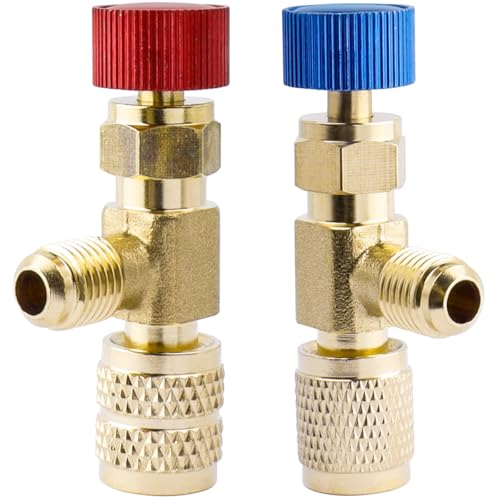
The two different valve sizes make this set distinct: it contains one blue 1/4-inch R22 charging valve and one red R22/R410 charging valve. The manufacturer describes the valves as brass and says their openings are adjustable for flow control. The set is aimed at air-conditioning manifold maintenance, and the maker says the valves can minimize refrigerant loss during charging and maintenance. This set suits someone who needs both connection sizes represented. The field data does not give a working-pressure rating, so check the required rating and exact port fit before using either valve.
Bottom line: Pick this when you need a two-piece set with 1/4- and 5/16-inch valves.
How to Choose Low Loss Refrigerant Fittings
Start with the connection size and gender at both ends; a 1/4-inch male-to-female fitting will not substitute for a 5/16-inch connection. Then choose the body style: a straight connector preserves a direct route, while angled couplers can help route a hose around nearby hardware. A ball valve adds manual shutoff, unlike a fixed coupler. Low-loss designs aim to reduce refrigerant release when disconnecting, but they do not eliminate the need for careful refrigerant handling. For this group, use the angles and pressure ratings as selection criteria, not as a substitute for matching the equipment and hose requirements. Select only a fitting whose connection and pressure rating meet the equipment specifications.
Connection Sizes and Refrigerant Port Fit
Connection size is a key fit check: 1/4-inch SAE flare fittings are common on refrigerant hoses, while many newer R-410A systems use 5/16-inch service ports. That pattern is not universal, so identify the actual port and hose end before choosing an adapter or valve. Male and female threads must also match; size alone does not establish compatibility. Refrigerant names on a fitting do not prove that its threads fit a particular system. Keep refrigerant compatibility, thread size, and port gender as separate checks. Never force a mismatched thread: cross-threading can damage the connection and compromise sealing. When the port size is uncertain, verify it on the equipment before selecting a fitting.
Couplers and Shutoff Valves Compared
A quick coupler connects a hose with a fixed body, while a ball valve adds a manual means of opening or closing the passage. The 90-degree coupler is for a right-angle route; the 45-degree valve takes a less pronounced angle. A two-piece set trades a single fitting style for two connection sizes. Use this table to narrow the choice by the connection need and mechanism, then check the exact hose and port fit.
| Need | Fitting type | Check first |
|---|---|---|
| Right-angle connection | 90° quick coupler | 1/4-inch male-to-female fit |
| Angled manual shutoff | 45° ball valve | 1/4-inch SAE connection |
| Two connection sizes | Two-valve set | Which valve matches each port |
Safe Refrigerant Fitting Use
Refrigerant can cause frostbite on contact, and pressurized systems can release refrigerant forcefully if a connection fails. Use refrigerant-rated fittings and hoses, keep skin and eyes away from the connection point, and wear appropriate eye and hand protection. In the United States, intentional venting of ozone-depleting refrigerants is generally prohibited under EPA Section 608 rules, with limited exceptions; refrigerant recovery requires suitable equipment. A low-loss fitting is not a recovery device and does not make venting acceptable. Before disconnecting, close the appropriate valve and follow the equipment and tool procedures. If a connection leaks or the correct rating is unknown, stop rather than trying to tighten or adapt it under pressure.
Frequently Asked Questions
What does a low loss refrigerant fitting do?
A low-loss fitting is designed to reduce refrigerant release when a hose is disconnected. It does not eliminate release or replace proper recovery and handling practices.
Are 1/4-inch and 5/16-inch refrigerant fittings interchangeable?
No; the two sizes do not directly mate. Many newer R-410A service ports use 5/16-inch connections, while 1/4-inch SAE connections are common on hoses, so verify each end.
Why do refrigerant couplers have angled bodies?
Angled bodies change the hose route at the connection: 45 degrees gives a shallower turn than 90 degrees. Choose an angle that clears nearby parts without putting strain on the hose.
What pressure rating should a refrigerant fitting have?
The fitting must meet or exceed the equipment and hose pressure requirements for the refrigerant and service conditions. One coupler here specifies 800 psi working pressure and 4,000 psi burst pressure; do not treat burst pressure as a working limit.
Can a low loss fitting prevent refrigerant frostbite?
No; it may reduce release during disconnection, but refrigerant can still escape under pressure and cause frostbite. Keep exposed skin away and use appropriate eye and hand protection.