
French Door Weather Stripping Between Doors: 5 Options

For a French door center gap, start with Benory T-Shaped Silicone Seal, 20 ft because its T-shaped profile has adhesive faces for attaching to door edges and the front. Choose a different style if the doors have a kerf groove, a larger measured gap, or a surface that does not suit adhesive.
French door weather stripping seals the meeting edges where paired doors close; measure the gap with both doors shut and check that the strip will not interfere with the latch or closing.
We earn a commission if you buy through links on this page. As an Amazon Associate I earn from qualifying purchases. Products are compared on manufacturer specifications, not hands-on testing.
- Best overall: Benory T-Shaped Silicone Seal, 20 ft – Its T-shaped profile has two adhesive faces for door edges and a clear silicone strip.
- Best for kerf frames: Litaibai Kerf Seal, 40 ft – Press-in installation fits 1/8-inch kerf slots and 1/4- to 1/2-inch closed gaps.
- Best for larger gaps: Aureyata D-Shaped EPDM Seal, 20 ft – The hollow D-profile is sized for 5/16- to 15/32-inch gaps.
| Product | Best for | Attachment | Gap fit | Length | Shop |
|---|---|---|---|---|---|
| Benory T-Shaped Silicone Seal, 20 ft | Adhesive T-seal | Two adhesive faces | Door-edge gaps; no range given | 20 ft | Check Price on Amazon |
| Litaibai Kerf Seal, 40 ft | Grooved frames | Press-in kerf flange | 1/4–1/2 in | 40 ft | Check Price on Amazon |
| Elvone T-Shaped Silicone Seal, 20 ft | Wide T-strip | Peel-and-stick; T-profile | 0–1 in | 20 ft | Check Price on Amazon |
| Holikme Flexible Seal, 33 ft | Wide surface gaps | Peel-and-stick | Up to 1.2 in | 33 ft | Check Price on Amazon |
| Aureyata D-Shaped EPDM Seal, 20 ft | Large uneven gaps | Self-adhesive; hollow profile | 5/16–15/32 in | 20 ft | Check Price on Amazon |
French door weather stripping between doors
Compare the attachment style and measured gap before choosing a strip for the center meeting edges.
Benory T-Shaped Silicone Seal, 20 ft

For a French door center seam, this T-shaped clear silicone strip is the only option here with two adhesive faces that attach along the door side and front. The 1.38-inch-wide roll is 20 feet long and can be cut to length after measuring. Its flexible silicone profile is intended to conform to gaps, and the clear finish may blend with different door colors. The limitation is that no usable gap range is given, so measure the closed seam and check that the strip will not obstruct the latch or prevent full closure before applying it.
Bottom line: Choose this when an adhesive T-profile suits the meeting edges and a clear finish is preferred.
Litaibai Kerf Seal, 40 ft
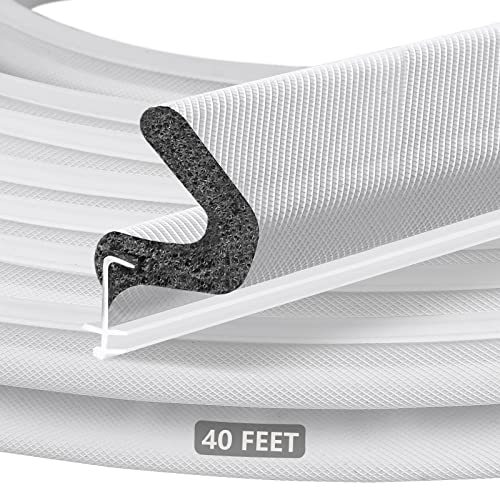
Unlike the adhesive strips, this white seal presses into a pre-cut groove, making it a candidate only when the French door frame has a compatible kerf. It fits a 1/8-inch kerf slot and closed gaps from 1/4 to 1/2 inch; the 40-foot roll can be cut for multiple doors. The maker says it helps reduce drafts and light leaks. It is not self-adhesive and is intended for grooved frames, so it is not a fit for a plain meeting edge without that slot.
Bottom line: Pick this only for a grooved frame with a compatible kerf and measured gap.
Elvone T-Shaped Silicone Seal, 20 ft

Elvone gives a wider T-shaped strip than the other T-seal here: its overall width is about 2 inches, and the thickness is 0.07 inch. The 20-foot clear silicone strip is cut-to-fit and is intended for gaps from 0 to 1 inch. Its design places the T-shaped portion at the gap, while the other side has no adhesive backing; that distinction matters when planning how it will attach across paired doors. Confirm the intended mounting orientation and ensure both doors can close freely before installation.
Bottom line: Consider this for a measured gap within its range when its T-profile mounting suits the seam.
Holikme Flexible Seal, 33 ft

Holikme is a broad peel-and-stick strip rather than a dedicated kerf seal, with two rolls totaling 33 feet and a 1.8-inch width. The maker says the flexible strip suits gaps up to 1.2 inches and can be cut to length for doors or windows. Its use includes sealing under interior doors, so the format may suit a broad, flat surface but is less specifically shaped for the narrow meeting edge of French doors. Check that the strip has a clean bonding surface and does not cross the latch path.
Bottom line: Choose it only if the center seam offers enough flat surface for the wide adhesive strip.
Aureyata D-Shaped EPDM Seal, 20 ft

Aureyata uses a hollow D-shaped EPDM profile, setting it apart from the flat or T-shaped strips in this group. Its specified fit is 5/16 to 15/32 inch, and the 20-foot white roll has mesh-reinforced adhesive backing. The hollow shape is designed to compress and rebound as the door opens and closes. That compression can help with an uneven seam, but the fit range is narrower than the kerf seal’s; measure several points along the closed doors and do not use it where the gap falls outside the range.
Bottom line: Pick this for an uneven center gap that measures within its range.
How to choose weather stripping for French doors
Measure the center gap with both doors closed before selecting a profile. Weather stripping works by filling or compressing into a gap; too-thick material can keep a latch from engaging, while too-thin material may leave an air path. A kerf seal requires a groove, while adhesive-backed strips need a clean, dry bonding surface. For the choices, a gap of 1/4 to 1/2 inch and a 1/8-inch frame slot points to a press-in kerf style; a gap of 5/16 to 15/32 inch matches the D-shaped seal’s range. If the seam varies, measure near the top, middle, and bottom rather than relying on one point.
| Measured condition | Style to consider |
|---|---|
| 1/8-inch kerf and 1/4–1/2-inch gap | Press-in kerf seal |
| 5/16–15/32-inch gap | Hollow D-shaped seal |
| Other gap or no groove | Compare adhesive profile and confirm fit before installation |
Where French door seals go
The meeting stile is the vertical edge where the two French door panels meet; weather stripping there must seal the joint without blocking the inactive door’s latch or flush bolts. Many paired doors use an astragal, a vertical strip attached to one door that overlaps the other, rather than a simple adhesive strip on the face. Check whether an astragal is already present and whether the gap is between door edges or between the door and frame. A door-to-frame seal addresses a different gap than a center seam, so identify the leaking joint before choosing a profile.
For any strip, close the doors and confirm the sealing surface stays continuous from top to bottom. Keep the latch, hinges, and flush-bolt hardware clear; do not use a thick strip to compensate for a door that is out of alignment.
Installing a center-gap door seal
Clean and dry the bonding area before applying an adhesive seal, then measure, cut, peel, and press it into place. Adhesive grip depends on surface cleanliness and temperature; the maker of the D-shaped option advises warming the adhesive in cold weather and allowing 24 hours to bond. Press-in kerf material needs the old seal removed and the groove cleaned before the flange is pushed firmly into the slot. Test the doors repeatedly after fitting: both panels should close and latch normally, with no strip buckling or pulling loose at the ends.
Do not apply adhesive over dust, moisture, loose paint, or a moving hardware surface. If the doors need force to close after installation, remove or reposition the seal rather than forcing the latch.
Common French door weather stripping mistakes
The most common fit error is buying by roll width instead of the closed gap range. Width describes how much surface a strip covers, while a gap rating describes the opening its profile is meant to seal; those measurements are not interchangeable. A second error is treating a kerf seal as adhesive-backed: the press-in option needs a 1/8-inch groove, so it cannot substitute directly for a surface-mounted strip. A third is sealing the wrong joint, such as fitting a door-frame strip when the draft comes through the center meeting stile.
Before installation, verify the gap range, mounting surface, and hardware clearance. French door panels must still align and latch correctly after the seal is compressed.
Frequently Asked Questions
How do I measure the gap between French doors?
Close both doors and measure the opening between their meeting edges at the top, middle, and bottom. Use the largest and smallest readings to check whether the gap stays within a seal’s range.
Can I use kerf weather stripping without a groove?
No; a kerf seal presses into a slot in the frame, and this option is sized for a 1/8-inch kerf. A plain surface needs a compatible adhesive-mounted profile instead.
What is an astragal on French doors?
An astragal is a vertical strip on one leaf of a pair of doors that overlaps the other leaf at the center seam. Check for one before adding weather stripping, since it changes the sealing surface and clearance.
How much room should weather stripping take up?
Use a seal whose gap range includes the measured closed gap, and test that the doors latch without force. For example, the D-shaped option is specified for 5/16 to 15/32 inch.
How long should I wait before using adhesive weather stripping?
The maker of the D-shaped seal advises allowing 24 hours for its adhesive to bond. Keep that strip undisturbed during the bonding period and test the doors afterward.