
Flexible Drain Pipe for Bathtub: 3 Kits Compared

For a flexible bathtub drain pipe with an adjustment range, choose Flexible Freestanding Tub Drain Kit, 1-1/2 in: its hose stretches from 12.6 to 38.6 inches. Pick Qrity Flexible Low-Profile P Trap, 1-1/2 in or YYinno Flexible Flat P Trap Kit, 1-1/2 in instead if you prefer a different flexible-trap design or slip-joint connections.
These low-profile P-trap kits connect a tub drain to a drain line while retaining water in the trap; measure the available space and connection points before choosing.
We earn a commission if you buy through links on this page. As an Amazon Associate I earn from qualifying purchases. Products are compared on manufacturer specifications, not hands-on testing.
- Best overall: Flexible Freestanding Tub Drain Kit, 1-1/2 in – Its hose adjusts from 12.6 to 38.6 inches for varied drain layouts.
- Best for flexible bending: Qrity Flexible Low-Profile P Trap, 1-1/2 in – Its PP body is described as bending 360° for installation adjustment.
- Best for slip-joint connections: YYinno Flexible Flat P Trap Kit, 1-1/2 in – Its slip-joint connections are intended for tool-light installation.
| Product | Best for | Adjustability | Connection | Shop |
|---|---|---|---|---|
| Flexible Freestanding Tub Drain Kit, 1-1/2 in | Variable drain reach | 12.6–38.6 in | Threaded nut | Check Price on Amazon |
| Qrity Flexible Low-Profile P Trap, 1-1/2 in | Flexible PP body | 360° bending | Elbow and plug | Check Price on Amazon |
| YYinno Flexible Flat P Trap Kit, 1-1/2 in | Slip-joint setup | Flexible design | Slip-joint | Check Price on Amazon |
Flexible bathtub drain pipes
Compare diameter, adjustment and connection style, then match the kit to your tub’s drain layout and available clearance.
Flexible Freestanding Tub Drain Kit, 1-1/2 in

Flexible Freestanding Tub Drain Kit, 1-1/2 in stands out for its 12.6-to-38.6-inch stretch range, which can help when a freestanding tub’s drain and waste line are separated by a changing distance. The kit uses a low-profile flat P-trap and a 1-1/2-inch nut that connects to a threaded drain of the same size; the maker also mentions RV bathtub use. Measure the installed path rather than relying on the maximum extension, since bends and fittings affect the reach you need. The specifications do not identify its material, which matters if you need to match a specific pipe or fitting system.
Bottom line: Choose this when the drain-to-line distance may require adjustment within its 12.6-to-38.6-inch range.
Qrity Flexible Low-Profile P Trap, 1-1/2 in
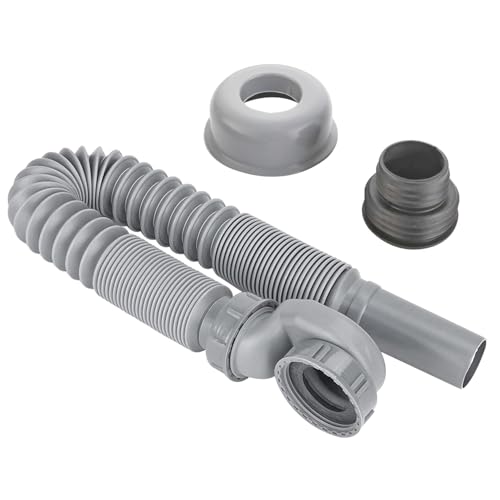
Qrity Flexible Low-Profile P Trap, 1-1/2 in is distinguished by its 360° bendable PP body and an elbow-and-plug construction. Its low-profile form is intended for low-position fixtures such as bathtubs and mop sinks, and the maker describes the material as corrosion- and aging-resistant. The 1-1/2-inch size matches the other kits here, but the fields give no extension range or connection details to compare. That makes it a less certain pick when you must bridge a measured gap or match a particular threaded or slip-joint fitting; confirm those interfaces against your existing drain before planning the installation.
Bottom line: Choose this if bendable PP construction is your priority and the connection points match.
YYinno Flexible Flat P Trap Kit, 1-1/2 in

YYinno Flexible Flat P Trap Kit, 1-1/2 in differs by specifying slip-joint connections, a useful distinction when the planned installation uses compatible slip-joint fittings. The kit has a low-profile flat P-trap design for freestanding tubs, and its maker positions it for both new construction and remodeling. This option suits buyers who can confirm the connection style and physical fit first; it may not work as a substitute for a threaded connection without compatible fittings.
Bottom line: Choose this when compatible slip-joint fittings are part of your planned setup.
How to choose a flexible bathtub drain pipe
Start with the drain diameter and connection type, then compare the distance and clearance beneath the tub. All three kits here are 1-1/2 inch, but their adjustment and connection information differs: one gives a 12.6-to-38.6-inch range, one describes a 360° bend, and one specifies slip-joint connections. Measure between the tub outlet and drain-line connection with the tub in its final position; include the path around obstructions, not just the straight-line gap. If your measured route needs more than 38.6 inches, the adjustable range on Flexible Freestanding Tub Drain Kit, 1-1/2 in is not enough. Before concealing any trap or pipe, confirm that the product and installation meet local plumbing code requirements.
Measure clearance and drain reach
Measure vertical clearance from the underside of the tub to the floor or other obstruction, and measure the horizontal route to the drain connection. A low-profile label alone does not establish that a trap will fit: compare the actual installed shape and fittings with the space available. A useful decision rule is to reject any kit whose required bend or connection points cannot fit within the measured clearance, even if its flexible body can bend. Keep the trap aligned so its outlet can connect without forcing a joint sideways. Allow access for assembly and future service; a connection buried behind a finished panel is harder to inspect if it loosens or leaks.
Understand the P-trap and flexible pipe tradeoffs
A P-trap holds water in its curved section to form a barrier between the drain and the room; a flexible body changes routing, not that basic function. Flexible designs can simplify tight layouts, while fixed rigid pipe keeps a defined shape and may be easier to support consistently. Corrugated or highly bendable sections can collect debris more readily than a smooth, properly aligned drain path, so avoid unnecessary bends and low spots. Flexible components also do not automatically meet every plumbing code or tub manufacturer’s requirements. Check local rules before enclosing the installation, especially where a drain assembly will be inaccessible after construction.
| Installation need | What to prioritize |
|---|---|
| Variable measured gap | Documented adjustment range |
| Curved route around an obstruction | Flexible body and enough clearance |
| Existing slip-joint fittings | Compatible slip-joint connections |
| Threaded 1-1/2-inch drain | Matching threaded connection |
Installation checks and common mistakes
Dry-fit the components before tightening or closing the access area, and check that each connection aligns without pulling the pipe out of shape. Do not assume a flexible trap can be stretched to its limit and still reach cleanly around bends; leave enough slack for its installed route. Match threaded fittings to threads and slip-joint fittings to compatible slip-joint parts rather than forcing unlike connections together. After assembly, run water and inspect every joint for leaks before finishing the surrounding enclosure. Keep the trap accessible when practical, and avoid relying on a flexible drain to correct a drain outlet positioned at the wrong height.
Frequently Asked Questions
What size pipe do most bathtub drains use?
A 1-1/2-inch drain connection is common for residential tubs, and all three kits here are that size. Verify the outlet and drain-line connection before buying, since matching diameter does not guarantee matching threads or joint style.
Does a bathtub P-trap need to hold water?
Yes, the water retained in a P-trap forms a seal between the drain and the room. Keep the trap correctly oriented and connected so it can retain that seal rather than routing around it.
Can a flexible bathtub drain pipe be concealed?
Only after confirming the product and installation meet local plumbing rules and the tub maker’s requirements. Flexible joints are harder to inspect once enclosed, so test for leaks and preserve service access where possible.
How do I measure a flexible tub drain?
Measure the actual route from the tub outlet to the drain-line connection with the tub in its final position, including bends and obstacles. For Flexible Freestanding Tub Drain Kit, 1-1/2 in, the stretch range is 12.6 to 38.6 inches, but a routed path may require more length than a straight measurement.
Are flexible bathtub traps harder to clean?
They can be, particularly when the route has corrugations, extra bends or low spots where debris can collect. Keep the path as direct as the layout permits and retain access for inspection and cleaning.