
Foam Interlocking Floor Tiles: 4 Sets Compared

For most home gyms, 32-Tile EVA Gym Mat Set stands out because its 32 half-inch tiles cover 128 square feet. Choose a different set if you need smaller individual tiles, a smaller coverage area, or a teak finish.
Interlocking foam floor tiles connect at puzzle-shaped edges to form a removable cushioned surface.
We earn a commission if you buy through links on this page. As an Amazon Associate I earn from qualifying purchases. Products are compared on manufacturer specifications, not hands-on testing.
- Best overall: 32-Tile EVA Gym Mat Set – Thirty-two 24-inch tiles provide 128 square feet of coverage at ½ inch thick.
- Best for a 48-square-foot area: ProsourceFit 12-Tile Puzzle Mat – Twelve 24-inch tiles cover 48 square feet and are ½ inch thick.
- Best for smaller tiles: Haulcove 18-Tile EVA Set – Each tile measures 12.6 inches square and 0.4 inch thick.
- Best for a teak finish: Art3d Teak 24-Tile Mats – The 24-tile set has a teak finish and covers 96 square feet.
| Product | Best for | Tile dimensions | Thickness | Coverage | Shop |
|---|---|---|---|---|---|
| 32-Tile EVA Gym Mat Set | Large home gyms | 24 × 24 in | 0.5 in | 128 sq ft | Check Price on Amazon |
| Haulcove 18-Tile EVA Set | Compact layouts | 12.6 × 12.6 in | 0.4 in | 18 sq ft | Check Price on Amazon |
| ProsourceFit 12-Tile Puzzle Mat | 48-square-foot gyms | 24 × 24 in | 0.5 in | 48 sq ft | Check Price on Amazon |
| Art3d Teak 24-Tile Mats | Decorative gym floors | 24 × 24 in | 0.5 in | 96 sq ft | Check Price on Amazon |
Foam interlocking floor tiles compared
Compare tile dimensions and coverage first, then match thickness and surface to the room and activity.
32-Tile EVA Gym Mat Set

For a larger continuous workout area, this set provides the most coverage among these options: 32 tiles measuring 24 by 24 inches cover 128 square feet. The 0.5-inch high-density EVA foam has a textured surface, and puzzle edges connect or separate without tools. The maker says the material offers shock absorption and the texture enhances grip. This set suits home workouts and equipment areas where a broad foam surface is the priority. Its black finish and large tiles may be less suitable when you want a decorative look or need a layout built from smaller pieces.
Bottom line: Choose this set when you want broad coverage from half-inch tiles.
Haulcove 18-Tile EVA Set

Unlike the 24-inch options, this Haulcove set uses smaller 12.6-inch tiles and covers 18 square feet, making it suited to a compact exercise zone. Each tile is 0.4 inch thick, with textured top and bottom surfaces. The maker says the EVA foam is water-resistant and wipes clean after sweat, light spills, or dirt; the lightweight tiles can also be rearranged and stacked for storage. The smaller pieces allow more layout flexibility, but this set covers far less floor area than the 48-, 96-, and 128-square-foot choices.
Bottom line: Pick it for a small zone where compact tiles are useful.
ProsourceFit 12-Tile Puzzle Mat
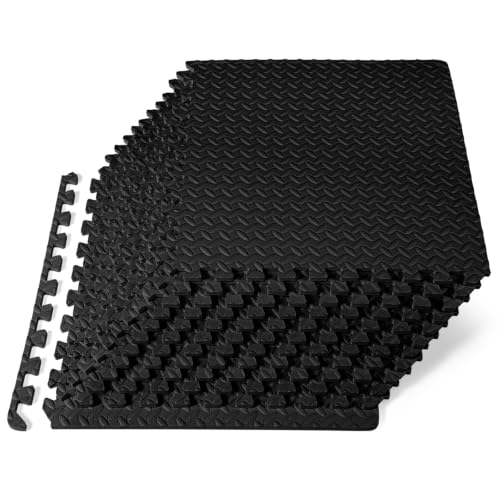
For a 48-square-foot workout area, this set pairs twelve 24-inch tiles with a half-inch thickness. Its distinguishing points are the absence of toxic phthalates and a water-resistant, noise-reducing design. The maker describes the EVA foam as non-skid and recommends flat, hard surfaces for best results; it also identifies carpet protection as a use. This is a practical middle ground if the 128-square-foot set is more coverage than needed. The black finish and 12-tile count offer less coverage than either larger 24-inch set.
Bottom line: Choose it when 48 square feet of half-inch matting is enough.
Art3d Teak 24-Tile Mats
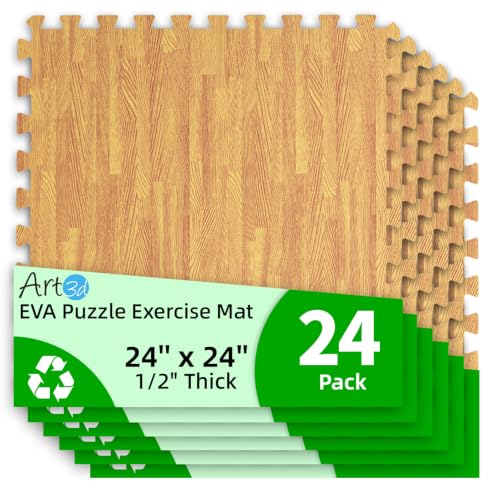
A teak finish distinguishes this Art3d set from the black choices, while its 24 tiles measure 24 inches square and cover 96 square feet at 0.5 inch thick. Puzzle edges and included edge pieces create a finished perimeter, and the textured surface is described by the maker as non-slip. The maker says the cushioning supports workouts and helps protect floors from equipment or exercise impact. This suits a home gym where a wood-look finish matters alongside substantial coverage. Its 96-square-foot area is smaller than the 128-square-foot option but larger than the 48-square-foot set.
Bottom line: Pick it for a wood-look finish with substantial workout-area coverage.
How to choose foam interlocking floor tiles
Start with the floor area you need to cover, then compare tile thickness and surface features. A 24-inch square tile covers 4 square feet; multiplying tile count by 4 gives a quick coverage check for that size. For example, 12 such tiles cover 48 square feet. These sets range from 18 to 128 square feet, so measure the exercise zone rather than assuming a pack will fill the whole room. If equipment feet or your workout area require a close fit, sketch the layout and account for perimeter edges before choosing a pack. For a compact area or flexible arrangement, 12.6-inch tiles create smaller increments; their coverage is 18 square feet in the set here.
Tile thickness and floor fit
Thickness changes cushioning and the height of the finished surface: the sets here use 0.4- or 0.5-inch foam. Choose the thinner 0.4-inch option when minimizing the added floor height matters; choose a half-inch set when that extra thickness better suits your exercise area. Foam tiles work best on a clean, level surface because grit or uneven flooring can interfere with the tile edges and create an unstable feel. Leave clearance around doors and fixed equipment, and check that tile edges do not obstruct a doorway. Foam is not a substitute for a purpose-built load-bearing gym floor; use appropriate flooring for heavy equipment or concentrated loads.
Coverage, layouts and tile counts
Tile dimensions determine how many seams and cuts a layout needs. A 24-inch square tile is 2 feet by 2 feet, while a 12.6-inch tile is just over 1 foot square; smaller pieces make finer adjustments around an odd-shaped zone but add more seams. Use this coverage comparison to narrow the set before planning the border.
| Tile size | Set coverage | Practical fit |
|---|---|---|
| 12.6 × 12.6 in | 18 sq ft | Small zone or finer layout increments |
| 24 × 24 in | 48 sq ft | Smaller workout area |
| 24 × 24 in | 96 sq ft | Large area with teak finish |
| 24 × 24 in | 128 sq ft | Largest workout area here |
Choose based on measured usable floor area, not the room’s full dimensions if furniture, equipment, or doors occupy part of it.
Cleaning and everyday use
Water-resistant foam surfaces can be wiped after light spills or sweat, but moisture should not be left trapped beneath a floor mat. Move tiles periodically to dry the floor underneath, especially over wood or other moisture-sensitive surfaces. Remove grit before reconnecting tiles, since debris can keep puzzle edges from sitting flush. Foam is intended as a cushioned exercise surface, not a hardwearing replacement for flooring under heavy rolling loads; large equipment may compress foam at its contact points. Use a flat, clean base and inspect seams after rearranging the layout so edges remain connected and level.
Frequently Asked Questions
How many square feet does one 24-inch tile cover?
A 24-inch square tile covers 4 square feet because each side is 2 feet. Multiply the tile count by 4 to estimate total coverage before accounting for layout cuts or edge pieces.
Can foam interlocking tiles go over carpet?
Some foam mats are described for carpet protection, but a stable, flat surface is generally preferable for exercise. Deep or plush carpet can shift underfoot, so test the assembled surface for movement before doing workouts on it.
How thick should foam workout tiles be?
The sets here are 0.4 or 0.5 inch thick, so choose based on the cushioning and added floor height you need. Check door clearance if the mat will sit near a doorway.
How do you keep puzzle floor tiles from separating?
Fit the puzzle edges fully together on a clean, level floor and avoid pulling the surface sideways during exercise. Recheck the seams after moving tiles or equipment, since an uneven base can make connections work loose.
Can exercise equipment sit on foam floor tiles?
These mats are intended for workout equipment areas, but foam can compress under concentrated loads. For heavy equipment or small feet that concentrate weight, use flooring rated for the load rather than relying on foam alone.