
Ford 300 Inline 6 Carburetors Compared by Fit

For a 1975–1982 Ford 300 inline-six with a Carter YF-style setup, KIPA D5TZ9510AG YF-Style Carburetor is the closest fit because its engine range and replacement numbers include D5TZ9510AG. Choose another option if your engine year, carburetor style or original part number differs; the 1-barrel carburetor must match the intake and linkage as well as the engine.
We earn a commission if you buy through links on this page. As an Amazon Associate I earn from qualifying purchases. Products are compared on manufacturer specifications, not hands-on testing.
- Best overall: KIPA D5TZ9510AG YF-Style Carburetor – Its 1975–1982 Ford 300 fit and D5TZ9510AG replacement number align with the target application.
- Best for dimensions: maXpeedingrods YFA 1-Barrel Carburetor – It gives a 43 mm air-inlet bore and 75 mm center-to-center mounting-stud spacing.
- Best for gasket extras: YF Carter D5TZ9510AG Replacement Carburetor – Its package includes one carburetor and three gaskets.
| Product | Best for | Fitment years and engines | Choke | Shop |
|---|---|---|---|---|
| KIPA D5TZ9510AG YF-Style Carburetor | 1975–1982 Ford 300 | 1975–1982; 240/250/300 inline six | Automatic | Check Price on Amazon |
| THUNDERMINGO D5TZ9510AG YF Carburetor | Carter YF replacements | 1975–1982; 240/250/300 six | Automatic | Check Price on Amazon |
| YF Carter D5TZ9510AG Replacement Carburetor | Gasket-included package | 1975–1982; 240/250/300 six | — | Check Price on Amazon |
| D5TZ9510AG YF/YFC1 Carburetor | Ford truck applications | 1975–1982; 240/250/300 six | Automatic | Check Price on Amazon |
| maXpeedingrods YFA 1-Barrel Carburetor | Measured mounting fit | 1965–1985; 200/250/300 six | Automatic | Check Price on Amazon |
Ford 300 Inline 6 Carburetors
Compare engine-year fit, choke type and stated dimensions before choosing a 1-barrel replacement.
KIPA D5TZ9510AG YF-Style Carburetor

For the 1975–1982 Ford 300 application, this 1-barrel replacement identifies D5TZ9510AG and D4PZ9510AC among its replacement numbers. The maker also lists fitment for 240 and 250 inline-six engines and several Ford truck and van lines, so match the engine and original carburetor rather than relying on vehicle name alone. The automatic choke suits a setup built for that choke arrangement. Its fit range ends in 1982; buyers with later engines or a different carburetor configuration should verify the exact number and linkage before choosing.
Bottom line: Choose this for a 1975–1982 Ford 300 when the original number and YF-style setup match.
THUNDERMINGO D5TZ9510AG YF Carburetor

This YF-type replacement is aimed at 1975–1982 Ford 240, 250 and 300 six-cylinder engines, with D5TZ9510AG and RSC-300A among its replacement identifiers. It also names several Carter-related numbers, which can help when comparing an old unit’s markings. The automatic choke is a key configuration match, not just a convenience: the intake, choke wiring or heat connection, and throttle linkage need to suit the existing installation. The maker mentions other single-barrel applications too, but those broadened uses are not a substitute for confirming the Ford engine and carburetor number.
Bottom line: Pick this when the existing Ford carburetor matches its YF-type and replacement-number range.
YF Carter D5TZ9510AG Replacement Carburetor

The distinguishing point here is the included gasket set: the package contains one carburetor and three gaskets. The application is a 1975–1982 Carter YF-style setup for Ford 240, 250 and 300 six-cylinder engines, using D5TZ9510AG as the replacement number. That makes the number and carburetor style important checks before installation. The maker does not identify a choke arrangement, so buyers replacing an automatic-choke unit should confirm that the replacement matches their current setup before ordering; year and engine match alone do not establish every connection.
Bottom line: Choose this if you want the YF replacement package with three gaskets.
D5TZ9510AG YF/YFC1 Carburetor

This replacement focuses on Ford 240, 250 and 300 six-cylinder engines from 1975–1982 and identifies the Carter YF/YFC1 type. It also names D5TZ9510AG, RSC-300A and multiple related numbers, making original-number comparison useful for narrowing fit. The automatic choke is a configuration-specific feature; verify that the vehicle’s choke connections and throttle linkage correspond to the existing carburetor. Treat the engine and number compatibility as the useful selection criteria.
Bottom line: Pick this when the Ford engine, automatic choke and YF/YFC1 identification agree.
maXpeedingrods YFA 1-Barrel Carburetor
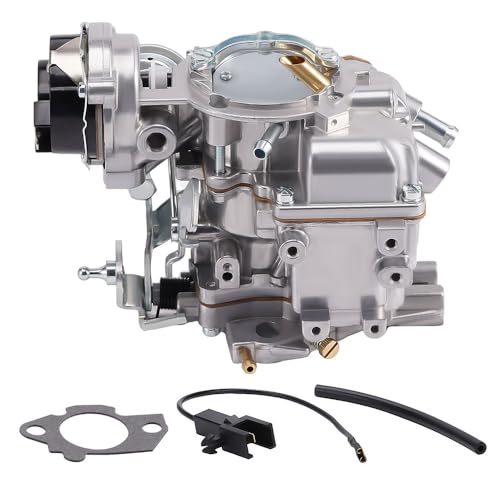
This YFA-style option provides the most explicit mounting dimensions: 75 mm between mounting studs, a 43 mm air-inlet bore, and a 48 mm inner choke-air-horn diameter. Those measurements can help compare an existing carburetor and intake, especially where engine-year coverage is broader at 1965–1985 for 200, 250 and 300 engines. It is listed with an automatic choke and replacement numbers including D5TZ9510AG. Before choosing it, verify that the original carburetor is YFA-style and compare the mounting and bore dimensions; broad year coverage does not guarantee matching linkage or every engine configuration.
Bottom line: Choose this when measured YFA mounting dimensions are the deciding fit check.
How to match a Ford 300 carburetor
Match the carburetor by original part number, carburetor family and engine year before comparing vehicle names. YF and YFA are one-barrel Carter-style families, but a similar appearance does not prove that the base, choke, fuel inlet and throttle connections match. Check the number stamped on the old carburetor or its identification tag, then compare it with the replacement number. Also compare the mounting-stud spacing and air-horn opening when those measurements are available. A decision rule: if the old part number is not in the replacement’s cross-reference, do not assume a Ford 300 label alone guarantees compatibility; confirm the base pattern and linkage dimensions first.
YF versus YFA carburetor fit
YF and YFA labels indicate related one-barrel carburetor types, but fit depends on the exact casting, application and connections. Ford 300 engines span different years and configurations, so broad year claims can include several possible arrangements. The YFA replacement gives 75 mm center-to-center stud spacing and a 43 mm air-inlet bore; compare those dimensions with the old carburetor and intake rather than estimating by eye. A replacement with an automatic choke also needs the matching choke setup. This matters most when changing between carburetor variants or installing a replacement on a vehicle with altered linkage. Treat the engine family as a starting point, not the only fit test.
Carburetor installation and tuning checks
A carburetor meters fuel and mixes it with incoming air, while the choke restricts air during cold starts. After installation, check for fuel leaks, secure fuel and vacuum connections, and verify throttle movement returns freely before starting the engine. Keep fuel away from ignition sources and work only on a cool engine in a ventilated area. Idle mixture and speed depend on engine condition, ignition timing, vacuum leaks and altitude, so a new carburetor cannot compensate for a mechanical fault. If idle remains unstable, inspect for vacuum leaks and confirm ignition timing before changing mixture settings. Use the engine’s service procedure for final adjustments.
Common Ford 300 carburetor fit mistakes
The common mistake is choosing by vehicle model or displacement while overlooking year, carburetor family and choke arrangement. A truck with a 300 six may have been modified, and a replacement that shares a D5TZ9510AG cross-reference still needs compatible mounting and linkage. Another mistake is assuming a claimed performance improvement will apply to every engine; carburetor calibration, engine condition and installation affect results. Compare the old unit’s number, base dimensions, fuel inlet position and choke connections. If those do not line up, confirm the exact replacement application before installation. Never test for leaks with an open flame; gasoline vapor can ignite.
Frequently Asked Questions
What carburetor type does a Ford 300 inline six use?
The products here are one-barrel Carter YF or YFA-style replacements, but the correct type depends on the engine’s year and original configuration. Match the existing carburetor number and mounting pattern rather than relying on displacement alone.
How do I check the carburetor mounting size?
Measure the distance between the centers of the mounting studs and compare the air-inlet opening. One listed YFA model gives 75 mm stud spacing and a 43 mm inlet; measurements from the installed carburetor are the better fit check.
Does a Ford 300 carburetor need an automatic choke?
Only if the existing application uses an automatic choke and the replacement connections match it. Check the old choke mechanism and wiring or heat connection before selecting an automatic-choke carburetor.
Can a 1975 carburetor fit a 1985 Ford 300?
Not automatically: some YFA coverage is stated through 1985, while several D5TZ9510AG YF options specify 1975–1982. Verify the original carburetor number, family and mounting dimensions for the specific engine.
What should I check after installing a carburetor?
Check for fuel leaks and confirm that the throttle linkage moves freely and returns before starting the engine. Keep ignition sources away from fuel and vapor, and perform idle adjustment only after checking for vacuum leaks and ignition issues.