
Gas Tanks for Outboard Boat Motors: 5 Compared

For a compact outboard setup, choose VEVOR 3.17-Gallon Marine Tank for its 3.17-gallon capacity and included 9.8-foot hose with Yamaha-compatible connectors. Choose a different tank if you need more fuel capacity or your motor uses another connector; connector fit is essential for a usable fuel line.
Portable outboard tanks hold gasoline separately from the engine and feed it through a fuel hose, so capacity and connector compatibility are the key buying checks.
We earn a commission if you buy through links on this page. As an Amazon Associate I earn from qualifying purchases. Products are compared on manufacturer specifications, not hands-on testing.
- Best overall: VEVOR 3.17-Gallon Marine Tank – Its 3.17-gallon tank includes a 9.8-foot hose and Yamaha-compatible connectors.
- Best for longer outings: VEVOR 14.53-Gallon Marine Tank – Its 14.53-gallon capacity holds more fuel than the other options.
- Best for mid-size capacity: VEVOR 6.34-Gallon Marine Tank – Its 6.34-gallon tank includes a 9.8-foot hose described as fitting most marine tank interfaces.
| Product | Best for | Capacity | Hose and connector | Tank material | Shop |
|---|---|---|---|---|---|
| VEVOR 3.17-Gallon Marine Tank | Compact Yamaha setups | 3.17 gal | 9.8 ft; Yamaha-compatible | HDPE | Check Price on Amazon |
| VEVOR 6.34-Gallon Marine Tank | Mid-size capacity | 6.34 gal | 9.8 ft; most marine interfaces | Polyethylene | Check Price on Amazon |
| VEVOR 14.53-Gallon Marine Tank | More fuel capacity | 14.53 gal | 9.8 ft; Yamaha-compatible | — | Check Price on Amazon |
| 3-Gallon Portable Tank with Gauge | Simple level checks | 3 gal | Hose included; connector — | — | Check Price on Amazon |
| STMHOM 3-Gallon Marine Tank | Portable 3-gallon use | 3 gal (12 L) | Line included; connector — | — | Check Price on Amazon |
Gas Tanks for Outboard Boat Motors
Compare tank capacity and hose compatibility first, then match the tank to your available storage space.
VEVOR 3.17-Gallon Marine Tank

The 3.17-gallon size makes this a compact choice, and the included 9.8-foot hose has a 6 mm inner diameter and Yamaha-compatible connectors. The tank is high-density polyethylene (HDPE), and the maker says it resists aging, impact and corrosion. Its 14.4-inch length and 11.6-inch width help gauge storage fit, though check clearance for the 10.2-inch height too. This tank suits an outboard setup that matches the connector type and needs a smaller fuel reserve. The Yamaha connector compatibility is a limitation for owners whose motor or fuel system uses a different fitting.
Bottom line: Pick this for a compact tank when the Yamaha-compatible hose fitting matches your setup.
VEVOR 6.34-Gallon Marine Tank

The 6.34-gallon capacity offers more reserve than the 3-gallon-class tanks without moving to the largest option here. It includes a 9.8-foot hose with an 8 mm inner diameter; the maker says the hose fits most marine tank interfaces, so confirm your fitting before relying on that match. The polyethylene tank has a visible gauge for checking fuel level. Its 18.11-inch length, 12.8-inch width and 10.24-inch height are useful for planning a storage spot. The broader claimed interface compatibility is not universal, so buyers needing a known connector type should verify their motor connection.
Bottom line: Choose this when you want 6.34 gallons and the hose fitting matches your motor.
VEVOR 14.53-Gallon Marine Tank

The 14.53-gallon capacity is the largest in this group, making this tank the option for setups that prioritize carrying more fuel over compact storage. It includes a 9.8-foot hose with an 8 mm inner diameter and Yamaha-compatible connectors. The tank measures 24.8 inches long, 18.31 inches wide and 12.2 inches high, so measure the intended compartment before selecting it. The maker recommends filling to 80% of capacity to reduce evaporation and safety risks; apply that recommendation when planning usable fuel volume. The Yamaha-specific connector may rule it out for other fuel-system fittings.
Bottom line: Pick this when capacity matters more than a small storage footprint and the connector fits.
3-Gallon Portable Tank with Gauge
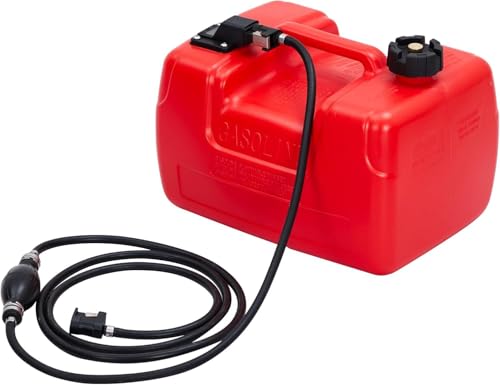
The clear fuel-level window is the distinguishing feature of this 3-gallon tank, letting owners check the remaining supply without relying only on a calculated consumption estimate. It includes a hose and has an I-shaped carrying handle, plus an adjustable cap with sealing and venting modes. The product also describes a built-in air-inlet filter. Connector compatibility is the key limitation: verify that the hose end mates with your outboard fuel system.
Bottom line: Choose this if a visible fuel gauge and carry handle matter most, after confirming hose fit.
STMHOM 3-Gallon Marine Tank

The STMHOM is another 3-gallon portable tank, with a 12-liter capacity, I-shaped handle, fuel-level indicator and integrated air-inlet filter. Its cap offers sealing and venting modes, which lets the owner select the appropriate cap position for storage or use. At this capacity, it fits buyers seeking a small portable supply rather than the larger reserve offered by the 6.34- and 14.53-gallon tanks.
Bottom line: Choose this for a 3-gallon portable tank with an indicator, once the line fitting is confirmed.
How to choose an outboard fuel tank
Choose by connector first, then by the amount of fuel you can safely carry and store. A portable tank is only useful if its fuel hose and engine-side connector match; the hose diameter alone does not establish connector fit. Next, compare tank capacity with the space available and the engine’s fuel demand. A 3-gallon tank is easier to position than a 14.53-gallon tank, but capacity alone cannot predict runtime because outboard fuel use varies with engine size, load and throttle. Measure the storage area in all three dimensions and leave access to the cap and hose. Avoid choosing solely by gauge or handle features if the connector is incompatible.
Tank capacity and storage fit
Portable tanks in this group range from 3 to 14.53 gallons, a wide difference in both carried fuel and storage footprint. Use the largest capacity only if the boat has enough secure, ventilated space for the tank and its hose; a full tank weighs substantially more than an empty one, so account for fuel weight when handling it. For a space narrower than 12 inches, the 11- to 11.6-inch-wide options are the only ones with a reported width near that threshold; allow extra room to lift and remove the tank. Measure the complete compartment rather than the opening alone, and keep the tank from shifting while underway.
| Need | Capacity range here | Selection point |
|---|---|---|
| Compact portable supply | 3–3.17 gal | Confirm connector and stowage fit |
| Middle capacity | 6.34 gal | Check hose interface claim |
| Largest reserve | 14.53 gal | Plan space and full-tank handling |
Fuel hose and connector compatibility
Match the tank hose to the outboard’s fuel connection before buying; connector style matters more than a close-looking hose diameter. Among these options, two VEVOR tanks specify Yamaha-compatible connectors, while another says its hose fits most marine tank interfaces. The 3-gallon products identify an included hose or line but do not identify its connector in the specifications, so verify the fitting before ordering. Hose lengths here reach 9.8 feet, which can help when tank placement is farther from the motor, but avoid routing a hose where it can kink, chafe or obstruct movement. A clean, secure connection helps prevent leaks.
Safe use and storage of portable gasoline tanks
Gasoline vapors ignite easily, so keep portable tanks away from flames, sparks and smoking, and refuel with the engine off. Leave expansion space rather than filling a tank to the brim; one maker here recommends an 80% fill level for its large tank. Keep the cap and vent configured as intended for the tank’s current use, since a sealed tank and a vented tank serve different conditions. Secure the tank upright and protect it from prolonged direct sun; one maker cautions that extended sunlight can age and expand its tank. If gasoline spills, stop and clean it up before restarting the motor, and ventilate enclosed areas.
Frequently Asked Questions
How much fuel does an outboard motor use per hour?
Fuel use depends heavily on horsepower, throttle and load, so tank capacity alone cannot give a reliable runtime. Use the engine manufacturer’s consumption figure for your motor and reserve fuel rather than planning to run a tank completely empty.
Can any portable tank connect to an outboard motor?
No; the tank’s hose connector must match the motor’s fuel inlet or any required fitting. Check connector type as well as hose diameter, because a matching diameter does not guarantee a compatible connection.
How much space should I leave in a boat gas tank?
Do not fill a gasoline tank to the brim because fuel expands with temperature changes. One maker in this group recommends an 80% fill for its 14.53-gallon tank; follow the tank’s cap and vent requirements as well.
How should I store a portable outboard fuel tank?
Store a portable gasoline tank upright, secured against movement, and away from ignition sources. Avoid prolonged direct sunlight, which one maker warns can contribute to tank aging and expansion.
Should a portable boat fuel tank be vented?
Use the tank’s venting arrangement as intended for the operating or storage condition; a vent position is not interchangeable with a sealed position. Keep gasoline vapor away from flames and sparks, and ventilate the boat before starting the engine.