
12 Volt DC Relay Options Compared by Type and Fit

For a general automotive switching choice, 5-Pin 12V SPDT Automotive Relay pairs a 12V DC coil with an SPDT contact layout and heavy-gauge primary leads. Choose a different type when the circuit needs a 4-pin SPST connection, multiple DPDT contacts, or an optocoupler-isolated control board.
A 12V DC relay uses a low-voltage coil to switch a separate contact circuit; confirm the load’s voltage, current, and wiring arrangement before choosing one.
We earn a commission if you buy through links on this page. As an Amazon Associate I earn from qualifying purchases. Products are compared on manufacturer specifications, not hands-on testing.
- Best overall: 5-Pin 12V SPDT Automotive Relay – Combines a 12V DC coil, SPDT contacts and 12 AWG primary leads for automotive wiring.
- Best for 4-pin wiring: Gebildet 12V 40A 4-Pin SPST Relay – Uses an SPST configuration and includes a 12 AWG harness socket with a built-in diode.
- Best for DPDT switching: MY2NJ 12V DPDT Relay with Socket – Provides two normally open and two normally closed contacts in an 8-pin socket relay.
| Product | Best for | Contact configuration | Connection type | Shop |
|---|---|---|---|---|
| 5-Pin 12V SPDT Automotive Relay | Automotive wiring | SPDT, 5-pin | 12 AWG primary leads | Check Price on Amazon |
| Gebildet 12V 40A 4-Pin SPST Relay | SPST harness setups | SPST, 4-pin | 12 AWG harness socket | Check Price on Amazon |
| EPLZON NT90 12V SPDT Relay | Quick-connect wiring | SPDT, 1NO/1NC | 10 quick-connect terminals | Check Price on Amazon |
| MY2NJ 12V DPDT Relay with Socket | Two-circuit switching | DPDT, 2NO/2NC | 8-pin socket base | Check Price on Amazon |
12 Volt DC Relay Options
Match the coil voltage, contact arrangement and connection style to the circuit you need to switch.
5-Pin 12V SPDT Automotive Relay
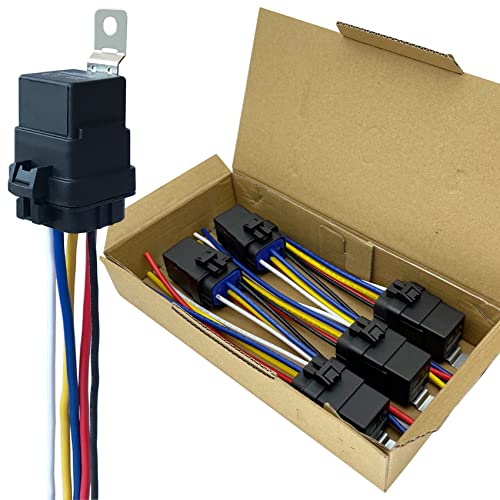
For a 5-pin automotive setup needing a changeover contact, 5-Pin 12V SPDT Automotive Relay combines an SPDT relay with heavy-duty wiring. Its primary leads use 12 AWG tinned copper, while the coil leads use 16 AWG; coil power is 1.8 W and resistance is 80 Ω. The maker says the housing repels water and dust, but it should not be used in water. The maker also advises staying 10 to 15% below the rated load. Choose another option if the circuit needs an integrated socket diode or a board-mounted control interface.
Bottom line: Choose this for 5-pin automotive switching with wired leads.
Gebildet 12V 40A 4-Pin SPST Relay

Unlike the changeover arrangement of 5-Pin 12V SPDT Automotive Relay, Gebildet 12V 40A 4-Pin SPST Relay is a 4-pin SPST relay with a harness socket and built-in diode. Its standard coil operating point is 12V, and the minimum operating voltage is 8V. The maker says the diode suppresses induced voltage during switching; polarity therefore matters, so wire the coil according to the harness and circuit requirements. Choose another option if you need SPDT contacts or a coil resistance.
Bottom line: Pick this for a 4-pin SPST circuit with a harness socket.
EPLZON NT90 12V SPDT Relay

EPLZON NT90 12V SPDT Relay differs from the automotive harness styles by arriving as a complete relay assembly with 10 quick-connect terminal wires and flange mounting. It has a 12V DC coil and SPDT contacts, with the rating given as 30A at 240VAC. Its dimensions are 1.97 × 1.05 × 1.1 inches. That AC contact rating should not be treated as a 30A DC rating; verify that the contact rating matches the circuit being switched. Choose another option if you specifically need a 12 AWG automotive socket harness.
Bottom line: Choose this when flange mounting and quick-connect wiring suit the installation.
MY2NJ 12V DPDT Relay with Socket

For two linked changeover circuits, MY2NJ 12V DPDT Relay with Socket uses a DPDT layout with two normally open and two normally closed contacts. The 12V DC coil sits in an 8-pin relay with a socket base; a mechanical indicator and LED signal lamp show relay state and coil energization. Its contact capacity is 10A at 240VAC, so that figure is not a DC load rating. Choose it for a socket-based control setup rather than a compact automotive harness, and check that the load’s voltage and current stay within the applicable contact rating.
Bottom line: Pick this for an 8-pin socket installation needing DPDT contacts.
How to choose a 12 volt DC relay
Start with the coil supply, then match the contacts to the switched circuit. A 12V DC coil is the control side; its voltage does not tell you the contact side’s allowable voltage or current. SPST contacts switch one circuit on or off, while SPDT contacts select between normally open and normally closed paths; DPDT operates two such paths together. Compare the load’s voltage and current against the contact rating for that load type. For example, a rating stated at 240VAC cannot be assumed to apply at DC. When the load is near the relay’s limit, choose a relay with headroom rather than sizing exactly to the nominal current.
| Need | Contact arrangement | Connection style |
|---|---|---|
| Single on/off path | SPST | Four-pin harness |
| Choose between two paths | SPDT | Five-pin automotive or terminal-wired relay |
| Switch two paths together | DPDT | Eight-pin socket relay |
| Controller signal isolation | One-channel relay board | Screw terminals |
Relay contact layouts and pin counts
Pin count is useful only when it matches the relay’s wiring diagram and socket. A common automotive SPDT arrangement has five terminals, often numbered 30, 85, 86, 87 and 87a; verify the diagram because terminal function matters more than appearance. SPST relays commonly use four terminals for a coil and one switched contact path. DPDT relays use more terminals because they switch two paths, and an 8-pin socket is a different footprint from a vehicle harness. Do not force a relay into a socket: bent female contacts can prevent reliable electrical contact. For a relay with an internal diode, observe coil polarity rather than assuming either coil terminal can be positive.
Match relay ratings to the load
Choose a contact rating for the actual load voltage and current, not just the coil’s 12V label. DC loads such as motors can draw more current at startup than while running, and inductive loads can create switching arcs; allow margin and use a rating specified for the relevant DC load. A relay marked 30A at 240VAC does not establish a 30A DC capacity. For automotive selection, the maker of 5-Pin 12V SPDT Automotive Relay recommends staying 10 to 15% below its rating; treat this as specific guidance for that relay rather than a universal rating rule. Never use a water-repellent enclosure as permission to submerge a relay or socket.
Wiring and installation precautions
Keep the coil circuit and switched-load circuit distinct when planning connections. Fuses protect wiring from overcurrent and should be sized for the wire and load, not simply copied from a relay’s maximum contact rating. A relay’s wire gauge also matters: thicker primary leads can carry more current than thinner leads under comparable conditions, but allowable current depends on insulation, installation and length. Secure the relay and socket against vibration, keep terminals insulated from accidental contact, and disconnect power before wiring. If a circuit switches a motor or other inductive load, use components and suppression appropriate to that load rather than assuming every relay’s internal diode serves the switched contacts.
Frequently Asked Questions
What does SPDT mean on a 12V relay?
SPDT means single-pole, double-throw: one common contact can connect to either a normally open or normally closed path. A common automotive version has five terminals, but verify the pin diagram before wiring.
Can a 12V relay switch a 24V circuit?
The 12V marking describes the coil, not the allowable contact voltage. Use a relay only when its contact rating explicitly covers the circuit’s voltage and current; an AC rating alone does not establish a DC rating.
Does a relay with a built-in diode need correct polarity?
Yes. A diode across the coil conducts in one direction, so reversed coil polarity can cause a fault or prevent operation. Follow the relay or harness polarity diagram and protect the supply with an appropriately sized fuse.
How much current can a 12V automotive relay carry?
There is no universal current capacity for a 12V relay; the coil voltage alone does not set the contact rating. Match the rating to the switched load’s voltage and current, and provide margin for motor startup or other inrush.
Can a waterproof relay be submerged in water?
No: water-repellent or dust-resistant construction does not automatically mean submersible. Keep the relay and its connections out of standing or flowing water unless its specific rating explicitly permits immersion.