
GE UltraPro HD Antenna: 4 Models Compared by Fit

For most viewers who can mount an antenna outdoors or in an attic, GE Outdoor HD Antenna 29884 is the strongest fit because it is weather resistant and claims reception up to 70+ miles. Choose an indoor model instead if you need a TV-top or tabletop setup, and compare placement and amplification before deciding.
We earn a commission if you buy through links on this page. As an Amazon Associate I earn from qualifying purchases. Products are compared on manufacturer specifications, not hands-on testing.
- Best overall: GE Outdoor HD Antenna 29884 – Outdoor- and attic-ready construction with a claimed range of 70+ miles.
- Best for amplification: GE Hover Amplified Antenna 37075 – Its integrated amplifier and 4G/5G LTE filter distinguish it from the unamplified indoor options.
- Best for compact TV-top mounting: UltraPro Hover Indoor Antenna 83713 – Its compact hover design attaches directly to the top of a TV.
| Product | Best for | Mounting style | Claimed range | Amplifier | Shop |
|---|---|---|---|---|---|
| GE Outdoor HD Antenna 29884 | Attic or outdoor | Attic or outdoor | 70+ miles | No amplifier specified | Check Price on Amazon |
| GE Hover Amplified Antenna 37075 | Boosted indoor signal | TV-top, wall, or tabletop | 55+ miles | Integrated amplifier | Check Price on Amazon |
| UltraPro Hover Indoor Antenna 83713 | Compact TV-top fit | TV-top hover mount | Up to 40 miles | No amplifier specified | Check Price on Amazon |
| GE Flat Panel Indoor Antenna 33681 | Adjustable indoor placement | Adjustable stand; dipole ears | Up to 40 miles | No amplifier specified | Check Price on Amazon |
GE UltraPro HD Antennas
Compare each model’s placement options and signal features against your room and local broadcast conditions.
GE Outdoor HD Antenna 29884

GE Outdoor HD Antenna 29884 is the only outdoor-rated option here, with attic or mast mounting and a weather-resistant build. GE says it receives VHF and UHF signals from up to 70+ miles and supports ATSC 3.0 broadcasts where available. Its standard coax connection works with TVs and converter boxes, and its 16.6-inch width is worth considering when planning a mounting spot. The main limitation is placement: this model is intended for attic or outdoor use, so it is not the choice for a simple TV-top setup. Actual reception still depends on local signals and obstructions.
Bottom line: Pick this if you can mount an antenna in an attic or outdoors and want the longest claimed range.
GE Hover Amplified Antenna 37075

GE Hover Amplified Antenna 37075 stands apart from the other indoor options with a built-in amplifier and 4G/5G LTE filter. GE claims reception up to 55+ miles using PureAmp Technology; the antenna can sit atop a TV, mount on a wall, or rest on a nearby tabletop, and swivels horizontally to help optimize reception. It includes a 5-foot coax cable and supports ATSC 3.0 broadcasts where available. The amplifier does not guarantee better reception in every location, so this model may be unnecessary if an unamplified antenna already receives the channels you want.
Bottom line: Choose this for an indoor setup where the built-in amplifier and multiple placement options are useful.
UltraPro Hover Indoor Antenna 83713

UltraPro Hover Indoor Antenna 83713 uses a compact hover-style design that attaches directly to the top of a TV, making it distinct from the flat panel and amplified choices. The antenna swivels horizontally, receives VHF and UHF signals, and has a claimed range of up to 40 miles. Its simple TV-mounted format suits viewers who want the antenna close to the television rather than on a wall or outdoors. The trade-off is fewer placement choices in the feature set: if the TV’s position gives poor reception, a different mounting location may be important.
Bottom line: Pick this for a compact TV-top antenna when a claimed range of up to 40 miles suits your location.
GE Flat Panel Indoor Antenna 33681
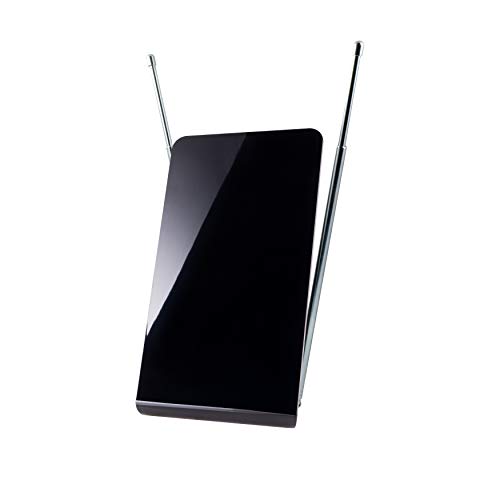
GE Flat Panel Indoor Antenna 33681 is the indoor choice with an adjustable stand and extendable rabbit-ear dipoles, rather than a hover mount. GE says it receives VHF and UHF signals up to 40 miles away and supports ATSC 3.0 broadcasts where available. The package includes a 5-foot coax cable, and its 10.5-inch height can help you judge whether a shelf or nearby surface has enough room. This model’s indoor placement and claimed range may not suit a distant or heavily obstructed broadcast location; repositioning an indoor antenna can also be less convenient than using an outdoor mount.
Bottom line: Choose this if you want an indoor stand with adjustable dipole elements rather than a TV-top mount.
How to Choose a GE UltraPro HD Antenna
Start with placement, because antenna height and a clear path toward broadcast towers often matter more than a package’s maximum-range claim. A roof or attic location can avoid walls and nearby obstructions, while an indoor antenna is easier to place near the television. These four models range from a TV-top hover design to an outdoor-rated antenna; the claimed ranges are not guarantees for every address. UHF broadcasts occupy 470–608 MHz, while VHF television uses 54–88 MHz and 174–216 MHz, so broad VHF/UHF reception can matter when local stations use different bands. Use your location’s broadcast-channel map to identify the direction and band of stations you want, then choose a mounting style you can position accordingly.
Indoor and Outdoor Antenna Placement
Outdoor or attic placement is the practical direction when indoor walls, nearby buildings, or terrain block broadcast signals; the roofline can also provide a clearer path. Indoor antennas are simpler to position, but moving one even a few feet or turning it toward the tower can change reception. Use this quick rule: if an indoor antenna cannot receive a desired station after trying several positions near a window, consider an attic or outdoor mount instead of relying on a higher advertised range. For outdoor installations, secure the mast and protect the coax entry; grounding and bonding requirements apply to antenna systems, so follow local electrical code and use a qualified installer if unsure. Keep antennas and coax away from power lines.
| Situation | Placement to consider | Trade-off |
|---|---|---|
| Clear indoor signal path | TV-top or tabletop | Easy positioning; affected by room obstructions |
| Indoor signal is obstructed | Attic | Less visible; installation access matters |
| Need an exterior location | Outdoor mast | Weather exposure and safe mounting matter |
What Antenna Range and Amplification Mean
A range is a manufacturer claim, not a reliable promise of reception at every home. Terrain, building materials, antenna height, tower direction, and interference all affect whether a station arrives clearly. An amplifier can help compensate for signal loss through long coax runs or splitters, but it cannot restore a signal blocked by a hill or eliminate every source of interference; excess amplification can also worsen reception when strong signals overload a tuner. The amplified model here includes a 4G/5G LTE filter, while the other models do not specify an amplifier. Avoid choosing solely by the largest mileage figure: first consider whether the antenna can be placed high and unobstructed, then whether a long cable run makes amplification relevant.
Scanning for Channels and ATSC 3.0
After connecting an antenna, run the television’s antenna or over-the-air channel scan; repeat the scan after moving or rotating the antenna because digital tuners need to update the channels they can lock. A scan does not make a weak signal stronger, so adjust placement before rescanning if stations are missing or breaking up. ATSC 3.0, also called NextGen TV, is available only where local broadcasters have deployed it, and a compatible television or tuner is needed to receive that format. An antenna can receive over-the-air broadcasts, but it does not ensure every channel is available at your address. Check local station availability and the TV’s tuner compatibility before treating ATSC 3.0 support as a deciding feature.
Frequently Asked Questions
Do indoor TV antennas work through walls?
Indoor antennas can receive broadcasts through walls, but dense materials and multiple walls can weaken signals. Try a window-facing location and compare reception after moving the antenna several feet.
Should I point an antenna toward broadcast towers?
Yes, direction can affect reception, especially for directional antennas. Use a local broadcast map to find tower directions, then rotate or reposition the antenna and rescan channels.
Can an amplifier improve every weak TV signal?
No; an amplifier can offset loss from long coax runs or splitters, but it cannot overcome a blocked path or create a missing broadcast signal. Test placement before adding amplification.
How often should I rescan over-the-air channels?
Rescan after changing antenna location or direction, since the tuner may find a different set of receivable stations. Rescanning does not repair poor reception without an antenna-position change.
Does an antenna provide ATSC 3.0 by itself?
An antenna can receive over-the-air signals, but ATSC 3.0 reception also requires a compatible TV or tuner and local broadcasts in that format. Availability varies by broadcast market.