
Glass Measuring Cups With Raised Markings Compared

For raised measurement marks on a glass measuring vessel, choose Anchor Hocking 2-Quart Batter Bowl: its 2-quart bowl has embossed lines, a molded spout and thick glass. Choose another option if you want a conventional handled cup, a smaller capacity or markings etched into the glass rather than raised.
We earn a commission if you buy through links on this page. As an Amazon Associate I earn from qualifying purchases. Products are compared on manufacturer specifications, not hands-on testing.
- Best overall: Anchor Hocking 2-Quart Batter Bowl – Its 2-quart capacity and embossed lines make it the clearest match for raised markings.
- Best for small pours: Raneped 240 mL Engraved Glass Cup – The 240 mL cup has etched milliliter markings on both sides.
- Best for batch prep: Pyrex Essentials 3-Piece Measuring Cup Set – The set includes 1-, 2- and 4-cup measures.
| Product | Best for | Capacity | Marking style | Shop |
|---|---|---|---|---|
| Anchor Hocking 2-Quart Batter Bowl | Raised markings | 8 cups | Embossed lines | Check Price on Amazon |
| Raneped 240 mL Engraved Glass Cup | Small quantities | About 1 cup | Etched milliliters | Check Price on Amazon |
| Left-Handed 2-Cup Glass Measuring Cup | Left-handed reading | 2 cups | Embedded scale | Check Price on Amazon |
| Pyrex Essentials 3-Piece Measuring Cup Set | Multiple capacities | 1, 2 and 4 cups | Bold scale | Check Price on Amazon |
Glass Measuring Cups With Raised Markings
Compare the marking style and vessel size first, then choose the shape that fits your measuring and pouring tasks.
Anchor Hocking 2-Quart Batter Bowl
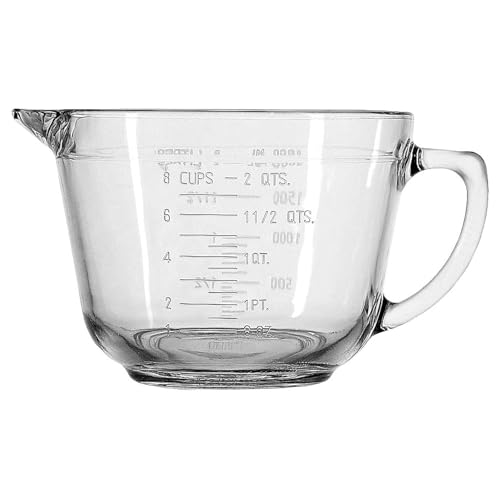
Raised embossed lines distinguish this 2-quart batter bowl from the etched or printed scales on the other choices. The 8-cup glass vessel has a molded spout and extra-thick glass, and its uses include mixing, reheating and pouring. It is microwave, refrigerator, freezer, dishwasher and preheated-oven safe up to 425°F. That broad use range suits cooks who want to measure and mix a larger batch in one vessel. Its bowl shape is less compact than a small handled measuring cup, so it is a less convenient fit for measuring a small splash of liquid.
Bottom line: Choose this if raised lines and an 8-cup bowl suit your kitchen tasks.
Raneped 240 mL Engraved Glass Cup

This is the smallest single-cup option here, with a 240 mL capacity and permanent etched milliliter graduations on both sides rather than raised lines. The dual-sided scale is intended for left- and right-handed reading, and the cup has a handle and V-shaped spout for directing pours. The maker says the handle is heat-resistant and dishwasher safe. It suits small liquid portions and users who prefer etched marks, but it does not match a request for raised graduations. Confirm whether the 240 mL size is sufficient if you regularly measure larger batches.
Bottom line: Pick this for small portions if etched marks work for you.
Left-Handed 2-Cup Glass Measuring Cup

Unlike the raised-line batter bowl, this 2-cup glass measure emphasizes left-handed readability and has visible scales in cups, milliliters and ounces. The maker says the thick glass carries measurement marks as part of the glass rather than as stamped graphics. That makes it a relevant alternative if reading the scale from the left-hand side matters more than having embossed graduations. The capacity is 2 cups, making it smaller than the 2-quart bowl. The marking method is not identified as embossed, so choose it for its left-handed scale rather than assuming the lines stand proud of the glass.
Bottom line: Choose this if left-handed scale access is your priority.
Pyrex Essentials 3-Piece Measuring Cup Set
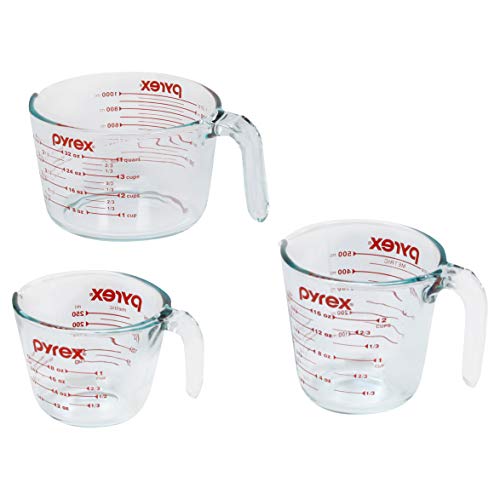
This set covers three capacities—1, 2 and 4 cups—instead of offering one large bowl or one small cup. Each cup has bold ounce and milliliter markings, a curved spout and an easy-grip handle; the measurements are not described as raised. The set is microwave, dishwasher, freezer and preheated-oven safe, and its dimensions range from 6 inches in diameter for the 1-cup vessel to 8 inches for the 4-cup vessel. It suits cooks who want several sizes for different recipes. It is not the best fit if embossed measurement lines are essential.
Bottom line: Pick this for several cup sizes rather than raised marks.
How to choose a glass measuring cup with raised markings
Choose by marking surface first: embossed marks stand above the glass, while etched marks are cut into its surface and printed scales sit on top. If a raised scale is essential, look for the word “embossed” or “raised” rather than assuming that permanent or bold marks are tactile. Capacity is the next decision: a US cup is about 237 mL, and a 2-quart vessel holds 8 cups. A 1-cup measure works for small liquid portions; larger bowls reduce the need to measure a batch in repeated fills. Spout shape and handle placement affect pouring comfort, but neither changes a cup’s calibrated capacity. For a left-handed pour, confirm that the scale is visible from the side you will use.
Raised, etched and printed measurement marks
Raised marks are molded or embossed into the glass and can be felt at the surface; etched graduations are engraved into it, while printed marks are applied externally. Those are different construction methods, not interchangeable descriptions. This matters when you want tactile lines or want to distinguish permanent markings from surface printing. A scale may use cups, fluid ounces, milliliters or several systems, so check that it matches the units in your recipes. In US cooking, a customary cup is 8 fluid ounces, while 1 liter is 1,000 milliliters. A molded line still needs to be read at the correct level: set the vessel on a level counter and view the liquid surface at eye height to reduce parallax error.
Capacity and vessel shape for kitchen measuring
Match capacity to the largest amount you commonly measure: 1 quart equals 4 cups, and 2 quarts equal 8 cups. A handled cup is easier to lift and pour when measuring a few cups of liquid; a wide batter bowl gives more room to mix but takes more counter and storage space. Sets with 1-, 2- and 4-cup vessels offer more size choices, though each piece needs storage. Use a liquid measuring vessel for water, milk or oil, filling it on a flat surface and checking the meniscus at eye level. Dry ingredients are usually measured with dry cups and leveled at the rim; scooping flour into a liquid cup can pack it and change the amount. For a recipe requiring accuracy, weigh ingredients when the recipe gives a weight.
Glass measuring cup heat and handling
Heat limits are product-specific, not a property to assume for every glass measure. One bowl in this selection is specified for a preheated oven up to 425°F; that rating should not be transferred to other glass cups. Thermal shock can crack glass, so avoid moving a hot vessel directly into cold water or placing cold glass into a hot oven. Check that a vessel is explicitly rated for the appliance and temperature before heating it. Thick glass can still break if dropped or struck, and a full large bowl can be heavy: the 2-quart capacity holds 8 cups of liquid. Keep hot glass away from children and use a dry, secure grip when handling it.
Frequently Asked Questions
Are embossed marks the same as etched marks?
No. Embossed marks protrude from the glass surface, while etched marks are engraved into it. Printed graduations are a third type, applied to the surface rather than formed in the glass.
How many cups are in a 2-quart measuring bowl?
A 2-quart bowl holds 8 US cups because 1 quart equals 4 cups. That capacity is useful for larger batches, though the filled vessel will be heavier to lift than a small cup.
How should I read liquid measurements accurately?
Place the vessel on a level counter and read the liquid surface at eye height. For a curved meniscus in water-based liquids, use the bottom of the curve as the level; viewing from above or below can shift the apparent line.
Can every glass measuring cup go in the oven?
No; oven suitability and temperature limits depend on the specific vessel. The bowl with a 425°F preheated-oven rating is the only product here with a concrete oven limit, and thermal shock can damage glass.
Should I measure flour in a glass liquid cup?
A dry measuring cup is usually better for flour because it can be filled and leveled at the rim. Scooping flour into a liquid measure can compact it, changing the amount; weighing it is more consistent when a recipe provides a weight.