
Hamster Cages With Tunnels: 5 Models Compared

For hamster cages with tunnels, Mcage 5-Floor Hamster Mansion is the closest match for shoppers wanting a tall, five-level layout with included play tubes. Choose a different model if you prioritize a wider, single-level floor area or a clear-sided enclosure; extra levels do not replace continuous floor space.
Tunnels connect parts of a habitat and add routes for exploration, but the cage still needs a secure base, ventilation and room for bedding.
We earn a commission if you buy through links on this page. As an Amazon Associate I earn from qualifying purchases. Products are compared on manufacturer specifications, not hands-on testing.
- Best overall: Mcage 5-Floor Hamster Mansion – Five solid floors, included play tubes and a 3-inch-deep base create a tall, multi-level setup.
- Best for modular connections: MidWest Awesome Arcade Hamster Home – Connector pieces are included for standard play tubes and connecting another habitat.
- Best for clear viewing: 8-in-1 Acrylic Two-Tier Cage – The clear acrylic sides provide a 360-degree view, with an external tunnel connection.
| Product | Best for | Footprint | Height | Levels | Shop |
|---|---|---|---|---|---|
| Mcage 5-Floor Hamster Mansion | Tall multi-level setup | 23 × 14 in | 27 in | 5 | Check Price on Amazon |
| MidWest Awesome Arcade Hamster Home | Expandable tube setup | 18.1 × 11.4 in | 21.5 in | Multi-level | Check Price on Amazon |
| PawHut 5-Tier Hamster Cage | Portable tall habitat | 23.3 × 14.3 in | 27.3 in | 5 | Check Price on Amazon |
| 8-in-1 Acrylic Two-Tier Cage | Clear-sided viewing | 17.7 × 13 in | 11.8 in | 2 | Check Price on Amazon |
| PawHut Three-Tier Dwarf Hamster Cage | Dwarf-hamster layout | 18.9 × 12.6 in | 16.6 in | 3 | Check Price on Amazon |
Hamster Cages With Tunnels Compared
Compare each cage’s footprint and layout, then make sure the base and tunnel route suit your hamster and care setup.
Mcage 5-Floor Hamster Mansion

Mcage 5-Floor Hamster Mansion stands out for its five-floor layout, four solid floor pieces and four anti-slip ladders, along with play tubes, a hide house, bowl, bottle and 5-inch wheel. Its 3/8-inch bar spacing and 3-inch-deep base are specific design features for containment and bedding. This cage suits someone who wants several connected levels in one tall enclosure. The footprint is about 322 square inches, so the vertical layout does not provide the same continuous floor area as a larger, low enclosure; that matters when prioritizing running and burrowing space.
Bottom line: Choose this if a five-level layout and included play tubes are your main priorities.
MidWest Awesome Arcade Hamster Home
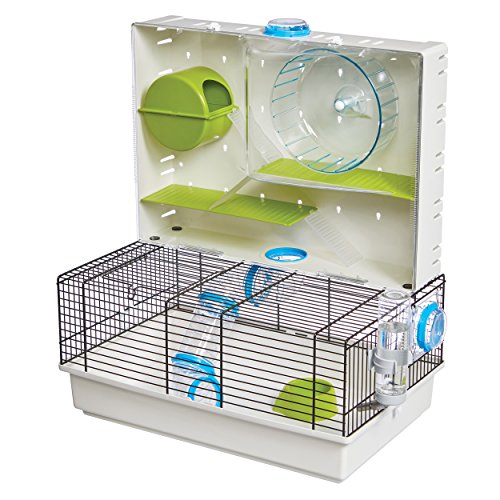
MidWest Awesome Arcade Hamster Home differs with a modular design: connector pieces fit standard play tubes and can link another hamster habitat. It also includes interior tubes, a wheel, bottle, bowl and nesting nook, plus a top access door and removable upper cover. This option fits a buyer who expects to extend the tube route or wants access from above. The footprint is about 206 square inches, a compact base for a hamster habitat; a small footprint can limit uninterrupted running and digging space even when the enclosure has multiple levels.
Bottom line: Pick this when connecting standard tubes or another habitat is important.
PawHut 5-Tier Hamster Cage

PawHut 5-Tier Hamster Cage is a five-tier wire cage with carry handles, tubes, ramps, a hut, wheel, bottle and dish. Its larger footprint than the compact models in this group makes it a fit for buyers seeking a tall habitat with integrated carrying handles. The maker says the steel wiring avoids pinching and provides ventilation; those are performance claims rather than a substitute for checking the assembled cage for gaps or loose parts. At about 333 square inches of floor footprint, the base remains much smaller than a 600-square-inch continuous floor target often used in hamster-care guidance.
Bottom line: Choose it for a tall, handle-equipped cage with an included tunnel route.
8-in-1 Acrylic Two-Tier Cage

8-in-1 Acrylic Two-Tier Cage stands apart with clear acrylic sides and a two-tier format, plus an external tube connection. Its included set has a wooden hideout and platform, wheel, bath container, bottle, dish and ladder. The low 11.8-inch height can suit a buyer seeking a compact, visible enclosure, but its footprint is about 230 square inches and the two-tier design does not create more continuous ground space. Check that any external tube route is secured and easy to inspect; an enclosed route that is hard to clean can trap bedding or waste.
Bottom line: Pick this for clear-sided viewing and a compact two-tier design.
PawHut Three-Tier Dwarf Hamster Cage

PawHut Three-Tier Dwarf Hamster Cage is the explicitly dwarf-hamster-oriented option, with three tiers, transparent tunnels, ramps, a hideout, wheel, bottle and bowl. It has the narrowest height among the wire multi-tier cages here and a 0.39-inch wire gap. This suits buyers focused on a dwarf-oriented accessory package and a shorter enclosure. Its footprint is about 238 square inches, so the stacked levels should not be mistaken for a broad ground area. The gap dimension is not a guarantee against every escape; inspect doors and tube joints as well as the wire spacing.
Bottom line: Choose this if you want a three-tier cage marketed for dwarf hamsters.
How to Choose a Hamster Cage With Tunnels
Start with usable floor area, then treat tunnels and upper levels as enrichment rather than a substitute for floor space. A common care target is at least 600 square inches of continuous floor area; measure the inside base, not the cage’s outer length and width. A cage with a 300-square-inch footprint remains a 300-square-inch floor even if it has several stories. For a tunnel route, look for smooth, wide passages with openings your hamster can turn around in, and avoid long dead ends that are difficult to inspect. A practical decision rule: if the base is under 600 square inches, prioritize a larger connected floor area over adding another tier. Check door latches, platform stability and tube joints before placing bedding or a pet inside.
Tunnel Fit, Bedding and Ventilation
Choose tunnel diameter for the adult hamster, not its size as a pup: Syrian hamsters generally need wider passages than dwarf hamsters, and a passage should allow an easy turn without squeezing. Many commonly sold hamster tubes are around 2 to 3 inches across, but the actual interior diameter and bends matter. Bedding depth also competes with tunnel entrances; 6 inches or more gives room for burrowing, while shallow bases can make a tunnel route easier to access but less useful for digging. Wire cages ventilate well, while acrylic sides need open ventilation areas to keep air moving. Keep bedding below vents and clear of tube joints, and avoid placing a heavy platform where it can collapse into a tunnel.
Levels and Accessories Compared
More levels add climbing routes, but they also add falls and cleaning points. Hamsters are ground-oriented burrowers, so solid, stable platforms are safer than exposed wire floors; a fall from a high platform can injure a small animal. A solid-surface wheel should let the hamster run with a straight back, and the correct diameter depends on species and body size—many care guides use roughly 8 to 12 inches for Syrians and 6.5 to 8 inches for dwarfs. These sizes are guidance, not a guarantee for every animal. Use this comparison to decide which feature matters most before choosing a layout.
| Priority | Look for | Why it matters |
|---|---|---|
| Burrowing and running | Broad continuous base | Levels do not add ground area |
| Tube exploration | Wide, accessible tube path | Supports turning and inspection |
| Climbing routes | Solid platforms and secure ramps | Reduces exposure to falls |
Cleaning and Setup Mistakes to Avoid
Plan to spot-clean soiled bedding daily and do a fuller clean about every 2 to 4 weeks, keeping some clean, familiar bedding to preserve scent. Long tunnels and multi-level cages have more seams where food, bedding and waste can collect, so make every section reachable without dismantling an unsafe stack. Wash reusable accessories with mild soap and rinse them thoroughly; strong fragrances can irritate a hamster’s sensitive respiratory system. Common setup mistakes include blocking ventilation with bedding, leaving tube joints loose, and placing a wheel where a hamster could fall from a platform. Before use, test doors and connectors by gently pulling each joint and check that no sharp wire ends or cracked plastic remain.
Frequently Asked Questions
How much floor space should a hamster cage have?
A common care target is at least 600 square inches of continuous floor space. Measure the usable base because extra tiers do not increase that ground-level area.
How wide should hamster cage tunnels be?
Choose a tunnel wide enough for the adult hamster to turn without squeezing; Syrian hamsters generally need wider passages than dwarfs. Many common tubes are around 2 to 3 inches across, but bends and interior diameter affect fit.
How deep should bedding be in a hamster cage?
Aim for at least 6 inches of bedding where the base permits, with deeper bedding giving more room for burrowing. Keep tunnel entrances and ventilation openings clear as bedding is added.
How often should I clean a hamster cage?
Spot-clean soiled bedding daily and do a fuller clean about every 2 to 4 weeks, depending on cage size and how quickly it becomes soiled. Retain some clean, familiar bedding during a full clean to preserve scent.
What wheel size is suitable for a hamster?
Many care guides use roughly 8 to 12 inches for Syrian hamsters and 6.5 to 8 inches for dwarfs. Choose a solid running surface and confirm the hamster can run with a straight back.
Are multi-level hamster cages safe?
Multi-level cages can add climbing routes, but stable solid platforms and low fall distances matter because hamsters can be injured by falls. Secure ramps, keep the wheel on a stable level and avoid open drops beside platforms.