
Heat Detectors for Garage Use: 5 Options Compared

Kidde Hardwired Heat Detector is the closest match for most garages because it is designed for garage use and alarms above 135°F. Choose another option if you need a panel-connected sensor, a different sensing approach or a thermal monitoring system.
A heat detector sounds an alarm in response to heat rather than smoke, making it useful in spaces where smoke alarms may be prone to nuisance alarms.
We earn a commission if you buy through links on this page. As an Amazon Associate I earn from qualifying purchases. Products are compared on manufacturer specifications, not hands-on testing.
- Best overall: Kidde Hardwired Heat Detector – Garage-focused, with a 135°F alarm threshold, 120V power and battery backup.
- Best for rate-of-rise sensing: First Alert BRK HD6135FB Heat Alarm – Uses rate-of-rise sensing and includes battery backup.
- Best for compatible Simplex panels: Simplex 4098-9734 TrueAlarm Sensor – Offers selectable temperature thresholds and IDNet panel connectivity.
| Product | Best for | Sensing or trigger | Power or connection | Backup or system fit | Shop |
|---|---|---|---|---|---|
| Kidde Hardwired Heat Detector | Most garages | Fixed 135°F | 120V hardwired | 9V battery; up to 18 alarms | Check Price on Amazon |
| First Alert BRK HD6135FB Heat Alarm | Rapid-rise sensing | Rate-of-rise; threshold — | Hardwired | 9V battery backup | Check Price on Amazon |
| First Alert 120V Heat Alarm | 135°F trigger | Fixed 135°F | 120V hardwired | — | Check Price on Amazon |
| Simplex 4098-9734 TrueAlarm Sensor | Simplex panels | 135°F, 155°F or 190°F; 15°F or 20°F/min | IDNet; compatible Simplex panels | Panel-connected; base separate | Check Price on Amazon |
| ScanaTemp AI Flame & Thermal Monitor | Thermal monitoring | Thermal and visible imaging | 2.4 GHz Wi-Fi | Cloud app; SMTP/MQTT | Check Price on Amazon |
Heat Detectors for Garage Use
Compare the sensing approach and installation requirements before choosing a detector for your garage.
Kidde Hardwired Heat Detector

For a garage that needs a standalone heat alarm, this Kidde model combines a 135°F trigger with hardwired power and battery backup. The 85-decibel alarm and red LED provide local alerts, while interconnection supports up to 18 compatible Kidde smoke, heat or CO alarms. A test-hush button handles testing and silencing. The maker says it is UL listed.
Choose it if the fixed threshold and interconnection fit your alarm setup. It does not offer selectable temperature settings, so a buyer who needs a different trigger or panel-addressable sensing should consider another type.
Bottom line: Pick this if you want a garage-oriented heat alarm with battery backup.
First Alert BRK HD6135FB Heat Alarm

Unlike the fixed-threshold Kidde, this First Alert BRK alarm uses rate-of-rise sensing to detect rapid temperature increases as well as high temperatures. It has a hardwired connection, 9V battery backup and an 85-decibel alarm. The maker says its microprocessor control is designed to reduce nuisance alarms; remote testing and muting require a separately sold household remote.
This is a fit for buyers who prioritize rapid-rise detection and remote control compatibility. The trigger threshold is not given, so confirm the required temperature behavior before choosing it over a fixed-temperature alarm.
Bottom line: Choose this if rate-of-rise sensing is more important than a fixed threshold.
First Alert 120V Heat Alarm

This First Alert alarm gives a simple fixed-temperature alternative: its name specifies 120V hardwired operation and a 135°F operating temperature. That makes its trigger and power needs easy to compare with a rate-of-rise model.
Consider it when a 135°F threshold and 120V wiring suit the garage. Buyers who need an alarm that continues operating during a power outage should verify backup power before choosing, since the specifications do not establish it.
Bottom line: Pick this if you need a straightforward 120V alarm with a 135°F trigger.
Simplex 4098-9734 TrueAlarm Sensor
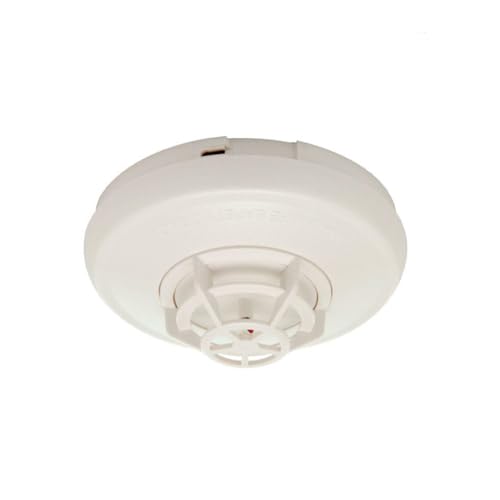
This Simplex sensor is a panel-connected option rather than a standalone garage alarm. Its fixed-temperature setting is selectable at the panel at 135°F, 155°F or 190°F, and rate-of-rise can be separately set to 15°F or 20°F per minute. The maker specifies IDNet operation with 4100ES, 4010ES and 4007ES panels; the compatible base is sold separately.
Choose it only when the existing alarm system supports the sensor and its base. A garage without a compatible panel needs a self-contained alarm instead. Its operating range is 32°F to 150°F, so check that this suits the installation environment.
Bottom line: Choose this for a compatible Simplex IDNet system, not as a standalone alarm.
ScanaTemp AI Flame & Thermal Monitor

This ScanaTemp unit is a remote thermal and visible-imaging monitor, not a conventional fixed-temperature garage alarm. It also monitors sound and motion, and its features describe alarm screenshots, 10-second audio, temperature readings and wireless notifications through a cloud app. The maker says it can integrate with Immix and SureView security systems.
It may suit a garage with electrical equipment where remote thermal monitoring is the goal.
Bottom line: Pick this for remote thermal monitoring rather than a conventional heat alarm.
How to Choose a Garage Heat Detector
Choose a fixed-temperature alarm for a defined threshold or rate-of-rise sensing when rapid heating is the concern. These are different trigger strategies: the Simplex sensor offers both selectable fixed settings and selectable rate-of-rise settings, while the Kidde and First Alert 120V model specify a 135°F trigger. Confirm whether you need a standalone alarm or a sensor that connects to a building panel before comparing features. With no compatible IDNet panel, the Simplex sensor is not a standalone substitute. For a garage where power interruption matters, prioritize a model with battery backup. Heat detectors do not replace smoke alarms elsewhere in a home; use the appropriate alarm type for each space and follow local fire-safety requirements.
Fixed-Temperature and Rate-of-Rise Sensing
Fixed-temperature sensing alarms at a set temperature, while rate-of-rise sensing responds to how quickly the temperature increases. The Simplex settings show the distinction clearly: it supports fixed thresholds of 135°F, 155°F or 190°F, plus a separately selected rise rate of 15°F or 20°F per minute. Those are settings for that sensor, not universal settings for every heat alarm. A fixed 135°F model is easier to compare when the trigger threshold is the priority; a rate-of-rise model may be preferable when rapid heating is the concern. Check the system’s permitted detector type and configuration before installation, especially for a panel-connected sensor.
| Need | Relevant option | Key constraint |
|---|---|---|
| Standalone alarm with threshold | 135°F fixed-temperature alarm | Requires suitable power and placement |
| Selectable threshold and rise rate | Panel-connected sensor | Requires compatible panel and base |
| Remote thermal monitoring | Imaging monitor | Different from a conventional local heat alarm |
Garage Placement and Alarm Safety
Heat alarms are often considered for spaces where smoke, dust or fumes can create nuisance alarms, but they are not a replacement for smoke alarms in living areas. Follow the detector maker’s placement instructions and local fire code; ceiling shape, joists, airflow and nearby heaters can affect placement and response. Do not mount a detector where routine heat sources could trigger it or where stored items block sensing. For a garage, verify that the chosen alarm’s operating temperature range covers the expected ambient conditions. The Simplex sensor lists a 32°F to 150°F operating range; that is an operating limit, distinct from its selectable alarm threshold.
Power, Interconnection and Panel Compatibility
Garage detector wiring determines what happens during an outage and whether another alarm can sound elsewhere in the building. A hardwired detector with battery backup can continue operating if household power is lost, provided the backup battery is installed and maintained. Interconnected alarms can alert occupants beyond the garage; check compatibility before mixing makes or alarm types. The Kidde supports up to 18 compatible alarms, while the Simplex unit requires an IDNet-compatible panel and a separate base. A wireless thermal monitor uses a different approach: confirm that the garage has suitable 2.4 GHz Wi-Fi coverage if remote notifications are part of the intended use.
Frequently Asked Questions
Can a heat detector replace a garage smoke alarm?
A heat detector responds to temperature rather than smoke, so it is not a like-for-like replacement for smoke alarms in living areas. Use the alarm type required by local code and the detector maker’s placement instructions.
What temperature should a garage heat alarm use?
A 135°F fixed-temperature trigger is one common product setting, and two options here specify that threshold. Choose based on the alarm system’s requirements and the garage’s normal ambient temperature; routine heat sources can cause nuisance alarms.
How does rate-of-rise heat sensing work?
Rate-of-rise sensing responds when temperature increases quickly, rather than waiting only for a fixed threshold. One sensor here offers settings of 15°F or 20°F per minute, but the applicable setting depends on the compatible panel configuration.
Will a hardwired heat detector work during a power outage?
A hardwired alarm works during an outage only if it has functioning backup power. The Kidde includes a 9V battery backup, and the First Alert BRK specifies a 9V backup; check and replace batteries as directed by the manufacturer.
Can I connect a heat detector to my existing alarm panel?
Only if the detector and panel use compatible systems. The Simplex sensor is IDNet-only and lists specific compatible Simplex panels, while the Kidde supports interconnection with compatible Kidde alarms.