
Heaters for Dog House Igloos: 4 Options Compared

For most igloo-style dog houses, Hound Heater Deluxe with Igloo Bracket is the direct fit because its included bracket is made for igloo-type houses. Choose K&H Lectro-Kennel Igloo Pad, Large instead if you want a heated floor pad and its 30-by-17.5-inch size fits the shelter; a wall-mounted heater suits owners who want to warm the air rather than the floor.
Dog-house heaters add electric heat to an outdoor shelter, so the right choice depends on mounting space, floor dimensions and safe access to power.
We earn a commission if you buy through links on this page. As an Amazon Associate I earn from qualifying purchases. Products are compared on manufacturer specifications, not hands-on testing.
- Best overall: Hound Heater Deluxe with Igloo Bracket – Its special mounting bracket is designed for igloo-type houses.
- Best for floor warmth: K&H Lectro-Kennel Igloo Pad, Large – The rigid 80W pad is shaped for round or dome-style shelters.
- Best for screw mounting: Hound Heater Deluxe, 400W – The 400W heater installs with four screws or bolts.
| Product | Best for | Power | Heating style | Cord length | Shop |
|---|---|---|---|---|---|
| Hound Heater Deluxe with Igloo Bracket | Igloo wall mounting | 400W | Wall-mounted air heat | 10 ft | Check Price on Amazon |
| K&H Lectro-Kennel Igloo Pad, Large | Warm floor surface | 80W | Floor pad | 5.5 ft | Check Price on Amazon |
| Hound Heater Deluxe, 400W | Screw-mounted heating | 400W | Wall-mounted air heat | 10 ft | Check Price on Amazon |
| Dreyoo 300/600W Pet House Heater | Two heat settings | 300W / 600W | Wall-mounted air heat | 6 ft | Check Price on Amazon |
Heaters for dog house igloos
Choose between a wall-mounted heater that warms shelter air and a floor pad that warms the resting surface.
Hound Heater Deluxe with Igloo Bracket

The included igloo bracket distinguishes this 400W Hound Heater from the screw-mounted model and floor pad. The unit plugs into a 110V outlet, has a thermostat, and is designed to provide dry heat in pet houses up to 100 cubic feet; the maker says it runs only when needed. A heat shield covers internal wires and components, and the cord is chew-resistant. Choose it when the shelter has a suitable wall-mounting spot. Its 400W draw and air-heating approach may be less suitable if you only want a warmed resting surface.
Bottom line: Pick this when you want a bracket-mounted heater made for an igloo-style shelter.
K&H Lectro-Kennel Igloo Pad, Large
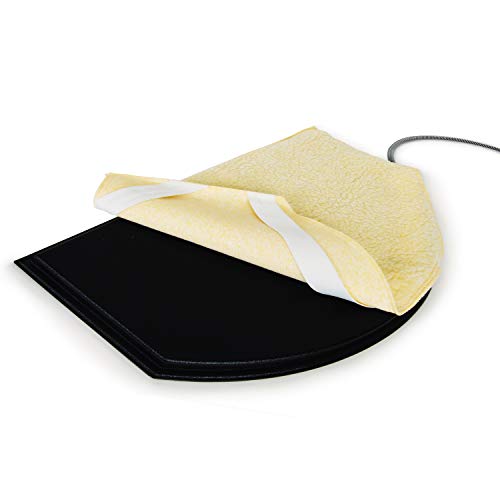
Unlike the wall-mounted units, this 80W rigid ABS pad warms the floor area where a dog rests. Its half-round shape is intended for round or dome-style houses, and the large size measures 30 by 17.5 inches. The pad responds to temperature changes, includes a removable fleece cover, and has a steel-wrapped cord. The maker says it has been tested and certified by MET Labs and exceeds US and Canadian electrical safety standards. Measure the usable floor area before choosing it; the rigid shell cannot flex around a smaller or irregular floor.
Bottom line: Choose this if a floor-warming pad fits the shelter’s available floor space.
Hound Heater Deluxe, 400W

This Hound Heater lacks the special igloo bracket included with Hound Heater Deluxe with Igloo Bracket, but its 400W heater can be installed with four screws or bolts. It plugs into a 110V outlet, uses a thermostat, and the maker says it provides dry heat for pet houses up to 100 cubic feet. The cord is chew-proof, and an internal heat shield protects the wiring and components. It is a reasonable alternative when the shelter wall can take screw mounting. Buyers who need a dedicated igloo bracket should choose a different configuration rather than assume the bracket is included.
Bottom line: Pick this if screw mounting works and you do not need the igloo bracket.
Dreyoo 300/600W Pet House Heater

The Dreyoo offers two power settings, 300W and 600W, rather than the single 400W output of the Hound heaters. It uses a thermostat that the maker says stops heating above 78.8°F and resumes below 68°F, and it includes overheat protection and a 6-foot anti-chew cord. The compact heater is intended for pet houses, chicken coops and rabbit shelters, with coverage dependent on how airtight the space is. It is a broader-use option, not an igloo-specific mounting system. Check that its mounting arrangement suits the shelter before choosing it.
Bottom line: Choose this for two power modes when its mounting arrangement fits the shelter.
Choose between air heat and a heated floor
Wall-mounted heaters warm shelter air, while a heated pad warms the surface a dog lies on. A pad is often the simpler choice when the floor is flat, dry and large enough for its rigid footprint; a wall heater is useful when floor space is limited. Igloo shelters are dome-shaped, so their usable floor diameter can be smaller than the outside diameter. Measure the interior floor, not the widest point of the dome, before selecting a pad. If the pad’s 30-inch length or 17.5-inch width exceeds the usable floor, choose a wall-mounted option instead. For wall units, confirm that the intended mounting location leaves the dog room to enter, turn and lie down.
Electrical safety matters outdoors: use a ground-fault circuit interrupter (GFCI)-protected outlet and keep plugs and connections out of standing water. Do not place a heater where bedding can cover it.
Compare heater styles for an igloo shelter
The main choice is whether to heat the air or the resting surface; the table summarizes what each type changes. A wall heater needs a stable mounting point and room around its housing, while a floor pad needs a measured floor area. Wattage alone does not determine comfort: shelter size, drafts, insulation and outdoor temperature also affect how much heat stays inside. The products with 400W output are wall heaters, while the rigid pad uses 80W, but those numbers do not make the designs interchangeable. Select the style based on where the dog rests and how the shelter can safely accommodate the equipment.
| Style | Where heat goes | Fit condition |
|---|---|---|
| Wall-mounted heater | Shelter air | Secure mounting point and clear space |
| Rigid heated pad | Resting surface | Floor must fit the pad footprint |
Keep the heater and cord away from water, chewing and loose bedding.
Measure an igloo dog house before installation
Measure the interior floor diameter and the usable wall area before choosing a heating device. A dome’s sloped walls reduce the flat floor area, so the outside diameter is not a reliable pad-fit measurement. For a pad, compare its full footprint with the dog’s resting area and leave room for entry and movement. For a wall-mounted unit, check that the mount fits a solid section rather than a curved or flexible panel. Cord reach is another fit constraint: place the shelter so the cord can reach a protected outlet without crossing a walkway or becoming a chew target. If an extension cord would be needed outdoors, choose a safer outlet location or installation plan rather than routing a loose cord.
Use outdoor dog house heaters safely
Outdoor electrical equipment should be connected to a GFCI-protected outlet, and plugs must stay clear of rain, snowmelt and puddles. Inspect the cord and housing regularly for chewing, cracking or damage; disconnect damaged equipment instead of continuing to use it. Keep blankets and loose bedding away from heater openings, and do not cover a pad with material the manufacturer does not permit. A thermostat helps regulate heat, but it does not replace checking the shelter for drafts, dampness or overheating. Dogs need room to move away from a heated area, so do not fill the entire floor with a heating surface or block the doorway with equipment. Follow the product’s mounting and electrical requirements.
Frequently Asked Questions
How do I size a heated pad for an igloo dog house?
Measure the flat interior floor, then compare it with the pad’s full footprint. For a 30-by-17.5-inch pad, the usable floor must accommodate that area while leaving room for the dog to move.
Is a dog house heater or heated pad better?
A wall heater warms shelter air, while a heated pad warms the resting surface. Choose a pad when the floor fits it; choose a wall unit when floor space is limited and there is a secure mounting spot.
Can I use an extension cord with an outdoor dog heater?
A direct connection to a GFCI-protected outlet is preferable for outdoor equipment. Avoid routing a loose cord across a walkway or where a dog can chew it, and keep all connections out of water.
Where should a heater go inside a dog house?
Mount a wall heater securely where the dog cannot chew or crowd the cord, and keep the unit clear of bedding. A pad belongs on a flat floor area with room for the dog to move off it.
How often should I check a dog house heater?
Inspect the cord, plug and heater before regular use and periodically through the season. Stop using equipment with chew marks, cracks, loose connections or signs of moisture damage.