
Hidden Door Hinges Outswing: 4 Options Compared

For an outswing hidden door, TamBee 6-Inch Outswing Concealed Hinge is the closest match because it is explicitly designed for outswing and opens 180 degrees. TamBee 6-Inch Black Concealed Hinge is another concealed 180-degree option; choose a pivot design only if its rotation or hold-open function suits your door better than a conventional outswing.
Concealed hinges sit within the door and frame, so available clearance and the door’s weight affect fit. Confirm the door’s finished weight and required swing before choosing.
We earn a commission if you buy through links on this page. As an Amazon Associate I earn from qualifying purchases. Products are compared on manufacturer specifications, not hands-on testing.
- Best overall: TamBee 6-Inch Outswing Concealed Hinge – Explicitly designed for outswing with 180-degree opening and three-way adjustment.
- Best for setup guidance: TamBee 6-Inch Black Concealed Hinge – Includes an installation template and offers three-way adjustment.
- Best for heavy doors: TamBee 4213 Hold-Open Pivot Hinge – Its maker gives a 1,100-pound capacity and a 90-degree hold-open feature.
| Product | Best for | Opening angle | Adjustment | Capacity | Shop |
|---|---|---|---|---|---|
| TamBee 6-Inch Outswing Concealed Hinge | 180-degree outswing | 180° | 3-way | 88 lb per pair | Check Price on Amazon |
| TamBee 6-Inch Black Concealed Hinge | Template-guided setup | 180° | 3-way | 88 lb per pair | Check Price on Amazon |
| 360-Degree Hidden Pivot Hinge Kit | Rotating pivot doors | 360° | — | 570 lb | Check Price on Amazon |
| TamBee 4213 Hold-Open Pivot Hinge | Heavy hold-open doors | 90° lock | — | 1,100 lb | Check Price on Amazon |
Hidden Door Hinges for Outswing Doors
Compare the concealed butt hinges with the pivot designs, which use a different swing mechanism.
TamBee 6-Inch Outswing Concealed Hinge

Unlike the pivot options, this concealed butt hinge is explicitly made for outswing doors and opens to 180 degrees. The maker says each pair supports up to 88 pounds; the hinge adjusts vertically by ±3 mm, horizontally by ±2 mm, and in depth by ±1 mm without removing the door. Zinc and aluminum alloy construction is intended to resist rust, and built-in spacers reduce friction for quieter movement. The two-hinge set suits a lighter secret door or bookcase door. Its 88-pound pair capacity makes it a poor fit if the finished door exceeds that limit.
Bottom line: Choose this for an outswing door under 88 pounds that needs a concealed 180-degree hinge.
TamBee 6-Inch Black Concealed Hinge

The included positioning template distinguishes this concealed 180-degree hinge from the other conventional hinge option. It is a two-hinge set with vertical adjustment of ±3 mm, horizontal adjustment of ±2 mm, and depth adjustment of ±1 mm without taking the door off. The maker says each pair supports up to 88 pounds and has built-in spacers to reduce friction. Its black finish may suit dark door hardware. This is a reasonable choice for a DIY installation where alignment guidance matters; the template does not change the pair’s load limit, so heavier doors need another solution.
Bottom line: Pick this when a positioning template and black finish matter for a concealed 180-degree door.
360-Degree Hidden Pivot Hinge Kit
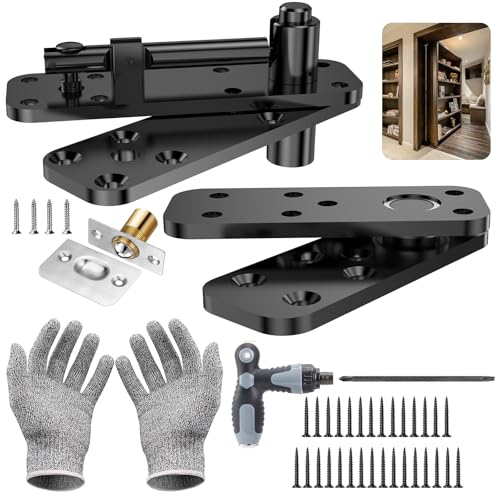
This is a pivot system rather than an outswing concealed butt hinge: it mounts on a central axis and is designed to rotate 360 degrees. The kit includes top and bottom pivot hardware, a ball catch, screws, and a screwdriver. Its maker claims a 570-pound load capacity and quiet rotation. That rotation and load claim may suit a heavier bookcase or secret door designed around a pivot axis. It is not a direct substitute for a 180-degree outswing hinge, and the central-axis layout requires a door and frame prepared for pivot installation.
Bottom line: Choose this only when a central-axis pivot and full rotation suit the door design.
TamBee 4213 Hold-Open Pivot Hinge

This heavy-duty pivot is distinct from the 180-degree concealed hinges because it locks open at 90 degrees. The maker claims a capacity of 1,100 pounds and says the pivot mechanism moves quietly; the hinge is made from 304 stainless steel. Installation instructions are included. The hold-open function can suit a large hidden door that needs to remain open without a separate damper. Because it is a pivot with a 90-degree hold-open position, it does not provide the same swing behavior as a conventional 180-degree outswing concealed hinge.
Bottom line: Select this for a heavy pivot door that needs a 90-degree hold-open position.
How to Choose Hidden Door Hinges for Outswing
Start with swing type, then compare the door’s finished weight with the hinge’s capacity. A concealed butt hinge and a pivot hinge are different mechanisms: the former sits in the door and frame, while a pivot turns around an axis near the door’s top and bottom. A 180-degree opening does not by itself confirm that the door clears nearby walls, trim, or furniture. Measure the intended swing path and the closed-door reveal before selecting hardware. As a practical rule, choose a hinge rated for at least the door’s full finished weight, including attached facing; do not treat a pair’s capacity as the capacity of each hinge. If the door is heavier than 88 pounds, the two concealed models here are not rated for it.
Concealed Hinges Versus Pivot Hinges
Choose a concealed butt hinge for a familiar outswing path, and a pivot only when the door is designed to rotate on a central axis. Concealed hinges typically require matching recesses in both the door edge and frame, so accurate layout matters before cutting. Pivot hardware moves the load through top and bottom points instead, which changes the framing and clearance requirements. Compare the mechanism and intended opening before comparing load numbers: the pivot kits’ higher maker-claimed capacities do not make them drop-in replacements for butt hinges.
The main functional difference is summarized here.
| Mechanism | Typical purpose | Fit consideration |
|---|---|---|
| Concealed butt hinge | Door swings from its edge | Recesses and 180-degree clearance |
| Pivot hinge | Door turns on a pivot axis | Top-and-bottom mounting and pivot layout |
Check Door Weight and Clearance Before Installation
Measure the complete door, not just its core: bookcase shelves, trim, and attached panels add weight and can change the balance. A hinge’s capacity is meaningful only when the specified number of hinges is used and the door and frame provide sound mounting material. Also check whether the door swings into a wall, cabinet, or hallway; a nominal 180-degree hinge angle does not guarantee unobstructed travel. Mark the hinge locations and swing arc before mortising, then make sure the closed door can sit flush without binding. When the frame or door construction is unusual, verify the hinge’s required recess and screw placement before cutting.
Adjust Concealed Hinges Without Misalignment
Three-way adjustment lets a door move vertically, sideways, and in or out, but each axis corrects a different alignment problem. Use vertical movement to address an uneven top or bottom gap, horizontal movement to even the side reveal, and depth movement to bring the closed face flush with the frame. Make small changes and recheck the latch side after each adjustment; moving one corner can alter the opposite reveal. Adjustment range is limited, so careful initial placement matters more than relying on post-install tuning. A hinge requiring a larger correction than its available adjustment range may need to be repositioned rather than forced.
Frequently Asked Questions
How much clearance does an outswing hidden door need?
The door needs enough open-side space for its full swing arc, including any bookcase projection or trim. A 180-degree hinge rating describes its opening angle, not whether nearby walls or furniture leave that path clear; mark the arc before installation.
Can concealed hinges support a heavy bookcase door?
Only if the finished door weight is within the hinge pair’s capacity and the frame can hold the screws securely. Shelves and books add load, so weigh the complete moving assembly rather than relying on the door slab’s nominal weight.
What does three-way hinge adjustment change?
Three-way adjustment moves the door vertically, horizontally, and in depth. For example, the specified range of ±3 mm vertical, ±2 mm horizontal, and ±1 mm depth is a small alignment correction, not a substitute for accurate hinge placement.
Are pivot hinges interchangeable with concealed butt hinges?
No, pivot hinges turn around an axis while concealed butt hinges swing from the door edge. A pivot installation needs suitable top-and-bottom mounting and a door layout built for that rotation.
Should I install hidden hinges before finishing the door?
Plan the recesses and swing clearance before applying final finishes, because concealed hinges require precise cuts in the door and frame. Keep finish thickness and any attached panels in mind when checking the final reveal and door weight.