
High Temp Wire Connectors: Types and Fit Compared

For high temp wire connectors, Sherco-Auto 1,200-Piece Crimp Assortment is the closest match for buyers who need an assortment of crimp terminal styles, with 12-10, 16-14 and 22-18 AWG sizes and a 900°F rating. Choose a focused terminal instead if the connection calls for a particular tab or stud, or ceramic wire nuts for joining wires rather than terminating them.
We earn a commission if you buy through links on this page. As an Amazon Associate I earn from qualifying purchases. Products are compared on manufacturer specifications, not hands-on testing.
- Best overall: Sherco-Auto 1,200-Piece Crimp Assortment – The 1,200-piece assortment covers three wire gauges and multiple terminal styles, and is rated to 900°F.
- Best for wire splices: Ceramic Wire Nuts, 30-Piece Assortment – Ceramic wire nuts suit joining wires, with sizes for 18-8, 22-10 and 22-14 AWG and a 1,000°F maximum.
- Best for ring connections: Morris High-Temperature Ring Terminals – Nickel-plated steel ring terminals fit 12-10 AWG wire and a 0.190-inch stud.
- Best for 1/4-inch tabs: Sherco-Auto 100-Piece Female Spade Terminals – The female spade terminals are sized for 12-10 AWG wire and 1/4-inch male tabs.
| Product | Best for | Connection style | Wire size | Shop |
|---|---|---|---|---|
| Sherco-Auto 1,200-Piece Crimp Assortment | Mixed terminal jobs | Ring, spade, butt | 12-10, 16-14, 22-18 AWG | Check Price on Amazon |
| Ceramic Wire Nuts, 30-Piece Assortment | High-heat splices | Ceramic wire nuts | 18-8, 22-10, 22-14 AWG | Check Price on Amazon |
| Morris High-Temperature Ring Terminals | Ring terminals | Ring terminal, #10 stud | 12-10 AWG | Check Price on Amazon |
| Sherco-Auto 100-Piece Female Spade Terminals | Female spade tabs | Female spade, 1/4-inch tab | 12-10 AWG | Check Price on Amazon |
High Temp Wire Connectors Compared
Match the connector shape and wire range to the joint before considering the heat rating.
Sherco-Auto 1,200-Piece Crimp Assortment

For a mix of crimp connections, this assortment combines ring, spade and butt terminals across three wire ranges. The nickel-plated steel connectors are non-insulated, and the manufacturer rates them for 900°F and 600V. The assortment is suited to repair work where connector shape and wire gauge vary. Its breadth is also its limitation: it does not replace checking that each individual terminal matches the wire and mating hardware. Use a compatible crimper, and add adhesive-lined heat-shrink tubing when the joint needs moisture protection.
Bottom line: Choose this assortment when several terminal styles and wire gauges are needed.
Ceramic Wire Nuts, 30-Piece Assortment

Unlike the crimp terminals here, these connectors are ceramic wire nuts for joining wires, with small, medium and large sizes. The manufacturer says they are designed for environments above 200°F and can withstand temperatures up to 1,000°F. That makes them a different connection type from a quick-disconnect or ring terminal; choose them only when the wiring arrangement calls for a wire nut. Their wire ranges overlap in places, so match the specific combination of conductors to the nut size and the appliance requirements before installation.
Bottom line: Choose these for a wire-nut splice in a high-temperature setting.
Morris High-Temperature Ring Terminals

For a ring-style termination, this 100-count pack narrows the job to 12-10 AWG wire and a 0.190-inch stud, rather than offering an assortment of shapes. Its nickel-plated steel construction and butted seam are suited to high-temperature terminal applications; the manufacturer gives a 900°F rating. The stud dimension is the key fit constraint: a #10 stud and a 0.190-inch opening are not interchangeable with every fastener or mounting point. Confirm the actual stud size before choosing this fixed-size pack.
Bottom line: Choose these when the wire range and 0.190-inch stud match.
Sherco-Auto 100-Piece Female Spade Terminals
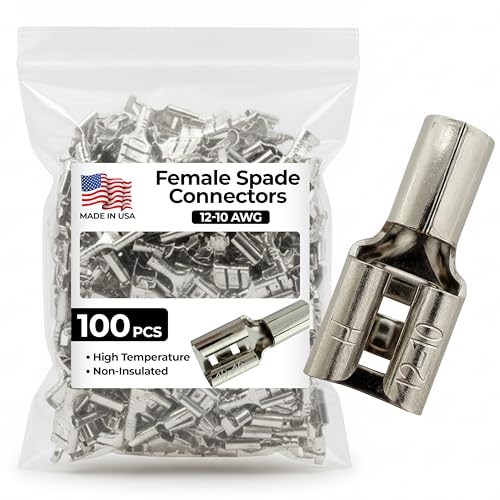
These female quick-disconnect terminals are dedicated to 12-10 AWG wire and 1/4-inch male tabs, making their mating size the deciding factor. The 100 non-insulated connectors are nickel-plated steel, and the manufacturer rates them for 900°F and 600V. Compared with a mixed assortment, this pack focuses on one terminal shape and wire range, which suits repeated replacements of the same connection. It will not fit a different tab width or wire gauge; check both dimensions before crimping.
Bottom line: Choose these for repeated female connections to 1/4-inch male tabs.
How to Choose High Temp Wire Connectors
Choose a connector by the joint first: a ring terminal fastens under a stud, a female spade slides onto a male tab, and a wire nut joins conductors. Then match the wire gauge and the mating hardware; a heat rating alone does not establish electrical compatibility. Wire gauges run in reverse order, so 12 AWG wire is thicker than 18 AWG wire. Keep the connector’s range aligned with the conductor, and do not assume a terminal for one range can safely clamp another. A practical rule is to select a fixed spade or ring only when both its wire range and tab or stud dimension match; otherwise use a suitable assortment and verify the individual piece.
Temperature Ratings and Electrical Limits
Temperature ratings describe a upper limit, not a target operating temperature or proof that the entire wiring assembly is suitable. The crimp connectors here carry 900°F ratings from their manufacturers, while the ceramic wire nuts are described as rated up to 1,000°F. The two ratings apply to different connector types and cannot establish which is right without the equipment’s requirements. Voltage ratings matter separately: a 600V rating does not tell you the allowable current or wire temperature. For appliance or industrial wiring, follow the equipment’s specified conductor type, terminal style and voltage limits, and do not exceed any component’s rating.
Connector Types and Their Fit
Connector shape determines how a joint attaches, so choose the type that matches the existing connection rather than substituting by heat rating. Ring terminals secure at a stud; female spades disconnect from male tabs; ceramic wire nuts twist conductors together. The 0.190-inch stud and 1/4-inch tab dimensions are distinct fit measurements, and a quarter-inch tab is not the same as a stud opening. Use this quick distinction to narrow the style before checking gauge and temperature suitability.
| Connection need | Connector style | Fit check |
|---|---|---|
| Fasten at a stud | Ring terminal | Wire range and stud diameter |
| Disconnect at a tab | Female spade | Wire range and tab width |
| Join conductors | Ceramic wire nut | Wire combination and nut size |
Crimping and High-Heat Wiring Safety
A crimp connection depends on the correct die and conductor fit; a loose or damaged crimp can create resistance and heat. Use a crimper intended for the terminal type and gauge, and inspect that the conductor is fully seated and the barrel is firmly compressed. These listed crimp terminals are non-insulated, so exposed metal needs appropriate clearance from other conductors and grounded surfaces. Adhesive-lined heat-shrink tubing can add moisture protection where appropriate, but it does not correct a poor crimp or make an incompatible terminal safe. Disconnect power before working, and use the equipment maker’s wiring specifications for the allowed voltage, current and temperature.
Frequently Asked Questions
What does AWG mean on wire connectors?
AWG is the American Wire Gauge system, where a smaller number indicates a thicker wire. Match the connector’s gauge range to the conductor rather than selecting by appearance.
Can a 900°F connector be used in any heater?
No; 900°F is a component temperature rating, not an assurance that the terminal suits every heater circuit. Check the heater’s required terminal style, conductor, voltage and current limits, and keep the operating conditions within every component rating.
How do I match a female spade connector to a tab?
Match both the wire range and the tab width; these female terminals specify 1/4-inch tabs. A different width may not seat securely, even if the connector fits the wire gauge.
When should I choose a ring terminal instead of a spade?
Choose a ring when the connection fastens under a stud or screw and should remain secured when the fastener is loosened. Match the opening to the actual stud diameter; a 0.190-inch opening is a specific fit, not a universal size.
Do ceramic wire nuts work like crimp terminals?
No; ceramic wire nuts join conductors, while ring and spade terminals terminate wire onto hardware. Use a wire nut only where the appliance or wiring design calls for that splice style and conductor combination.