
Intelligent Auto Zoom Lens Glasses Compared by Fit

Lkdgii Self-Adjusting Smart Glasses is the closest match for most shoppers seeking intelligent auto zoom lens glasses, with maker-described near-to-far focus and photochromic lenses. Choose Vision Pro Smart Auto-Focus Glasses instead if you need a stated +1.50 to +2.50 range, or CEJIJK 4-Pack Auto-Focus Readers if you want four pairs.
These glasses are marketed as self-adjusting readers for changing viewing distances; its maker does not establish a prescription or replace an eye exam.
We earn a commission if you buy through links on this page. As an Amazon Associate I earn from qualifying purchases. Products are compared on manufacturer specifications, not hands-on testing.
- Best overall: Lkdgii Self-Adjusting Smart Glasses – Combines maker-described near-to-far focus, photochromic tint and a two-pair set.
- Best for stated power range: Vision Pro Smart Auto-Focus Glasses – Specifies a +1.50 to +2.50 range for its multi-focus lenses.
- Best for a four-pair set: CEJIJK 4-Pack Auto-Focus Readers – Includes four pairs with pouches and metal frames.
| Product | Best for | Pack size | Photochromic lenses | Blue-light claim | Shop |
|---|---|---|---|---|---|
| Lkdgii Self-Adjusting Smart Glasses | Near-to-far use | 2 pairs | Yes | Up to 95% filtered | Check Price on Amazon |
| Lkdgii Auto-Focusing Smart Readers | Smart reader set | 2 pairs | Yes | Up to 95% filtered | Check Price on Amazon |
| CEJIJK 4-Pack Auto-Focus Readers | Four-pair set | 4 pairs | Yes | Blue-light filtering | Check Price on Amazon |
| Vision Pro Smart Auto-Focus Glasses | Known power range | 2 pairs | Yes | Up to 95% filtered | Check Price on Amazon |
| 3-Pair Auto-Focus Reading Glasses | Cases included | 3 pairs | — | Blue-light filtering | Check Price on Amazon |
Intelligent Auto Zoom Lens Glasses
Compare the focus claims, stated power range and set contents before choosing glasses for reading or screens.
Lkdgii Self-Adjusting Smart Glasses

Lkdgii Self-Adjusting Smart Glasses combines a claimed near-to-far focus adjustment with photochromic lenses, a feature set shared by some of these choices but paired here with a two-pair pack. The maker also claims the lenses filter up to 95% of blue light and darken outdoors. The product is intended for reading, computer work and distance viewing, so it may appeal to someone seeking one pair for several everyday tasks. Its fields do not give a corrective prescription or power range, so buyers who need a specific strength should verify that before ordering.
Bottom line: Pick this if you want a two-pair set marketed for near-to-far viewing.
Lkdgii Auto-Focusing Smart Readers

Lkdgii Auto-Focusing Smart Readers is another two-pair Lkdgii set, framed specifically as auto-focusing reading glasses rather than general smart glasses. Its features match Lkdgii Self-Adjusting Smart Glasses: the maker claims near-to-far focal adjustment, photochromic tint and filtering of up to 95% of blue light. That matters if you need known magnification rather than relying on a broad auto-focus claim; confirm a suitable power before choosing.
Bottom line: Choose this if you prefer a reading-focused name and want two pairs.
CEJIJK 4-Pack Auto-Focus Readers

CEJIJK 4-Pack Auto-Focus Readers stands apart with four pairs, metal frames, integrated soft silicone nose pads and anti-slip temple ends. Its progressive multifocus lenses are described for close reading through room-distance viewing, and the maker says the lenses tint outdoors and clear indoors. The pack includes pouches, with two gold-frame and two silver-frame pairs. Blue-light filtering is claimed without a percentage, unlike products that provide one.
Bottom line: Pick this if four pairs and metal frames matter more than a power range.
Vision Pro Smart Auto-Focus Glasses

Vision Pro Smart Auto-Focus Glasses is the only option here with a magnification range: +1.50 to +2.50. Its maker says the multi-focus lenses transition from fine print to mid-range computer screens, darken outdoors under UV light, and filter up to 95% of blue light. That defined range makes this choice more useful for buyers who already know the power they need. It is not intended for magnification above +2.50, according to its power guide, so shoppers needing stronger readers should not assume these will suit them.
Bottom line: Choose this if your needed reader power falls within +1.50 to +2.50.
3-Pair Auto-Focus Reading Glasses
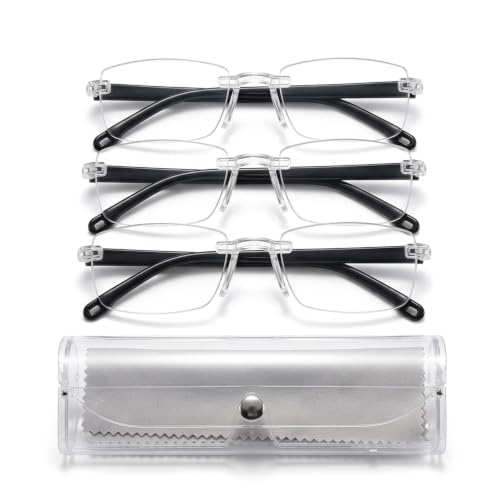
3-Pair Auto-Focus Reading Glasses is the only set here that includes a transparent hard case and a microfiber cleaning cloth, alongside three pairs. The maker describes intelligent zoom lenses that adjust with viewing distance and an anti-blue-light coating for screens. Photochromic tint is not among its features, so this set differs from the options explicitly described as darkening outdoors. It may suit someone who wants spare pairs and basic screen-task coverage, but buyers who need outdoor tint or a known reader power should verify those needs before choosing.
Bottom line: Pick this if three pairs plus a hard case and cleaning cloth suit your routine.
How to choose auto zoom readers
Choose by the power range and viewing tasks you can confirm, not by the phrase “auto focus” alone. Reading glasses commonly use positive diopter powers such as +1.50 or +2.50; a higher number gives more magnification but usually requires holding reading material closer. Progressive lenses place different powers in different zones, so the viewing area and how you position your head affect comfort. A measurable decision rule: if you already use a reader power, prioritize a pair whose range includes that number; only Vision Pro Smart Auto-Focus Glasses supplies a range here. If you do not know your power or your vision has changed, get an eye exam rather than guessing from a marketing label.
Fit and vision limits for smart readers
Fit includes more than whether a frame sits comfortably: lens centering and your pupillary distance affect where you look through the lenses. Conventional prescription lenses are made to a measured prescription, while the specifications here do not establish individualized correction. Multifocal zones can also require a small head-position adjustment when moving between a book and a screen. Do not use readers for driving or other distance-critical tasks unless an eye-care professional confirms they are appropriate; blur at distance can create a safety hazard. If one eye sees substantially differently, or near vision is suddenly blurred, do not rely on an adjustable-reader claim to diagnose the cause.
Photochromic and blue-light features
Photochromic lenses respond to ultraviolet exposure and can darken outdoors, then clear indoors; how dark they get and how quickly they change can vary with conditions. A photochromic tint is not automatically a substitute for sunglasses labeled to provide UV protection, so check the actual UV rating when outdoor eye protection is important. Blue-light filtering percentages are not directly comparable unless the measurement method and wavelength range match. Screen comfort also depends on practical factors: use the 20-20-20 break rule by looking about 20 feet away for 20 seconds every 20 minutes, and adjust screen glare and text size. These steps do not validate a lens power.
Care and common mistakes
Clean lenses with lukewarm water and a small amount of mild soap, then dry with a clean microfiber cloth; dry rubbing can drag grit across a lens and scratch coatings. Keep glasses in a case when they are not being worn, especially in a bag with keys or other hard objects. A common mistake is assuming that “auto focus” means the glasses can replace a prescribed correction for every distance. Another is using an unknown power for prolonged close work: if text stays blurry at a comfortable reading distance, stop relying on the pair and check your vision and lens power. Do not leave glasses on a hot dashboard, where heat can stress frames and lens coatings.
Frequently Asked Questions
Can auto-focus readers replace prescription glasses?
Not necessarily; the term alone does not establish a prescription or individualized correction. If you have a diagnosed vision condition or need different correction in each eye, ask an eye-care professional whether these glasses are suitable.
What does a +1.50 to +2.50 reader range mean?
The numbers are lens powers in diopters, with higher positive power providing more magnification for close work. The range on Vision Pro Smart Auto-Focus Glasses does not mean every wearer will find every power in that range comfortable.
Are photochromic lenses dark enough for driving?
Do not assume so: photochromic lenses can respond differently in a vehicle because windshield glass can reduce UV exposure.
How often should I take breaks from screen reading?
A common eye-comfort habit is the 20-20-20 rule: every 20 minutes, look about 20 feet away for at least 20 seconds. Increase text size and reduce glare if you are leaning toward the screen.
How can I tell if reading glasses are too strong?
If close text is clearest only when held uncomfortably near, or you develop persistent blur or headaches, the power may not suit you. Reader power should be checked by an eye-care professional, particularly when symptoms are new.